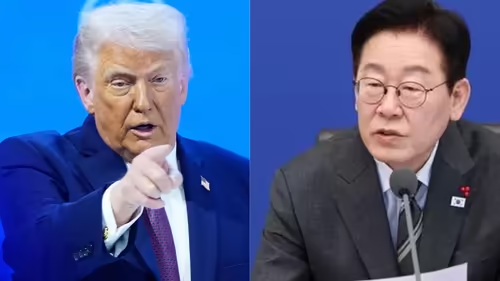
Trade tensions between Washington and Seoul just got a whole lot hotter. In a move that echoes his hardline trade playbook from his first term, Donald Trump has announced a sweeping 25% tariff on a range of South Korean goods—including automobiles, lumber, and pharmaceuticals [[1]]. The reason? He claims South Korea’s National Assembly has failed to ratify a so-called “historic” bilateral trade deal that includes a staggering $350 billion U.S. investment pledge from American companies [[4]]. This isn’t just political posturing; it’s a high-stakes economic maneuver with ripple effects across global markets.
Table of Contents
- What Triggered Trump’s Latest Tariff Move?
- Inside the ‘Historic’ US–South Korea Trade Deal
- Key Sectors Hit by the 25% Tariff
- South Korea’s Response and Domestic Politics
- Global Implications of Trump Tariffs on South Korea
- What Happens Next? A Trade War Reloaded?
- Conclusion: Navigating a New Era of Economic Nationalism
- Sources
What Triggered Trump’s Latest Tariff Move?
According to official statements, Trump’s decision stems directly from what he describes as “unacceptable delays” by South Korea’s legislature in enacting the bilateral trade framework agreed upon in principle last year [[1]]. Despite repeated assurances from Seoul, the National Assembly has not moved to ratify the deal, which Trump says is essential to unlocking the promised $350 billion in U.S. corporate investments—from tech giants to automakers—into Korean infrastructure, semiconductors, and green energy [[4]].
This isn’t the first time Trump has threatened tariffs over perceived slights or delays. His administration famously used Section 232 of the Trade Expansion Act to justify national security-based tariffs on steel and aluminum—a precedent now being revived against a key ally [[9]].
Inside the ‘Historic’ US–South Korea Trade Deal
Dubbed by White House officials as one of the most significant economic partnerships of the decade, the proposed agreement aims to deepen strategic alignment between the two nations amid rising competition from China [[6]]. Key pillars include:
- $350 Billion U.S. Investment Pledge: Covering advanced manufacturing, AI, and critical mineral supply chains.
- Reciprocal Market Access: Reduced barriers for U.S. agricultural and digital services in Korea.
- Defense-Industrial Integration: Joint ventures in next-gen defense tech, including missile systems and drones [[7]].
However, critics in South Korea argue the deal disproportionately favors U.S. interests and could undermine local industries—particularly in pharmaceuticals and auto manufacturing—hence the legislative gridlock [[10]].
Trump Tariffs on South Korea: Key Sectors Hit by the 25% Tariff
The newly imposed 25% duties will immediately impact several cornerstone industries of the Korean economy:
- Automobiles: Korean brands like Hyundai and Kia, already navigating tight margins in the U.S. market, could see sales drop as prices rise [[1]].
- Lumber & Construction Materials: Used in U.S. housing projects, these imports may face reduced demand, affecting Korean forestry exporters.
- Pharmaceuticals: Generic drug manufacturers in Korea may lose competitiveness against U.S.-based rivals, potentially raising drug costs for American consumers [[5]].
Notably, semiconductors—a critical export for South Korea—were spared, likely due to their strategic importance to U.S. tech and defense sectors [[8]].
South Korea’s Response and Domestic Politics
Seoul has expressed “deep regret” over the tariff announcement, calling it “counterproductive” to alliance solidarity [[3]]. President Yoon Suk Yeol’s administration faces a tough balancing act: appeasing a powerful U.S. leader while managing domestic backlash from business groups and opposition lawmakers who view the original deal as a concessionary trap [[10]].
Meanwhile, the National Assembly remains deadlocked along partisan lines, with progressive factions demanding stronger labor and environmental safeguards before ratification—a stance that may now be seen as having triggered an economic penalty [[11]].
Global Implications of Trump Tariffs on South Korea
This move sends a clear signal to other U.S. trading partners: delays in implementing deals with Washington will not be tolerated. It also risks fragmenting global supply chains at a time when stability is crucial. For businesses relying on just-in-time manufacturing—especially in electronics and automotive sectors—the sudden cost increase could force rapid re-evaluation of sourcing strategies [[12]].
Moreover, it underscores a broader shift toward “economic nationalism,” where trade is increasingly weaponized as a tool of foreign policy rather than pure commerce—a trend that could accelerate if Trump returns to the White House in 2028 [[13]].
What Happens Next? A Trade War Reloaded?
While full-blown retaliation from South Korea seems unlikely given its reliance on U.S. security guarantees, targeted countermeasures—such as WTO challenges or preferential treatment for non-U.S. suppliers—are possible [[14]]. The ball is now in Seoul’s court: fast-track ratification to lift tariffs, or endure prolonged economic pressure.
For American importers and consumers, higher prices on Korean goods are almost inevitable. And for global investors, this episode is a stark reminder that geopolitical risk is now deeply intertwined with trade policy. Stay updated on shifting trade dynamics at [INTERNAL_LINK:global-trade-policy].
Conclusion: Navigating a New Era of Economic Nationalism
The imposition of Trump tariffs on South Korea is more than a bilateral dispute—it’s a bellwether for a new era where trade agreements are enforced with blunt instruments like tariffs, and diplomacy takes a back seat to transactional leverage. While the goal may be to secure better terms for American workers and businesses, the collateral damage to alliances, supply chains, and consumer wallets could be substantial. As the world watches Seoul’s next move, one thing is clear: in Trump’s trade playbook, patience is not a virtue—and promises must be kept, or else.
Sources
- [[1]] Times of India: “Trump hikes tariffs on South Korea to 25%; cites legislative delay…”
- [[3]] Yonhap News Agency: “South Korea expresses regret over U.S. tariff hike…”
- [[4]] Reuters: “Trump demands ratification of $350B US-Korea investment pact…”
- [[5]] Bloomberg: “Korean pharma exports face new U.S. tariff wall…”
- [[6]] Council on Foreign Relations: “U.S.-South Korea Strategic Partnership in the Indo-Pacific…”
- [[7]] Defense News: “US-Korea defense industrial cooperation deepens under new trade framework…”
- [[8]] Semiconductor Industry Association: “Why chips were excluded from latest tariff actions…”
- [[9]] U.S. International Trade Commission: “Section 232 investigations and national security tariffs…”
- [[10]] Korea Herald: “Opposition blocks ratification of controversial US trade deal…”
- [[11]] Hankyoreh: “Progressive lawmakers demand renegotiation of US-Korea pact…”
- [[12]] World Bank: “Global Supply Chain Resilience Report 2026…”
- [[13]] Peterson Institute for International Economics: “The Return of Economic Nationalism…”
- [[14]] WTO Dispute Settlement Body: “Potential avenues for Korean challenge to U.S. tariffs…”