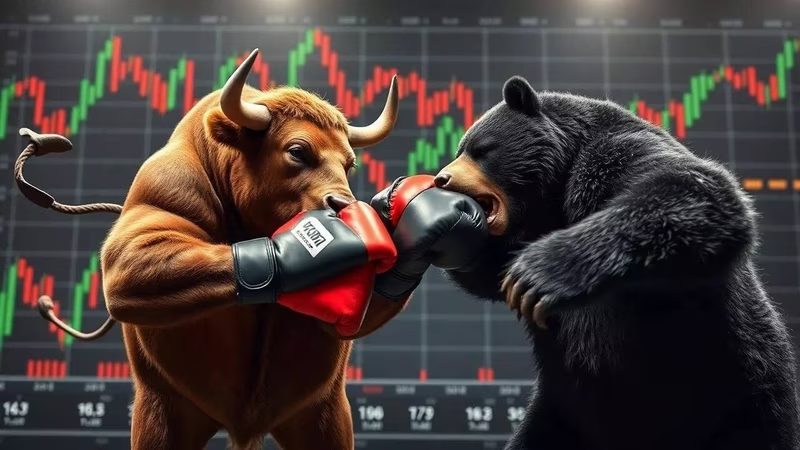
It’s a tense morning on Dalal Street. The usual buzz is replaced by a cautious hum as the Nifty50 stumbles just above the 26,000 mark and the BSE Sensex slips alarmingly below the 84,950 level. This isn’t just a routine market correction; it feels like a confluence of global headwinds and domestic anxieties is pushing our benchmarks into a tailspin. So, what’s really going on?
Table of Contents
- What’s Happening to Nifty50 Today?
- The Trump Tariff Tsunami & Its Impact on Indian Markets
- The Battle of the Investors: FII Outflows vs. DII Inflows
- Which Sectors Are Sinking the Fastest?
- What Does This Mean for Your Portfolio?
- Conclusion: Navigating the Market Uncertainty
- Sources
What’s Happening to Nifty50 Today?
The data is clear: both major Indian indices are in a downward spiral. On Thursday, January 8, 2026, the Nifty50 opened in the red at 26,106.50 and has since been hovering around the 26,077 mark, down nearly 0.25% [[1], [2]]. Its bigger sibling, the BSE Sensex, hasn’t fared any better, tumbling below the critical 84,950 level to trade at around 84,850 [[1], [5]]. This marks the third consecutive day of losses for the benchmark indices .
While the broader market, particularly mid and small-cap stocks, has shown some resilience, the heavyweight stocks that make up the Nifty50 and Sensex are feeling the heat the most. This concentrated selling pressure is a classic sign of risk aversion, where investors flee from perceived vulnerabilities.
The Trump Tariff Tsunami & Its Impact on Indian Markets
A significant catalyst for this global risk-off sentiment is the looming threat from across the Pacific. Former US President Donald Trump, now back in office, has escalated his trade war rhetoric, with India firmly in his crosshairs. His administration has floated the idea of imposing a staggering 50% tariff on a wide range of Indian exports [[21], [24]].
This isn’t just political posturing; it’s a direct threat to the heart of India’s export-driven sectors:
- Textiles and Apparel: A major employer and exporter, this industry would be crippled by such high tariffs.
- Pharmaceuticals: India’s ‘pharmacy of the world’ status could be challenged as US-based generics become more expensive for American consumers .
- IT Services: While not a physical good, the hostile trade environment could lead to stricter H-1B visa policies, impacting the core business model of India’s IT giants .
The market is a forward-looking machine. It’s not just pricing in the immediate impact of these potential tariffs, but the long-term damage to US-India trade relations and the uncertainty they bring to corporate earnings forecasts. This fear has been a constant overhang on market sentiment for weeks .
The Battle of the Investors: FII Outflows vs. DII Inflows
Another critical dynamic at play is the tug-of-war between foreign and domestic institutional investors. For the better part of the last few months, Foreign Institutional Investors (FIIs) have been on a consistent selling spree. In just the first two trading sessions of 2026, they’ve pulled out over ₹5,300 crore from the Indian equity markets . On January 7th alone, their net selling was a hefty ₹1,527 crore .
This FII flight is largely driven by the global risk aversion we mentioned, coupled with a strong US dollar and better investment opportunities in their home markets.
However, on the other side of the battlefield, Domestic Institutional Investors (DIIs)—our own mutual funds, insurance companies, and banks—have been staunch buyers. They’ve been injecting massive amounts of capital to support the market, buying a net ₹2,889 crore on January 7th and consistently providing a floor to prevent a complete collapse.
This battle can be summarized in the table below:
| Date | FII Net Activity (₹ Cr) | DII Net Activity (₹ Cr) |
|---|---|---|
| January 7, 2026 | -1,527.71 | +2,889.32 |
| January 6, 2026 | -107.63 | +1,749.35 |
While DII support is a strong positive for the long-term health of the Indian market, the sheer weight of FII selling is what’s dictating the short-term direction, contributing heavily to the Nifty50’s slide.
Which Sectors Are Sinking the Fastest?
Not all sectors are suffering equally. The ones most exposed to global trade and FII sentiment are taking the biggest hit:
- Metals: Global demand fears and a stronger dollar have hammered metal prices, dragging down companies in this space .
- Information Technology (IT):** Directly in the line of fire from US trade policies and a potential slowdown in global tech spending .
- Private Banks: Heavyweight stocks like HDFC Bank have been under pressure, contributing significantly to the Sensex’s fall .
In contrast, sectors like defence and select small-cap companies have shown relative strength, indicating that the market’s pain is concentrated in the large-cap, export-oriented segment .
What Does This Mean for Your Portfolio?
If you’re a long-term investor, this volatility is a reminder of the importance of a well-diversified portfolio. Trying to time the market bottom is a fool’s errand. Instead, focus on the fundamentals of the businesses you own. For those looking to deploy fresh capital, this dip could present a strategic buying opportunity in high-quality stocks that have been unfairly punished by the broad market sell-off. Always remember to consult with a SEBI-registered advisor before making any investment decisions. For more on building a resilient portfolio, check out our guide on [INTERNAL_LINK:long-term-investment-strategies-in-volatile-markets].
Conclusion: Navigating the Market Uncertainty
The current slide in the Nifty50 and Sensex is a complex story of external pressure and internal dynamics. The aggressive trade stance from the US administration is the primary spark, igniting fears of a global slowdown and hurting India’s export prospects. This has triggered a wave of selling by foreign investors, which, despite strong domestic buying support, is pushing the market lower in the short term. While the immediate outlook remains cautious, the underlying strength of the domestic economy and DII confidence could pave the way for a recovery once the global fog lifts.