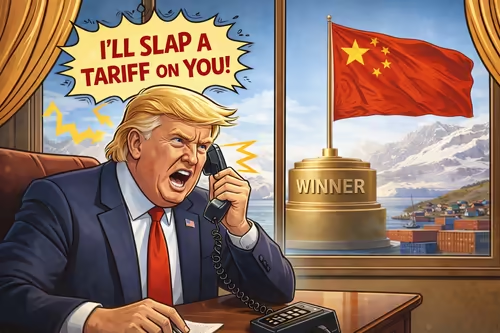
It sounds like a plot twist from a political satire: a former U.S. president threatening to impose sweeping Trump tariffs Europe over a remote Arctic island most Americans couldn’t find on a map. Yet here we are in early 2026, with Donald Trump once again wielding tariffs as a blunt instrument—this time targeting the European Union over its stance on Greenland.
But while the drama grabs headlines, the real story lies beneath the surface. Experts warn these tariffs won’t pressure Denmark or the EU into handing over Greenland (a notion widely dismissed as fantasy). Instead, they’re likely to backfire—hurting American consumers, straining NATO alliances, and unintentionally strengthening China’s global economic position. In short: the only clear winner in this high-stakes bluff might be Beijing.
Table of Contents
- The Greenland Pretext: What’s Really Going On?
- How Trump Tariffs Europe Hurt American Interests
- Why China Emerges as the Unexpected Winner
- Historical Context: Trump’s Past Trade Moves
- What This Means for Global Trade in 2026
- Conclusion: A Risky Game With High Stakes
- Sources
The Greenland Pretext: What’s Really Going On?
Back in 2019, Trump famously floated the idea of the U.S. “buying” Greenland—a semi-autonomous Danish territory rich in rare earth minerals and strategically positioned near the Arctic shipping routes. The proposal was met with ridicule in Copenhagen and concern in Washington. Fast forward to 2026, and Trump is now threatening to impose steep tariffs on European goods unless the EU supports greater U.S. influence in Greenland.
But analysts agree: this isn’t really about ice and minerals. It’s about projecting strength, rallying his base, and reasserting a “America First” narrative ahead of the 2028 election cycle. As one former U.S. trade official told Reuters, “Greenland is the excuse, not the objective.”
The EU has firmly rejected any notion of ceding sovereignty over Greenland, which remains under Danish constitutional authority. In response, Trump’s camp has floated tariffs on key European exports like German autos, French wine, and Italian machinery—sectors that directly impact millions of American jobs through supply chains and retail.
How Trump Tariffs Europe Hurt American Interests
Despite claims that tariffs protect U.S. workers, evidence from the last administration tells a different story. The Trump tariffs Europe strategy during his first term led to:
- Higher consumer prices: Studies by the Federal Reserve and the Peterson Institute found that 90% of tariff costs were passed directly to U.S. consumers, contributing to inflation .
- Job losses in agriculture and manufacturing: Retaliatory EU tariffs hit U.S. farmers hard, especially soybean and dairy exporters, leading to billions in lost sales and federal bailouts .
- Weakened alliances: NATO partners viewed the tariffs as economically hostile, undermining trust at a time of rising Russian and Chinese assertiveness.
Today, with inflation still a top voter concern, reviving this playbook is seen as economically reckless. “Tariffs are a tax on Americans,” says economist Laura Tyson, former chair of the Council of Economic Advisers. “They don’t bring back factories—they just make everything more expensive.”
Why China Emerges as the Unexpected Winner
Ironically, while Trump frames his trade policies as anti-China, they often end up benefiting Beijing. Here’s how:
- Market diversion: When U.S. tariffs block European goods, American importers turn to cheaper alternatives—including Chinese products. In 2025, U.S. imports from China actually rose despite ongoing trade tensions .
- EU-China alignment: Frustrated by U.S. unpredictability, the EU has deepened trade talks with China, including cooperation on green tech and critical minerals—areas where Greenland plays a key role.
- Strategic distraction: While Washington feuds with Brussels, China quietly expands its influence in the Arctic through scientific partnerships and infrastructure investments, filling the diplomatic vacuum.
As the Wall Street Journal noted, “Trump’s Greenland obsession may end up handing China the very Arctic foothold he’s trying to prevent.”
Historical Context: Trump’s Past Trade Moves
This isn’t the first time Trump has used tariffs as a geopolitical tool. His 2018 steel and aluminum tariffs on the EU, Canada, and Mexico were justified on “national security” grounds—a claim widely criticized as legally dubious. The result? A fragmented Western front and minimal gains in U.S. production.
Moreover, the promised revival of American manufacturing never materialized at scale. According to the Bureau of Labor Statistics, manufacturing employment grew more slowly during Trump’s term than during Obama’s final years—despite massive corporate tax cuts .
For deeper insights into past policy impacts, see our analysis on [INTERNAL_LINK:us-trade-policy-under-trump].
What This Means for Global Trade in 2026
If implemented, these new Trump tariffs Europe could trigger a cascade of consequences:
- The EU may accelerate its de-dollarization efforts and expand its own carbon-border tax, hitting U.S. exporters.
- Supply chains for electric vehicles and semiconductors—already fragile—could face new disruptions.
- China may offer Greenland investment deals that bypass Western sanctions, deepening its Arctic presence.
Global markets are already reacting nervously. The euro dipped slightly after Trump’s remarks, while Chinese state media praised the “decline of Western unity.”
Conclusion: A Risky Game With High Stakes
Trump’s threat to impose Trump tariffs Europe over Greenland may play well in campaign rallies, but it’s a dangerous gamble with real-world costs. From higher grocery bills to fractured alliances and unintended boosts to China’s global agenda, the downsides far outweigh any symbolic victory. In the complex chess game of 21st-century geopolitics, bluster rarely beats strategy—and right now, Beijing is playing the long game while Washington risks shooting itself in the foot.
Sources
- Times of India: Now, Trump tariffs Europe over Greenland: And the winner is China—explained
- Peterson Institute for International Economics: Who Pays for the Tariffs on China?
- Reuters: Trump renews call for U.S. to buy Greenland ahead of 2028 race
- Bureau of Labor Statistics: Employment, Hours, and Earnings from the Current Employment Statistics survey