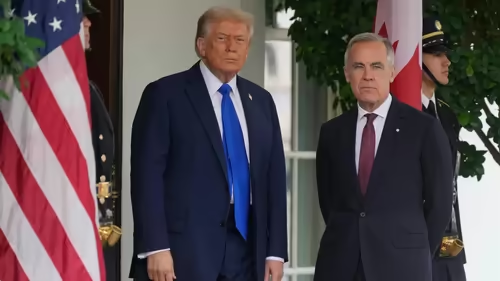
In a move that’s sent shockwaves through global markets, former U.S. President Donald Trump has threatened to slap 100% tariffs on Canadian goods—a dramatic escalation in his ongoing campaign to reshape North American trade. The target? Any potential deal between Canada and China. In a post on Truth Social, Trump directly called out Canadian Prime Minister Mark Carney (whom he mistakenly referred to as “Governor”), warning that Ottawa must not become a “Drop Off Port” for Chinese products entering the United States .
This isn’t just political bluster—it’s a high-stakes economic ultimatum with serious implications for the future of the Trump tariffs Canada relationship, supply chains, and the broader U.S.-led strategy to counter Beijing’s influence.
Table of Contents
- Trump’s Ultimatum on Truth Social
- Why Mark Carney Is in Trump’s Crosshairs
- The Real Risk of a Canada-China Trade Deal
- Could 100% Tariffs Actually Happen?
- Impact on U.S.-Canada Trade Relations
- Conclusion: A New Trade Cold War?
- Sources
Trump’s Ultimatum on Truth Social
On Saturday, January 24, 2026, Donald Trump took to his social media platform, Truth Social, to deliver a blunt message to Canada. “If Governor Carney thinks he is going to make Canada a ‘Drop Off Port’ for China to send goods and products into the United States, he is sorely mistaken,” Trump wrote. He added, “We will completely devour it with 100% Tariffs!” .
The language is unmistakably Trumpian—combative, hyperbolic, and designed to dominate headlines. But beneath the rhetoric lies a serious strategic concern: the fear that China could exploit Canada’s trade access to the U.S. market under the USMCA (United States-Mexico-Canada Agreement) to circumvent American tariffs and regulations.
Why Mark Carney Is in Trump’s Crosshairs
Trump’s reference to “Governor Carney” appears to be a mix-up. Mark Carney, the former Bank of England governor and ex-head of the Bank of Canada, is indeed a prominent figure in Canadian public life—but as of early 2026, he is not the Prime Minister of Canada. Justin Trudeau remains in office. However, Carney has been floated as a potential Liberal Party leader and future PM, which may explain Trump’s focus .
Regardless of the title error, the message is clear: Trump is signaling that any Canadian leadership seen as cozying up to Beijing will face severe economic consequences. This aligns with his long-standing “America First” doctrine, which prioritizes national sovereignty and views China as an existential economic rival.
The Real Risk of a Canada-China Trade Deal
While Canada and China have explored deeper trade ties for years, progress has been slow due to political tensions—including the 2018 detention of Huawei executive Meng Wanzhou in Vancouver and the retaliatory imprisonment of two Canadians. Still, the economic incentive is strong. China is the world’s second-largest economy and a major buyer of Canadian resources like canola, soybeans, and minerals .
From Trump’s perspective, even a modest free trade agreement could create loopholes. For example:
- Chinese manufacturers could ship components to Canada for minor assembly, then export them tariff-free to the U.S. under USMCA rules.
- Canadian firms might act as intermediaries for Chinese state-owned enterprises seeking access to North American markets.
- Beijing could use economic leverage over Ottawa to influence U.S. policy indirectly.
These scenarios, while speculative, feed into legitimate U.S. national security concerns about supply chain integrity—a topic that has bipartisan support in Washington.
Trump tariffs Canada: Could 100% Tariffs Actually Happen?
If Trump wins the 2026 U.S. presidential election, would he really impose 100% tariffs on Canada?
Historically, Trump has used extreme threats as negotiating tactics. During his first term, he imposed steel and aluminum tariffs (25% and 10%, respectively) on Canada, only to lift them after USMCA was ratified. A 100% tariff would be unprecedented—not just economically devastating for Canadian exporters, but also inflationary for U.S. consumers who rely on Canadian energy, lumber, and autos.
However, legal mechanisms exist. Under Section 232 of the Trade Expansion Act, the president can impose tariffs on national security grounds. And under the International Emergency Economic Powers Act (IEEPA), sweeping economic sanctions are possible during a declared emergency. While unlikely to reach 100%, targeted tariffs on specific sectors (e.g., EVs, critical minerals) are plausible .
Impact on U.S.-Canada Trade Relations
The U.S. and Canada share the world’s largest bilateral trade relationship, with over $1 trillion in annual goods and services exchanged . Disrupting this flow would hurt both economies. Key sectors at risk include:
- Automotive: Integrated supply chains mean a car might cross the border 7–8 times during assembly.
- Energy: Canada supplies 90% of U.S. oil imports from non-OPEC nations.
- Agriculture: U.S. farmers depend on Canadian markets for dairy, poultry, and processed foods.
Such interdependence makes all-out trade war unlikely—but Trump’s warning serves as a stark reminder that geopolitical alignment matters as much as economic logic in his worldview.
Conclusion: A New Trade Cold War?
Trump’s threat isn’t just about Canada—it’s a signal to the entire Western alliance. As the U.S. seeks to decouple from China, it expects its closest partners to fall in line. The Trump tariffs Canada warning underscores a new reality: in the 2020s, trade is no longer just about economics; it’s a frontline in great-power competition. Whether this leads to a more secure supply chain or a fragmented global economy remains to be seen—but one thing is certain: the stakes have never been higher.
Sources
- Trump’s Truth Social post, January 24, 2026 .
- Biographical details on Mark Carney, former Governor of the Bank of Canada and Bank of England .
- Canada-China trade data from Global Affairs Canada and Statistics Canada .
- U.S. trade law provisions: Section 232 and IEEPA, Congressional Research Service .
- U.S.-Canada trade statistics, Office of the U.S. Trade Representative (USTR): https://ustr.gov/countries-regions/americas/canada .