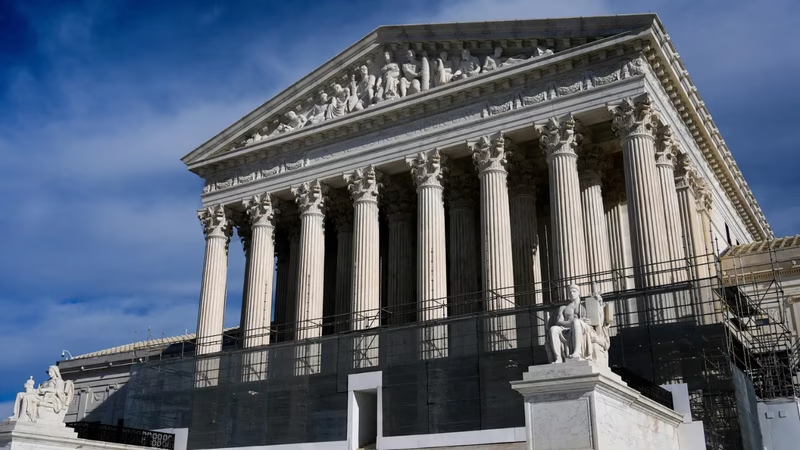
Washington is holding its breath. In a high-stakes legal drama with global economic consequences, the U.S. Supreme Court has decided to punt—at least for now. The justices have delayed their much-anticipated ruling on the constitutionality of former President Donald Trump’s aggressive Trump tariff policy, a decision that was expected to land this month but is now pushed to June .
This pause isn’t just a procedural footnote; it’s a significant development that keeps billions of dollars in import duties in legal limbo and leaves a critical question unanswered: How far can a president go in wielding unilateral power over America’s trade relationships? For thousands of American businesses that paid these tariffs, the wait means continued uncertainty over potential refunds. For the world, it means the rules of global trade remain in flux.
Table of Contents
- The Case Behind the Delay
- What is Trump Tariff Policy? Section 232 Explained
- Why the Supreme Court Ruling Matters for Presidential Power
- The Business Impact: Billions in Limbo
- Global Trade Ripples from a US Decision
- Conclusion: What to Watch for in June
- Sources
The Case Behind the Delay
The legal battle centers on tariffs imposed in 2018 under Section 232 of the Trade Expansion Act of 1962. This obscure provision allows a president to restrict imports if they are deemed a “threat to national security.” Trump used this authority to slap a 25% tariff on steel and a 10% tariff on aluminum from a wide range of countries, including allies like the European Union, Canada, and Mexico .
A coalition of importers, led by companies like Allegheny Technologies, challenged the move in court. They argued that the administration’s use of “national security” as a justification was a pretext for what was essentially a protectionist trade policy—a domain traditionally reserved for Congress under the U.S. Constitution . Lower courts have been split, setting the stage for the Supreme Court to deliver a definitive verdict.
What is Trump tariff policy? Section 232 Explained
To understand the controversy, you need to understand Section 232. It was designed during the Cold War as a tool to prevent a foreign adversary from dominating a critical industry like steel, which is vital for defense production. The law gives the Department of Commerce the power to investigate and the President the final say on imposing restrictions.
Trump’s team argued that a weakened domestic steel and aluminum industry, due to cheap foreign imports, constituted a national security threat. Critics, however, saw this as a massive overreach. They contend that using a national security law to address economic concerns fundamentally distorts its original intent and hands the executive branch unchecked power over a core legislative function: regulating commerce .
Why the Supreme Court Ruling Matters for Presidential Power
This case is about far more than just metal tariffs. At its heart, it’s a constitutional clash over the separation of powers. The U.S. Constitution explicitly grants Congress the power “to regulate Commerce with foreign Nations.” Over time, Congress has delegated some of this authority to the President, but always with specific guidelines and limitations.
A ruling against the government would be a major check on executive power, reinforcing the idea that a president cannot simply invent a national security rationale to bypass Congress on trade matters. Conversely, a ruling in favor of the government would set a powerful precedent, potentially giving future presidents a blank check to impose tariffs on almost any product by invoking a broad and subjective definition of “national security” .
The Business Impact: Billions in Limbo
While the legal and constitutional questions are paramount, the real-world impact is being felt in boardrooms and factory floors across the country. Companies that rely on imported steel and aluminum—think automakers, appliance manufacturers, and construction firms—have paid an estimated $40 billion in these tariffs since 2018 .
Many of these businesses filed lawsuits seeking refunds, arguing they were forced to pay an illegal tax. Their fate is now directly tied to the Supreme Court’s decision. If the Court rules the tariffs were unlawful, these companies could be entitled to massive refunds, providing a significant cash infusion. If the Court upholds the tariffs, that money is lost, and the cost will continue to ripple through supply chains, affecting prices for consumers.
Key industries waiting on the decision include:
- Automotive: Heavily reliant on steel for vehicle frames and parts.
- Construction: Uses vast quantities of steel for infrastructure and buildings.
- Manufacturing: Countless products, from washing machines to machinery, contain aluminum and steel components.
Global Trade Ripples from a US Decision
The United States is not an island. Its trade policies send shockwaves through the global economy. Trump’s tariffs prompted immediate retaliation from trading partners, who imposed their own duties on iconic American exports like bourbon, motorcycles, and agricultural goods . This tit-for-tat cycle disrupted long-standing trade relationships and fueled a period of intense market volatility.
The Supreme Court’s eventual ruling will signal to the world how the U.S. intends to wield its economic power. A decision that curbs presidential tariff authority could reassure allies and promote a more rules-based, predictable trading system. A decision that expands that authority could embolden future protectionist measures, further destabilizing an already fragile global trade environment.
Conclusion: What to Watch for in June
The Supreme Court’s delay in ruling on Trump tariff policy is a temporary reprieve, not a resolution. The June deadline looms large as a pivotal moment for American democracy, business, and its standing in the world. Will the Court reinforce the constitutional balance of power, or will it endorse a new era of expansive executive control over trade?
For businesses, the next few months are a period of anxious waiting. For policymakers, it’s a chance to prepare for two very different futures. One thing is certain: when the Court finally speaks, its words will echo far beyond the courtroom walls. To understand the historical context of US trade wars, see our deep dive on [INTERNAL_LINK:history-of-us-trade-policy].
Sources
- Reuters: U.S. Supreme Court delays ruling on Trump-era metal tariffs
- U.S. Department of the Treasury: Section 232 Investigations
- Congressional Research Service: The President’s Statutory Authority to Impose Tariffs
- Peterson Institute for International Economics: US collected $40 billion in Section 232 and 301 tariffs