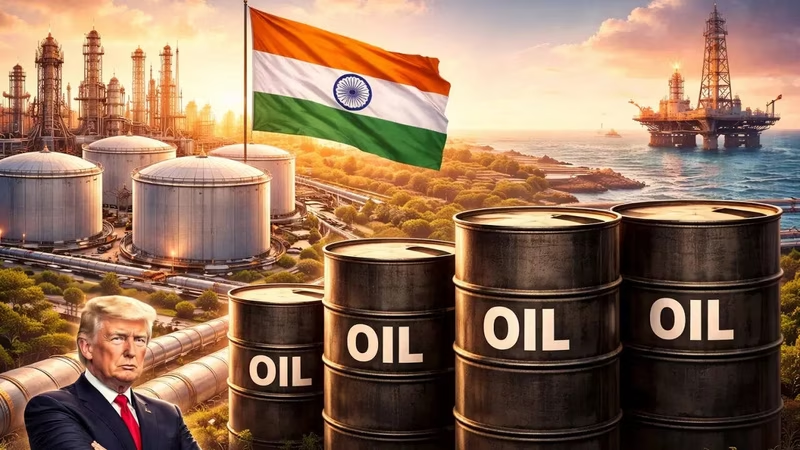
Introduction: When Geopolitics Meets the Gas Pump
Imagine waking up to news that your monthly fuel bill could double—not because of local taxes, but because a former U.S. president thousands of miles away just threatened a 500% tariff. That’s the kind of geopolitical whiplash India faces in an increasingly volatile world. With Donald Trump floating the idea of massive tariffs on countries like China and beyond, and simmering conflicts threatening global crude supplies, the spotlight is back on India’s oil security.
India imports over 85% of its crude oil—a statistic that sounds alarm bells for any economy. Yet, recent developments suggest the nation isn’t as vulnerable as it once was. Through smart diversification, strategic reserves, and refining agility, India has quietly built a buffer against external shocks. So, should we panic? Or is this a moment to appreciate the resilience baked into India’s energy architecture?
Table of Contents
- What Is Trump’s 500% Tariff Threat?
- Why Oil Security Matters for India
- How India Is Fortifying Its Oil Security
- The Global Crude Supply Shock Risk
- What This Means for Indian Consumers and Businesses
- Conclusion: Navigating an Unstable Energy World
- Sources
What Is Trump’s 500% Tariff Threat?
During his recent campaign rallies, Donald Trump has repeatedly vowed to impose “reciprocal” tariffs—up to 500%—on nations he claims are unfair to the U.S. While initially aimed at China, the broad language leaves room for escalation that could ripple across global trade, including energy markets .
Though crude oil itself isn’t typically subject to such tariffs, the knock-on effects are real. A trade war can disrupt shipping lanes, inflate insurance costs, and trigger speculative spikes in oil prices. More critically, if tariffs strain relations with key oil-producing allies or destabilize financial markets, the entire energy ecosystem feels the tremor.
Why Oil Security Matters for India
India is the world’s third-largest oil consumer and importer. Any major disruption in supply or price surge directly impacts inflation, the current account deficit, and even fiscal planning. Historically, oil shocks—like those in the 1970s or 2008—have sent India’s economy into tailspins.
But oil security isn’t just about having enough barrels; it’s about ensuring stable, affordable, and reliable access under all conditions. For a developing nation with rising energy demands, this is existential.
How India Is Fortifying Its Oil Security
Despite its import dependence, India has made significant strides in strengthening its oil security through three key strategies:
Diversified Sourcing Beyond the Middle East
Gone are the days when India relied almost entirely on Saudi Arabia and Iraq. Today, India sources crude from over 30 countries—including Russia (now a top supplier at discounted rates), the U.S., Nigeria, and even Guyana . This diversification reduces exposure to regional instability.
Strategic Petroleum Reserves (SPRs)
India has built underground caverns in Visakhapatnam, Mangalore, and Padur capable of holding 5.33 million metric tonnes of crude—enough for about 13 days of national consumption. Plans are underway to expand this to 22 days’ worth through public-private partnerships .
Refining Flexibility and Export Power
Indian refineries, like Reliance’s Jamnagar complex—the world’s largest—are among the most complex and flexible globally. They can process a wide range of crude grades, from heavy sour to light sweet, allowing them to switch suppliers based on price and availability. This flexibility also turns India into a net exporter of refined products, earning valuable forex .
The Global Crude Supply Shock Risk
Beyond tariffs, multiple flashpoints threaten global oil flows:
- Red Sea Disruptions: Houthi attacks have already rerouted tankers, adding time and cost.
- Russia-Ukraine War: Sanctions and counter-sanctions continue to distort global trade flows.
- OPEC+ Volatility: Production cuts or internal disagreements can swing prices wildly.
According to the International Energy Agency (IEA), even a 10% supply disruption could push global oil prices above $100/barrel—a scenario that would test every nation’s oil security framework .
What This Means for Indian Consumers and Businesses
While India’s strategic buffers help, consumers aren’t fully insulated. A sustained price spike could lead to:
- Higher petrol and diesel prices, unless the government absorbs the cost (hurting fiscal health).
- Increased logistics and manufacturing costs, feeding into broader inflation.
- Pressure on sectors like aviation and transport, which are highly fuel-sensitive.
However, India’s ability to source discounted Russian crude and its refining prowess act as shock absorbers. For now, the system is resilient—but not invincible. Staying informed and supporting policies that enhance energy independence, such as [INTERNAL_LINK:renewable-energy-transition], remains crucial.
Conclusion: Navigating an Unstable Energy World
Trump’s tariff rhetoric and global supply risks are serious, but they’re not new threats—they’re stress tests. India’s evolving approach to oil security shows a maturing energy strategy that balances pragmatism with preparedness. By diversifying sources, building reserves, and leveraging refining strength, India has turned vulnerability into managed risk. The road ahead demands continued vigilance, investment in alternatives, and diplomatic agility. For now, the nation’s energy shield holds—but the storm clouds haven’t passed yet.
Sources
- Times of India: Trump’s 500% tariff pressure & global crude supply shock risks
- Ministry of Petroleum and Natural Gas, India: Official Website
- International Energy Agency (IEA): Global Oil Security Reports
- BP Statistical Review of World Energy 2025
- Press Information Bureau (PIB): Strategic Petroleum Reserves Updates