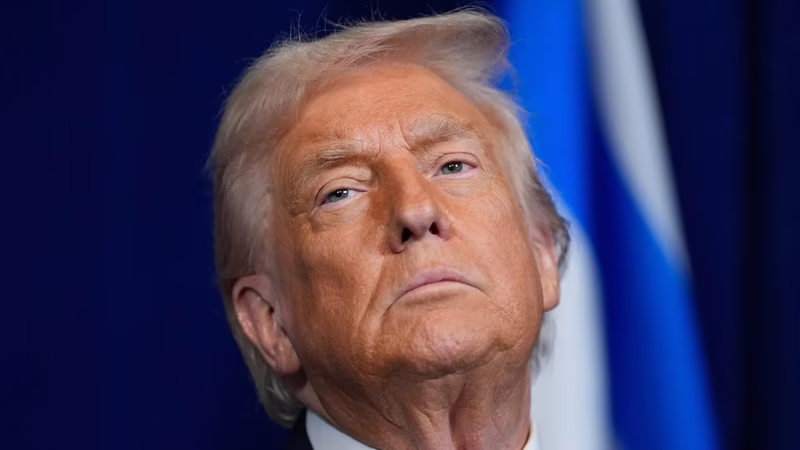
In a world where geopolitical tensions are running high, a single comment from a former US president can send shockwaves across the globe. That’s exactly what happened when Donald Trump weighed in on the controversial idea of capturing Putin. His blunt dismissal of the concept has sparked a new wave of debate about the future of the Russia-Ukraine conflict and America’s role in it.
Trump’s comments come on the heels of Ukrainian President Volodymyr Zelenskyy’s provocative suggestion that the United States should consider a Venezuela-style operation against Russian leadership. The timing couldn’t be more critical, as both nations stand at a potential crossroads for peace—or a prolonged, devastating war.
Table of Contents
- Trump’s Firm Stance on Capturing Putin
- The Maduro Precedent: Zelenskyy’s Bold Suggestion
- Why Trump Believes a Peace Deal is Imminent
- Global Reactions and the Path Forward
- Conclusion
- Sources
Trump’s Firm Stance on Capturing Putin
Donald Trump has made his position crystal clear: he does not believe a military or covert operation to apprehend Russian President Vladimir Putin is on the table. In his own words, such an action is “not going to be necessary” . This statement directly counters growing speculation and a recent, veiled suggestion from a key ally.
Trump, who has often positioned himself as a master dealmaker, expressed his deep disappointment with the ongoing conflict but framed it through the lens of an impending resolution. He believes that the immense losses suffered by both Russia and Ukraine, coupled with severe economic strain, have created the perfect conditions for a negotiated settlement. His confidence suggests he sees diplomatic channels, not dramatic military interventions, as the path to ending the war.
The Maduro Precedent: Zelenskyy’s Bold Suggestion
The idea of capturing Putin didn’t emerge in a vacuum. It was directly fueled by Ukrainian President Volodymyr Zelenskyy’s comments following a significant US operation in Venezuela. After the United States moved against Venezuelan leader Nicolas Maduro, Zelenskyy appeared to take a page from the same playbook .
In a now-famous remark, Zelenskyy quipped, “If you can do that with one dictator, maybe you can do it with another,” in an apparent reference to Putin . He went a step further, suggesting the US could target Chechen leader Ramzan Kadyrov—a close Putin ally—as a way to pressure the Kremlin . His exact words were, “Let them [the US] conduct some operation… with Kadyrov” .
This was a clear attempt by the Ukrainian leader to leverage a recent US foreign policy success to gain more aggressive support against his own adversary. However, his message appears to have been received quite differently in Washington.
Why Trump Believes a Peace Deal is Imminent
Trump’s dismissal of a mission to capture Putin is rooted in his core belief that the war is nearing its endgame. He argues that both sides are exhausted. Russia is facing unprecedented economic sanctions and heavy military casualties, while Ukraine is grappling with a manpower shortage and immense pressure on its infrastructure .
From Trump’s perspective, this mutual pain creates a powerful incentive for both leaders to come to the negotiating table. He has long advocated for a swift end to the conflict, often criticizing the level of US aid to Ukraine as being too open-ended. His prediction of an imminent settlement aligns with his broader foreign policy stance of prioritizing direct negotiation over prolonged proxy wars.
This view stands in stark contrast to many European allies and current US policymakers who argue that any peace deal must not reward Russian aggression and must guarantee Ukraine’s sovereignty and security.
Global Reactions and the Path Forward
The divergence between Zelenskyy’s desperate plea for more aggressive action and Trump’s confident prediction of a diplomatic solution highlights the complex and often conflicting strategies at play. While Zelenskyy seeks to maintain maximum pressure on Russia, Trump is already looking past the battlefield to the bargaining table.
Experts are divided on the likelihood of a quick settlement in 2026. Some analysts point to Trump’s influence as a potential catalyst for talks, while others warn that his approach could lead to a peace deal that fails to address Ukraine’s long-term security needs . The situation remains fluid, with the world watching to see whether diplomacy or continued conflict will define the next chapter of this war.
Conclusion
The notion of capturing Putin may make for dramatic headlines, but according to Donald Trump, it’s a scenario that belongs in fiction, not in real-world foreign policy. His firm rejection of the idea, paired with his belief in an imminent peace deal, sets a clear direction for his potential second-term foreign policy agenda. As the world navigates this tense moment, the contrasting strategies of Kyiv and a potential future Washington administration will be crucial in determining the fate of the Russia-Ukraine war. For more on US foreign policy, see our analysis on [INTERNAL_LINK:us-foreign-policy-shifts].
Sources
- Times of India: ‘Very disappointed’: Could Russia’s Putin face a similar fate after Maduro? What US President said
- Reuters: Trump dismisses idea of capturing Putin, calls it ‘unnecessary’
- The Kyiv Independent: Zelenskyy suggests US target Kadyrov to pressure Putin
- Foreign Policy: Trump Says He Expects a Ukraine Peace Deal With Putin