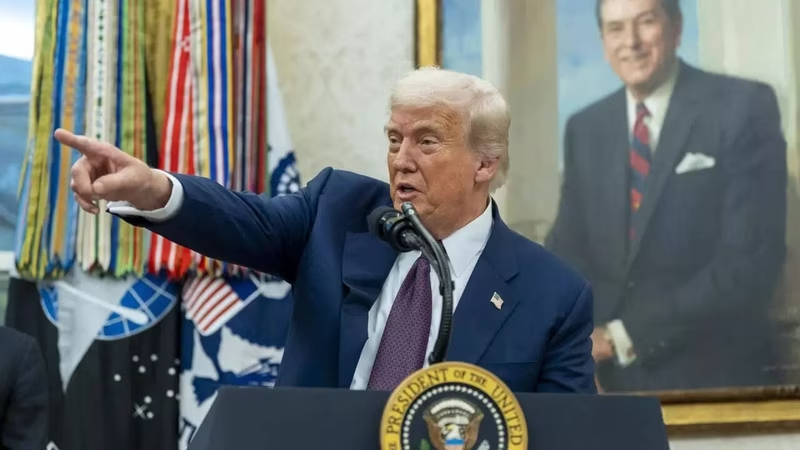
In a strategic maneuver that blends economic statecraft with high-stakes geopolitics, former President Donald Trump has taken decisive action to lock down a critical financial lifeline for Venezuela. By signing an executive order that declares a national emergency, the Trump administration has effectively placed a protective shield around billions of dollars in Venezuelan oil revenue currently held in U.S. financial institutions .
This isn’t just about protecting money; it’s about controlling the future of a nation. The order explicitly prohibits any transfer or seizure of these sovereign funds by private creditors, hedge funds, or other litigants who have been circling these assets for years. The clear message from Washington is that this money is not for private collection—it is a tool of U.S. foreign policy, to be used solely to incentivize a peaceful and democratic transition in Caracas. This move has significant implications for Venezuela’s embattled government, its international creditors, and the broader struggle for influence in Latin America.
Table of Contents
- The Executive Order: Breaking Down Trump’s Move
- Why Venezuelan Oil Revenue Is a Geopolitical Prize
- Creditors on the Hunt: The Debt Crisis Background
- US Strategy: Using Funds as Leverage for Democracy
- International Reactions and Legal Challenges
- Historical Context: US Sanctions on Venezuela
- Conclusion: A High-Stakes Poker Game
- Sources
The Executive Order: Breaking Down Trump’s Move
The core of this action is a presidential executive order that invokes the International Emergency Economic Powers Act (IEEPA). By declaring a new national emergency specific to the “unusual and extraordinary threat” posed by the potential dissipation of Venezuelan state assets, the order grants the U.S. Treasury Department sweeping authority .
Key provisions of the order include:
- Blocking Seizures: It freezes all property and interests in property of the Government of Venezuela that are in the U.S. or in the possession of U.S. persons, specifically targeting oil revenue streams.
- Prohibiting Transfers: It bars any transfer, payment, export, or withdrawal of these funds without explicit U.S. government authorization.
- Superseding Prior Rules: The order explicitly overrides any conflicting licenses or regulations that may have previously allowed for the attachment of these assets by creditors .
This legal framework ensures that the U.S. government, not a bankruptcy court or a vulture fund, will decide the ultimate fate of this capital.
Why Venezuelan Oil Revenue Is a Geopolitical Prize
Venezuela possesses the world’s largest proven oil reserves. Even in its current state of economic collapse, its state-owned oil company, PDVSA, continues to generate significant revenue, much of which flows through the international financial system, including U.S. banks .
For the U.S., controlling access to this revenue is a powerful non-military tool. It allows Washington to reward cooperative actors within Venezuela and punish those who undermine democratic efforts. For other global powers like Russia and China, who have extended massive loans to Caracas in exchange for oil, the U.S. move is a direct challenge to their influence in the region.
Creditors on the Hunt: The Debt Crisis Background
Venezuela has been in a state of default since 2017, owing an estimated $150 billion to a complex web of international creditors, including major investment banks and specialized distressed debt funds . These creditors have spent years pursuing Venezuelan assets worldwide, from Citgo Petroleum Corporation (PDVSA’s U.S. subsidiary) to gold reserves and now, oil revenue accounts.
Trump’s executive order is a direct response to this legal onslaught. By federalizing control over these funds, the U.S. is essentially saying that the national interest in shaping Venezuela’s political future outweighs the private contractual claims of its creditors.
US Strategy: Using Funds as Leverage for Democracy
The official White House statement accompanying the order was clear: the protected Venezuelan oil revenue will be “preserved for the benefit of the Venezuelan people” and used to support a “peaceful transition to democracy” . This aligns with the long-standing U.S. policy of recognizing opposition leader Juan Guaidó as the legitimate interim president, a stance that has been a cornerstone of Trump’s Latin America strategy.
The implicit promise is that if a new, U.S.-friendly government takes power in Caracas, these funds could be released to help rebuild the shattered nation. It’s a classic carrot-and-stick approach, where the carrot is a massive financial lifeline held firmly in Washington’s hand.
International Reactions and Legal Challenges
The order has drawn sharp criticism from the Maduro regime, which called it an “imperialist theft.” Meanwhile, creditors are expected to mount immediate legal challenges, arguing that the U.S. government is overstepping its authority by interfering in private commercial disputes.
[INTERNAL_LINK:history-of-us-venezuela-relations] provides deeper context on the decades-long tension between the two nations. The success of this strategy will depend on whether the U.S. can navigate these legal minefields while maintaining international support for its vision of a post-Maduro Venezuela.
Historical Context: US Sanctions on Venezuela
This executive order is the latest chapter in an escalating series of U.S. sanctions against Venezuela that began under the Obama administration and were dramatically expanded by Trump. These sanctions have targeted individuals, the financial sector, and the all-important oil industry, aiming to cripple the Maduro government’s ability to function .
Conclusion: A High-Stakes Poker Game
By shielding Venezuelan oil revenue from its creditors, the Trump administration has raised the stakes in its campaign to force a regime change in Caracas. This executive order is a potent demonstration of American financial power, using the country’s control over the global banking system as a weapon of foreign policy. Whether this gamble pays off by ushering in a new democratic era for Venezuela, or simply deepens the country’s economic paralysis, remains to be seen. But one thing is certain: the battle for Venezuela’s future will be fought as much in the courtrooms of New York as on the streets of Caracas.
Sources
- Text and summary of the executive order signed by President Trump .
- Background on Venezuela’s oil reserves and PDVSA operations .
- Reports on Venezuela’s international debt and creditor actions .
- [INTERNAL_LINK:timeline-of-us-sanctions-on-venezuela]
- U.S. Department of the Treasury – Official Website