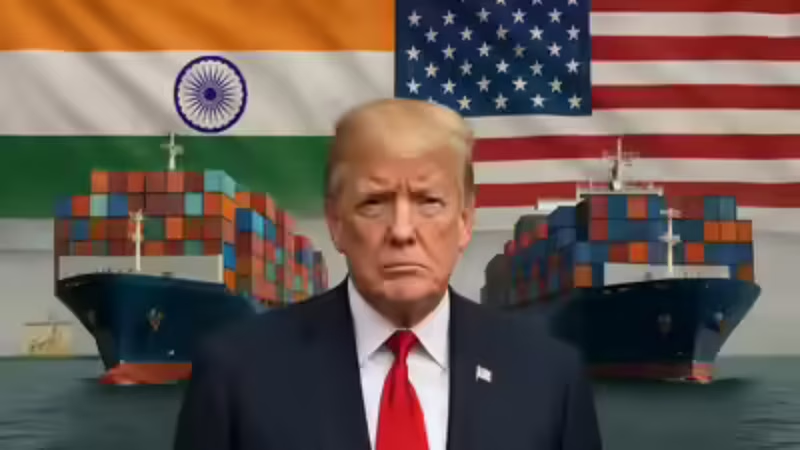
It was supposed to be a win-win: India secures cheap Russian oil, keeps its energy costs low, and avoids picking sides in the Ukraine war. But now, that careful balancing act is under direct threat from Washington. Former President Donald Trump has thrown a geopolitical grenade into the mix by backing the Sanctioning Russia Act—a bill that explicitly targets countries like India with potentially devastating Trump sanctions India-style penalties.
The legislation, passed with rare bipartisan support, authorizes the U.S. government to impose secondary sanctions and tariffs as high as 500% on any nation continuing to purchase significant volumes of Russian energy . And India—now one of Moscow’s top oil customers—is squarely in the crosshairs.
This isn’t just about foreign policy; it’s about India’s economic stability, energy security, and strategic autonomy. Let’s break down what this means—and why New Delhi can’t afford to ignore it.
Table of Contents
- What Is the Sanctioning Russia Act?
- Why India Is a Primary Target
- The ‘Trump Sanctions India’ Threat Explained
- Economic Impact on India
- Diplomatic Tightrope Walking
- Can India Avoid the Sanctions?
- Conclusion: Navigating a New Era of Pressure
- Sources
What Is the Sanctioning Russia Act?
Officially titled the Sanctioning Russia and Deterring American Adversaries Act, this U.S. bill aims to choke off Russia’s primary source of wartime revenue: energy exports. While Europe has largely weaned itself off Russian oil and gas, countries like China, India, and Brazil—members of the BRICS bloc—have stepped in as major buyers .
The Act empowers the U.S. President to:
- Impose tariffs of up to 500% on goods from nations importing over $1 billion annually in Russian energy
- Freeze assets of foreign entities facilitating such trade
- Restrict access to U.S. financial systems and technology
Critically, these are secondary sanctions—meaning they punish third-party countries for doing business with a sanctioned nation (Russia), even if those countries aren’t directly violating U.S. law.
Why India Is a Primary Target
Before 2022, India imported less than 2% of its oil from Russia. Today, that figure exceeds 40% . The reason? Heavily discounted Urals crude—often 30–50% cheaper than Brent benchmarks—has helped India manage inflation, stabilize its current account deficit, and build strategic reserves.
But from Washington’s perspective, every barrel India buys is cash flowing into Putin’s war chest. U.S. officials have repeatedly urged India to reduce purchases, but New Delhi has insisted its energy choices are a matter of “national interest,” not alignment .
[INTERNAL_LINK:india-russia-oil-trade-analysis] That stance may no longer be tenable if the Sanctioning Russia Act is fully enforced.
The ‘Trump Sanctions India’ Threat Explained
Although Trump is not currently in office, his vocal endorsement of this bill signals strong Republican backing—and increases the likelihood it will be aggressively implemented, especially if he returns to the White House in 2025.
The real danger lies in the tariff mechanism. A 500% duty on key Indian exports—like pharmaceuticals, textiles, or IT services—would make them uncompetitive overnight in the U.S. market, which accounts for nearly 18% of India’s total goods exports .
For context: a $10 shirt could face a $50 tariff. A $1,000 software license might incur $5,000 in duties. The economic shock would ripple across sectors.
Economic Impact on India
If enforced, the sanctions could trigger:
- Export collapse: Loss of access to the world’s largest consumer market
- Rupee volatility: Reduced dollar inflows could weaken the currency
- Inflation surge: Higher import costs for U.S.-made tech, medical devices, and aircraft
- Investor uncertainty: Foreign portfolio investors may pull back amid policy risk
The Reserve Bank of India and Ministry of Commerce are already running contingency scenarios—but there’s no painless exit.
Diplomatic Tightrope Walking
India finds itself caught between two giants. On one side, Russia offers cheap energy and historic defense ties. On the other, the U.S. is a critical partner in tech, defense (think GE jet engines and MQ-9B drones), and countering China in the Indo-Pacific.
New Delhi’s traditional non-alignment strategy is being stress-tested like never before. As one MEA official anonymously told Reuters, “We’re trying to walk a tightrope blindfolded—with both ends on fire.”
Can India Avoid the Sanctions?
Possibly—but it would require swift, strategic concessions:
- Gradually reduce Russian oil imports while diversifying to Middle Eastern suppliers
- Adopt transparent payment mechanisms (e.g., rupee trades) to avoid U.S. dollar clearing systems
- Offer intelligence or logistical support to Western efforts in other domains (e.g., maritime security)
However, any abrupt shift could spike domestic fuel prices and anger voters—making this a political minefield for the Modi government.
Conclusion: Navigating a New Era of Pressure
The Trump sanctions India scenario is no longer hypothetical. With the Sanctioning Russia Act now law, New Delhi must choose: double down on energy pragmatism at great economic risk, or recalibrate its Russia policy to preserve its vital U.S. partnership. Either path carries consequences—but inaction is the riskiest option of all.