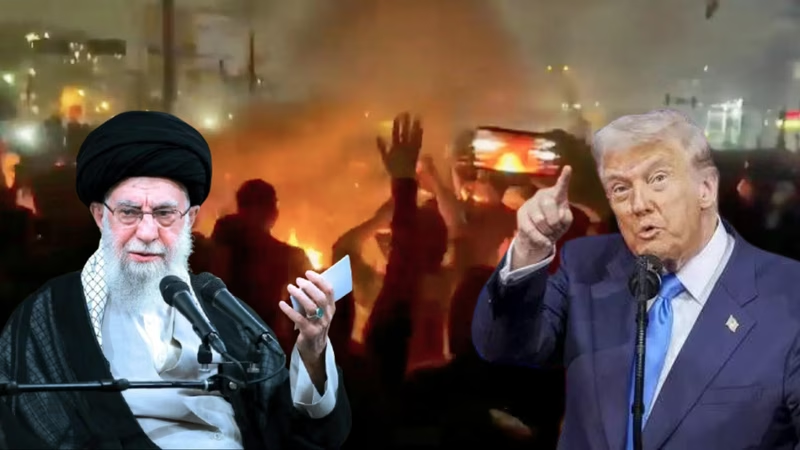
Tensions between Washington and Tehran have exploded into a high-stakes war of words—one that could ignite a regional conflagration.
Former U.S. President Donald Trump, speaking from Mar-a-Lago on Sunday, January 11, 2026, delivered a blistering response to Iran’s recent threat to strike American military bases across the Middle East. “If they even think about it,” Trump warned, “we will hit them at levels they’ve never seen before—and they know exactly what I mean” .
The statement comes amid one of the bloodiest crackdowns in Iran’s recent history. Activist groups report at least **544 civilians killed** and over 18,000 detained since nationwide protests erupted following the death of a young student in police custody. The Iranian government, led by President Masoud Pezeshkian, has accused the United States and Israel of orchestrating the unrest—a claim both nations deny .
Table of Contents
- The Iran Protests: Background and Casualties
- Trump Reacts to Iran Threat: Key Statements
- Iran Accuses US and Israel of Fomenting Unrest
- International Response: UN and Allies Speak Out
- Military Posture: US Bases on High Alert
- Historical Context: Trump vs. Iran – A Volatile History
- Conclusion: Brinkmanship in a Fragile Region
- Sources
The Iran Protests: Background and Casualties
What began as a localized demonstration in Tehran over alleged police brutality has spiraled into a nationwide uprising against economic hardship, political repression, and mandatory hijab laws. Protesters have burned images of Supreme Leader Ayatollah Khamenei and chanted “Death to the Dictator.”
According to the Norway-based Human Rights Activists News Agency (HRANA), security forces have used live ammunition, tear gas, and internet blackouts to suppress dissent. Over **544 deaths** have been verified—including 72 minors—and mass arrests have overwhelmed detention centers .
Critically, the Iranian government shut down mobile internet access for 90% of the country, severely limiting real-time reporting and coordination among protesters—a tactic condemned globally as a violation of digital rights.
Trump Reacts to Iran Threat: Key Statements
Iran’s Revolutionary Guard Corps (IRGC) recently declared that any U.S. support for “seditionists” would be met with direct strikes on American bases in Qatar, Kuwait, and Iraq. In response, Trump reacts to Iran threat with characteristic bluster but strategic ambiguity:
“They’re playing with fire. We have the strongest military in the history of the world. If they touch one American soldier, we’ll take out their nuclear sites, their oil fields, their command centers—everything. And it won’t be proportional. It’ll be total.”
While Trump holds no official power, his comments carry weight. As the presumptive 2026 Republican nominee, his stance signals how a potential second administration might handle Iran—likely abandoning diplomacy in favor of maximum pressure .
Iran Accuses US and Israel of Fomenting Unrest
President Pezeshkian addressed the nation on state TV, claiming the protests were “engineered by Mossad and CIA agents” using social media bots and encrypted messaging apps. He cited intercepted communications as evidence—though none have been independently verified.
This narrative is a long-standing trope in Iranian state propaganda, used to delegitimize grassroots movements. However, it resonates domestically, where anti-American sentiment remains potent decades after the 1979 revolution.
International Response: UN and Allies Speak Out
The United Nations High Commissioner for Human Rights, Volker Türk, issued an urgent appeal: “The Iranian authorities must immediately cease the violent crackdown, restore full internet access, and release arbitrarily detained protesters” .
Meanwhile, the European Union called for “restraint and dialogue,” while Israel—often a scapegoat in such crises—denied any involvement, stating, “We support the Iranian people’s right to freedom, but we do not interfere in their internal affairs” .
Military Posture: US Bases on High Alert
In response to IRGC threats, U.S. Central Command (CENTCOM) has elevated force protection levels at key installations:
- Al Udeid Air Base (Qatar): Home to 10,000+ U.S. personnel; now under THAAD missile defense coverage.
- Camp Arifjan (Kuwait): Logistics hub; additional Patriot batteries deployed.
- Al Asad Airbase (Iraq): Hosts 2,500 troops; drone surveillance intensified.
Pentagon officials stress that no imminent attack is expected—but contingency plans for surgical strikes on IRGC targets are active .
Historical Context: Trump vs. Iran – A Volatile History
This isn’t the first time Trump has threatened Iran with “levels never seen.” In 2020, he ordered the drone strike that killed Quds Force commander Qasem Soleimani—a move that brought the two nations to the edge of war. Iran retaliated with missile attacks on Iraqi bases, injuring over 100 U.S. soldiers .
His “maximum pressure” campaign—featuring crippling sanctions—failed to bring Iran to the negotiating table but did cripple its economy. Now, with Iran enriching uranium to 60% purity, the nuclear clock is ticking faster than ever.
Conclusion: Brinkmanship in a Fragile Region
As Trump reacts to Iran threat with apocalyptic rhetoric, and Tehran doubles down on conspiracy theories, ordinary Iranians pay the price. The world watches nervously: one miscalculation—a misread signal, a stray rocket—could spark a conflict with global repercussions. Diplomacy may be frayed, but it remains the only path away from the abyss.
Sources
- Times of India: “‘We will hit them at levels…’ Trump reacts to Iran’s threat” – https://timesofindia.indiatimes.com/…
- Reuters: “Iran blames US, Israel for protest unrest”
- HRANA: “544+ Killed in Iran Protests – Verified Toll” – https://www.hranana.org
- Associated Press: “Trump’s Iran Comments Signal 2026 Foreign Policy”
- OHCHR Statement, Jan 11, 2026 – https://www.ohchr.org
- Israeli Foreign Ministry Briefing, Jan 10, 2026
- U.S. CENTCOM Press Release, Jan 11, 2026
- U.S. Department of Defense Archives: “Soleimani Strike Aftermath” – https://www.defense.gov (External Authority)