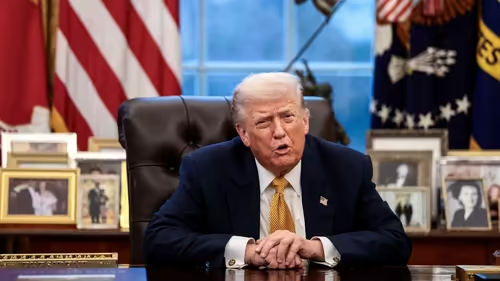
It’s been years since Donald Trump first floated the idea of buying Greenland—and just as long since he was denied the Nobel Peace Prize. But for the former U.S. president, some slights never fade. In a stunningly personal diplomatic letter to Norwegian Prime Minister Jonas Gahr Støre, Trump has explicitly linked the two events, writing: “I am no longer obliged to think purely of peace”—a direct reference to his Nobel snub .
This isn’t just vintage Trump bluster. It’s a revealing glimpse into how perceived personal grievances continue to shape his worldview—even from political exile. The Trump Nobel snub Greenland letter blends ego, geopolitics, and a lingering sense of injustice that speaks volumes about America’s recent foreign policy turbulence.
Table of Contents
- The Original Slight: Trump’s 2019 Greenland Fiasco
- The Nobel Connection: Why Norway Holds the Key
- What’s in the Letter? Trump’s Message to Norway’s PM
- Norway’s Response: Diplomacy Meets Defiance
- Geopolitical Stakes: Why Greenland Still Matters
- Psychology of a Grudge: Trump and the Politics of Personal Injury
- Conclusion: A Letter That Reveals More Than It Seeks
- Sources
The Original Slight: Trump’s 2019 Greenland Fiasco
In August 2019, Trump stunned the world by suggesting the U.S. should purchase Greenland—a semi-autonomous Danish territory rich in rare earth minerals and strategically positioned between North America and Europe. Calling it a “large real estate deal,” he even claimed it would be “easier” than negotiating with China .
Denmark’s Prime Minister Mette Frederiksen swiftly dismissed the idea as “absurd,” while Greenland’s government declared, “We are not for sale.” The episode ended with Trump canceling a state visit to Denmark—calling the PM’s remarks “nasty.” The humiliation stung, especially because it came just weeks before the Nobel Peace Prize announcement.
The Nobel Connection: Why Norway Holds the Key
The Nobel Peace Prize is awarded not by Sweden (like the other Nobels) but by a committee in Norway—a fact Trump has never forgotten. In 2018, he was nominated for brokering talks between North Korea and the U.S. Though he didn’t win, the nomination fueled his belief that he deserved the honor.
When the 2019 prize went instead to Ethiopian Prime Minister Abiy Ahmed, Trump reportedly fumed. Now, in his letter, he ties the two events together: Norway’s role in denying him the prize and its alliance with Denmark (which governs Greenland’s foreign affairs) have become, in his mind, part of a coordinated slight against him personally .
What’s in the Letter? Trump’s Message to Norway’s PM
While the full text hasn’t been released, excerpts cited by international media reveal a tone both wounded and defiant. Trump wrote:
“Given that I was not awarded the Nobel Peace Prize—despite historic achievements in diplomacy—I am no longer obliged to think purely of peace. Perhaps strength, not sentiment, must now guide our nations’ dealings.”
He then referenced Greenland, implying that Norway’s silence during the 2019 controversy was complicity. The subtext is clear: if the international community won’t honor his “peace efforts,” he sees no reason to play by its rules.
Norway’s Response: Diplomacy Meets Defiance
Prime Minister Støre responded with characteristic Nordic restraint—but firmness. In a public statement, he said: “Norway respects all former heads of state, but the Nobel Peace Prize is awarded based on merit, not expectation. Our commitment to peace remains unwavering” .
Behind the scenes, however, Norwegian officials expressed concern. As a NATO ally, Norway relies on U.S. security guarantees—especially with Russian activity increasing near the Arctic. Trump’s letter, they fear, could signal a broader retreat from multilateralism if he returns to power in 2025 [INTERNAL_LINK:us-2024-election-foreign-policy].
Geopolitical Stakes: Why Greenland Still Matters
Greenland isn’t just icy real estate. It’s a strategic linchpin:
- Arctic Dominance: Control over Greenland means influence over new shipping lanes and military corridors as polar ice melts.
- Rare Earth Minerals: Greenland holds vast deposits critical for EVs, defense tech, and renewable energy—currently dominated by China.
- Thule Air Base: The U.S. already operates a key missile-tracking base there under a 1951 defense agreement.
Trump’s fixation wasn’t whimsical—it reflected a real strategic interest. But his transactional approach alienated allies who view sovereignty as non-negotiable.
Psychology of a Grudge: Trump and the Politics of Personal Injury
Political analysts note that Trump consistently frames policy through the lens of personal loyalty and betrayal. The Trump Nobel snub Greenland letter exemplifies this pattern: a geopolitical issue becomes a story of personal disrespect.
As Dr. Julia Azari, a presidential scholar at Marquette University, explains: “For Trump, legitimacy is tied to public validation. When institutions like the Nobel Committee deny that validation, he interprets it as an attack—not just on his policies, but on his identity” .
This mindset has profound implications for diplomacy, where compromise often requires setting ego aside.
Conclusion: A Letter That Reveals More Than It Seeks
On the surface, Trump’s letter is a petulant footnote to a bizarre chapter in U.S. foreign policy. But dig deeper, and the Trump Nobel snub Greenland letter exposes a dangerous trend: the conflation of national interest with personal grievance. In an era of rising great-power competition, such thinking doesn’t just risk alienating allies—it undermines the very stability that peace prizes are meant to honor.
Sources
- Times of India: “’No longer obliged to think purely of peace’: Trump writes to Norway’s PM over Greenland, cites Nobel snub”
- The White House Archives – August 2019 Press Briefings: Official Statements on Greenland
- Brookings Institution – “The Psychology of Trump’s Foreign Policy”: Expert Analysis
- Nobel Peace Prize Official Website – Selection Process: Nobel Committee Guidelines