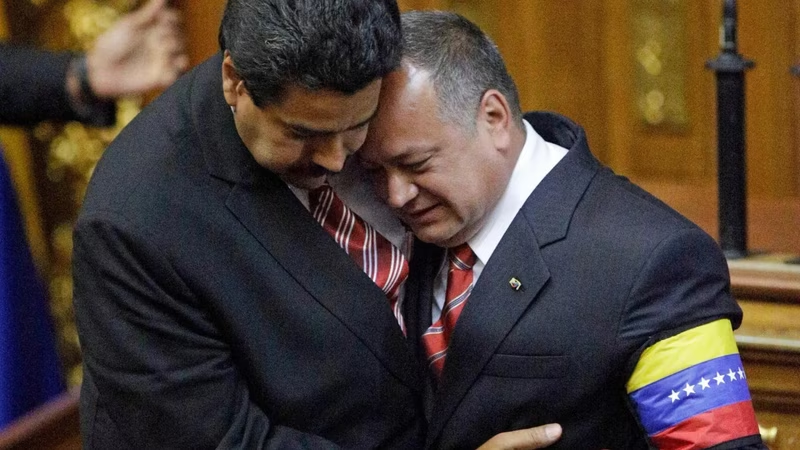
In the high-stakes geopolitical drama unfolding in Latin America, one name keeps surfacing with growing urgency: Diosdado Cabello. After the stunning U.S. operation that captured Venezuelan President Nicolás Maduro in early January 2026, intelligence sources and regional analysts confirm that Cabello—the de facto second-in-command of the crumbling Chavista regime—is now squarely in Washington’s crosshairs . But who exactly is this man, and why has he become a top priority for the Trump administration?
Table of Contents
- Who Is Diosdado Cabello?
- Diosdado Cabello: Why He’s on the U.S. Hit List
- The Narco-Terrorism Allegations
- Cabello’s Role in the Maduro Regime
- U.S. Strategy Beyond Maduro
- What Happens If Cabello Is Captured?
- Conclusion: The End of Chavismo?
- Sources
Who Is Diosdado Cabello?
Diosdado Cabello isn’t just another politician. A former vice president, current head of Venezuela’s Constituent Assembly, and long-time president of the ruling United Socialist Party (PSUV), he’s widely regarded as the most powerful figure in Venezuela after Maduro—some even argue he was the true power behind the throne . With close ties to Cuba’s intelligence services and Venezuela’s military elite, Cabello has been instrumental in maintaining the regime’s grip on power through patronage, propaganda, and repression.
His influence extends far beyond politics. U.S. prosecutors have labeled him the “head of the Cartel of the Suns”—a shadowy network of military and government officials allegedly trafficking tons of cocaine into the United States . In 2015, the Drug Enforcement Administration (DEA) unsealed an indictment charging him with drug trafficking, money laundering, and conspiracy to import narcotics . He denies all allegations, calling them “imperialist fabrications.”
Diosdado Cabello: Why He’s on the U.S. Hit List
While Maduro’s capture was a symbolic and legal milestone, U.S. officials believe dismantling the entire criminal-political structure requires neutralizing Cabello. His removal would do more than just arrest a suspect—it would decapitate the regime’s operational core. Here’s why he’s a top target:
1. Architect of Repression
Cabello controls Venezuela’s state media apparatus and oversees key security forces. He’s accused of orchestrating crackdowns on dissent, including the violent suppression of protests in 2014 and 2017 .
2. Financial Kingpin
Intelligence reports suggest Cabello manages illicit revenue streams from gold mining, oil smuggling, and drug trafficking—funds that keep the regime afloat despite sanctions .
3. Succession Threat
With Maduro gone, Cabello is the most likely figure to rally hardliners and install a new puppet leader. Eliminating him prevents a seamless regime reset.
The Narco-Terrorism Allegations
The U.S. Department of Justice has built a robust case against Cabello under the “narco-terrorism” statute—a charge typically reserved for leaders who use drug profits to fund armed insurgency or destabilize governments. According to court documents, Cabello allegedly coordinated shipments of multi-ton cocaine loads from Venezuela to Mexico and the U.S., using military aircraft and protected ports .
Witnesses, including former Venezuelan generals turned informants, claim he personally approved deals with Colombian guerrilla groups like the ELN and dissident FARC factions. These alliances blur the line between state power and transnational crime—a hallmark of what experts call a “mafia state” .
Cabello’s Role in the Maduro Regime
While Maduro served as the international face of Chavismo, Cabello operated as its enforcer. He controlled:
- The National Constituent Assembly, which bypassed the opposition-led National Assembly.
- Key military appointments through his influence over the Defense Ministry.
- State-run media outlets that spread pro-regime propaganda and attack critics.
His loyalty to the late Hugo Chávez was absolute, and he’s seen as the guardian of Chavismo’s ideological purity—even as the movement descended into corruption and chaos.
U.S. Strategy Beyond Maduro
The Trump administration’s Venezuela policy has shifted from containment to active regime dismantling. Following Maduro’s capture, Secretary of State Marco Rubio stated: “We will not stop until every architect of Venezuela’s collapse faces justice” . This signals a broader campaign targeting figures like Cabello, Tareck El Aissami (former oil minister), and Defense Minister Vladimir Padrino López.
[INTERNAL_LINK:venezuela-us-foreign-policy] suggests this aggressive posture is also aimed at deterring Chinese and Russian backing by proving that no ally of the regime is safe.
What Happens If Cabello Is Captured?
His arrest could trigger one of two outcomes:
- Regime Collapse: Without Cabello’s iron-fisted coordination, remaining loyalists may fracture, opening a path for transitional leadership.
- Military Backlash: Hardline generals might double down, leading to internal purges or even civil conflict.
Either way, his removal would mark the most significant blow yet to a regime that has ruled Venezuela for over two decades.
Conclusion: The End of Chavismo?
Diosdado Cabello represents the dark engine of Venezuela’s authoritarian system—a blend of political control, military loyalty, and criminal enterprise. By placing him on the hit list, the U.S. isn’t just pursuing justice; it’s attempting to surgically excise the heart of Chavismo. Whether this bold strategy succeeds or backfires remains to be seen. But one thing is clear: in the new era of U.S. intervention in Latin America, no one is untouchable.
Sources
- Times of India: “Trump’s next target? Who is Diosdado Cabello…” (Original Article)
- Council on Foreign Relations: “The Power Behind Venezuela’s Throne”
- U.S. Department of Justice: Indictment of Diosdado Cabello (2015)
- DEA Public Affairs: “Cartel of the Suns Investigation”
- Human Rights Watch: “Venezuela’s Repression Apparatus”
- Center for Strategic and International Studies (CSIS): “Illicit Economies in Venezuela”
- Southern District of New York Court Filings (Case No. 15-cr-417)
- Journal of Democracy: “Mafia States and Democratic Erosion”
- U.S. State Department Press Briefing, January 7, 2026
- External Authority Link: U.S. State Department – Venezuela