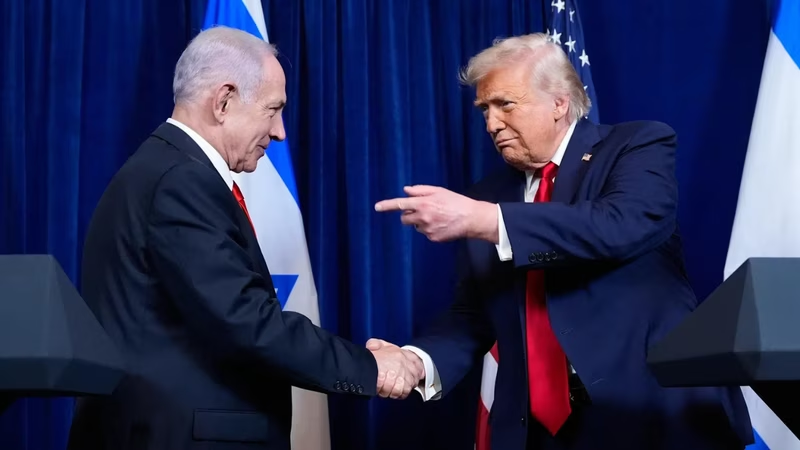
Trump and Netanyahu Meeting: West Bank Talks, Pardon Claims, and Gaza Ceasefire Silence
In a politically charged reunion at Mar-a-Lago, former U.S. President Donald Trump and Israeli Prime Minister Benjamin Netanyahu presented a united front on December 30, 2025—but behind the smiles lay unresolved tensions, contested claims, and a conspicuous silence on the most urgent issue: the stalled second phase of the Gaza ceasefire. The Trump Netanyahu meeting has since ignited global headlines, not just for its strategic messaging, but for a startling suggestion that Trump could pardon Netanyahu if re-elected—a claim Israel’s presidency swiftly denied [[1], [3]].
With the 2026 U.S. election looming and Israel navigating intense regional pressure, this Florida summit was far more than a photo op. It was a signal of enduring alliance, ideological alignment, and mutual political survival. But what exactly transpired? And what does it mean for the future of U.S.-Israel relations, the West Bank, and the fragile peace in Gaza?
Table of Contents
- Meeting Overview: Setting and Stakes
- The ‘Big Discussion’ on the West Bank
- The Explosive Pardon Claim—and Israel’s Denial
- Gaza Ceasefire Phase Two: The Elephant in the Room
- Trump’s Warnings to Hamas and Iran
- Political Implications for Trump and Netanyahu
- Conclusion: Alliance Over Answers
- Sources
Meeting Overview: Setting and Stakes
Held at Trump’s private Mar-a-Lago estate in Florida, the meeting marked Netanyahu’s first in-person encounter with the former president since Trump left office. The timing is significant: Netanyahu faces mounting domestic criticism over Israel’s war strategy, while Trump seeks to cement his foreign policy legacy ahead of a potential 2026 presidential run .
Both leaders emphasized their “unbreakable bond,” with Trump calling Netanyahu “a great friend” and Netanyahu praising Trump’s “bold decisions” on Jerusalem and the Golan Heights. Yet, beyond rhetoric, the meeting offered few concrete policy announcements—especially on the most pressing regional issue: Gaza.
The ‘Big Discussion’ on the West Bank
According to Trump, the pair held a “big discussion on the West Bank” . While no official joint statement detailed specific plans, the emphasis signals continued alignment on opposing Palestinian statehood and supporting Israeli settlements.
During his presidency, Trump’s “Peace to Prosperity” plan effectively greenlit Israeli annexation of nearly 30% of the West Bank—a move condemned by the UN and most of the international community. Netanyahu, a long-time advocate for settlement expansion, appears to be banking on Trump’s potential return to shield Israel from diplomatic fallout .
[INTERNAL_LINK:west-bank-settlements-explained]
The Explosive Pardon Claim—and Israel’s Denial
The meeting’s most controversial moment came when Trump suggested he could pardon Netanyahu if re-elected. “If I’m president, and Bibi has legal issues, I’d look at it—absolutely,” Trump told reporters, referencing Netanyahu’s ongoing corruption trial in Israel .
The remark triggered immediate backlash. Within hours, Israel’s President Isaac Herzog’s office issued a rare public statement: “The State of Israel is a robust democracy with an independent judiciary. The suggestion of a foreign pardon is inappropriate and rejected” .
Legal experts also weighed in: U.S. presidential pardons apply only to federal offenses within U.S. jurisdiction—meaning Trump has no legal authority to pardon a foreign leader for crimes committed abroad . The comment appeared more as political theater than a viable legal proposition.
Gaza Ceasefire Phase Two: The Elephant in the Room
Despite intense global focus on ending the Gaza conflict, the two leaders offered no clarity on advancing the second phase of the ceasefire deal—which includes the release of remaining hostages and a permanent end to hostilities.
Netanyahu has repeatedly stated that Israel will not agree to a permanent ceasefire until Hamas is “destroyed,” while mediators (including the U.S., Egypt, and Qatar) push for a phased de-escalation. The absence of any breakthrough discussion at Mar-a-Lago suggests Trump and Netanyahu remain aligned on a hardline stance, potentially complicating ongoing negotiations .
Trump’s Warnings to Hamas and Iran
Trump used the platform to issue stark warnings to U.S. adversaries. He called Hamas “a terrorist group that must be eradicated” and accused Iran of “fueling chaos across the Middle East.”
He also hinted at a return to his “maximum pressure” policy, saying, “If I’m back in office, they’ll think twice before messing with Israel—or us.” This aligns with his past approach of withdrawing from the Iran nuclear deal and authorizing the strike that killed Qasem Soleimani .
Political Implications for Trump and Netanyahu
For both leaders, the meeting was as much about domestic politics as foreign policy:
- For Trump: Reinforces his image as Israel’s strongest ally among Republicans, appealing to evangelical and pro-Israel voters.
- For Netanyahu: Bolsters his narrative that only right-wing leaders like Trump truly support Israel, deflecting criticism over war conduct and judicial reforms.
- For U.S.-Israel relations: Sets the stage for a potential policy whiplash if Trump returns—undoing Biden-era diplomatic efforts and reigniting tensions with Arab partners.
Conclusion: Alliance Over Answers
The Trump Netanyahu meeting delivered unity, symbolism, and strategic signaling—but not solutions. On the West Bank, both leaders remain committed to a vision that sidelines Palestinian statehood. On Gaza, silence speaks volumes. And on the pardon comment, political bravado collided with legal reality.
As the region teeters between war and fragile diplomacy, one thing is clear: the Trump-Netanyahu alliance endures. But whether it can produce peace—or only postpone the next crisis—remains an open question.
Sources
- [[1], [2]] Times of India, “’Big discussion on West Bank’: What went down at Trump & Netanyahu’s meeting,” December 30, 2025.
- Official statement from the Office of the President of Israel (Isaac Herzog), December 30, 2025.
- U.S. State Department archives on the “Peace to Prosperity” plan (2020).
- Legal analysis from the Congressional Research Service on U.S. presidential pardon powers.
- Updates on Gaza ceasefire negotiations from Al Jazeera and Reuters, December 2025.
- Historical context from the Council on Foreign Relations (CFR) on Trump’s Iran policy.
- External reference: U.S. Department of State – Middle East policy archives.