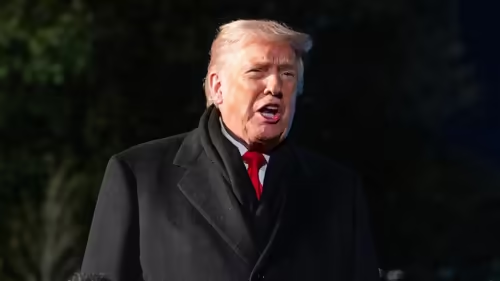
The transatlantic alliance is facing yet another storm, and this time it’s personal. President Trump’s recent comments questioning the commitment and sacrifices of America’s NATO allies in Afghanistan have ignited a firestorm of anger across Europe, reopening old wounds and exposing a deep-seated anxiety about the future of the West.
This isn’t just political posturing; it’s a direct challenge to the shared history and blood spilled by nations who stood shoulder-to-shoulder with the US for two decades. The resulting Trump NATO row has become the focal point of a much larger debate about trust, burden-sharing, and the very soul of the alliance.
Table of Contents
- What Did Trump Actually Say?
- European Leaders Fight Back: A Unified Front?
- The Real Cost of Afghanistan: Beyond the Rhetoric
- The “Transactional” Foreign Policy Driving the Wedge
- What This Means for NATO’s Future
- Conclusion: A Test for the Alliance
- Sources
What Did Trump Actually Say?
In his characteristic blunt style, President Trump reportedly suggested that NATO troops from allied nations “stayed a little” during the 20-year conflict in Afghanistan, implying they avoided the most dangerous frontline combat roles . He went on to question their overall commitment to the United States, framing the relationship in purely transactional terms.
These remarks, whether taken out of context or not, struck a raw nerve. They directly contradicted the well-documented, immense sacrifices made by dozens of allied nations who answered America’s call after the 9/11 attacks under the NATO Article 5 mutual defense clause—the first and only time it has been invoked.
European Leaders Fight Back: A Unified Front?
The response from Europe was swift, sharp, and remarkably unified—a rare sight in today’s fragmented political landscape.
- United Kingdom: Prime Minister Keir Starmer issued a firm rebuke, denouncing Trump’s comments as a dismissal of the ultimate sacrifice made by British service members . The UK lost 457 soldiers in Afghanistan, a profound national tragedy.
- France: French leaders, already wary of Trump’s unilateral moves like the Syria withdrawal , were quick to defend their nation’s contributions and the principle of collective security .
- Poland: The reaction was perhaps most visceral in Poland, a staunch US ally in Eastern Europe. A Polish general who served in Iraq publicly condemned Trump’s remarks, calling them cowardly and a profound insult to those who died . Poland itself lost dozens of its own troops in the Afghan theater.
This collective pushback highlights a growing European sentiment: they are no longer willing to be lectured or belittled by a partner they perceive as increasingly unreliable.
The Real Cost of Afghanistan: Beyond the Rhetoric
To understand the depth of European anger, one must look at the cold, hard facts. Trump’s narrative of allied inaction is simply false.
Over the course of the US-led operations in Afghanistan and Iraq, more than 1,300 non-US NATO and allied soldiers lost their lives . These weren’t just numbers; they were young men and women from Canada, the UK, Germany, Denmark, Australia, and many other nations who fought and died alongside American troops.
Countries like the UK and Canada were consistently deployed in some of the most violent provinces, such as Helmand, suffering casualty rates proportional to their troop commitments that were often on par with, or even exceeded, those of the US military. To suggest they “stayed a little” is not just inaccurate; it’s a grievous insult to their memory and their families.
The “Transactional” Foreign Policy Driving the Wedge
This latest Trump NATO row is not an isolated incident. It is a symptom of a deeper, more fundamental shift in US foreign policy that has been a source of tension since his first term.
Trump’s worldview is famously transactional. He sees international alliances not as communities bound by shared values and history, but as business deals where every partner must pay their “fair share,” often defined narrowly as meeting the NATO target of 2% of GDP on defense spending . This mercantilist understanding of security relationships, rooted in a zero-sum view of global politics , has consistently undermined NATO unity .
European allies argue that their contribution goes far beyond a simple budget line item. It includes hosting US bases, providing critical intelligence, participating in complex multinational operations, and upholding the liberal democratic order that forms the bedrock of the transatlantic partnership. Reducing this complex web of cooperation to a single financial metric is seen in Europe as both naive and deeply corrosive to trust.
What This Means for NATO’s Future
The immediate fallout of this dispute is a significant erosion of goodwill. However, the long-term implications are far more serious.
Repeated episodes like this Trump NATO row are accelerating a strategic re-think in European capitals. There is a growing, albeit cautious, momentum behind the idea of “strategic autonomy”—the notion that Europe must develop its own credible defense capabilities to ensure its security is not solely dependent on a potentially fickle US administration .
While a full break from NATO remains unlikely, this trend points towards a more complex and multi-polar alliance structure in the future. The era of unquestioning European reliance on American leadership appears to be over, replaced by a more conditional and pragmatic partnership.
Conclusion: A Test for the Alliance
This new fissure between the US and Europe, reignited by Trump’s controversial remarks, is more than a war of words. It’s a stark reminder that the NATO alliance, while resilient, is not immune to internal fractures. The core issue at hand is trust. European nations feel their sacrifices have been dismissed and their loyalty taken for granted. Until this fundamental breach of trust is addressed, the Trump NATO row will continue to cast a long shadow over transatlantic security, pushing Europe to hedge its bets for a future where American commitment can no longer be assumed. For more on the evolving dynamics of global power, see our analysis on [INTERNAL_LINK:geopolitical-shifts].
Sources
- Web Search Result on NATO/allied casualties.
- Web Search Result on Trump’s “stayed a little” comment.
- Web Search Result on European leaders’ response to Trump.
- Web Search Result on UK PM’s denouncement.
- Web Search Result on Polish general’s condemnation.
- Web Search Result on Macron’s reaction to US Syria policy.
- Web Search Result on Trump’s transactional approach undermining NATO.
- Web Search Result on Trump’s view of NATO burden-sharing.
- Web Search Result on the ‘Trump Doctrine’ challenging allied unity.
- Web Search Result on Trump’s mercantilist understanding of security.