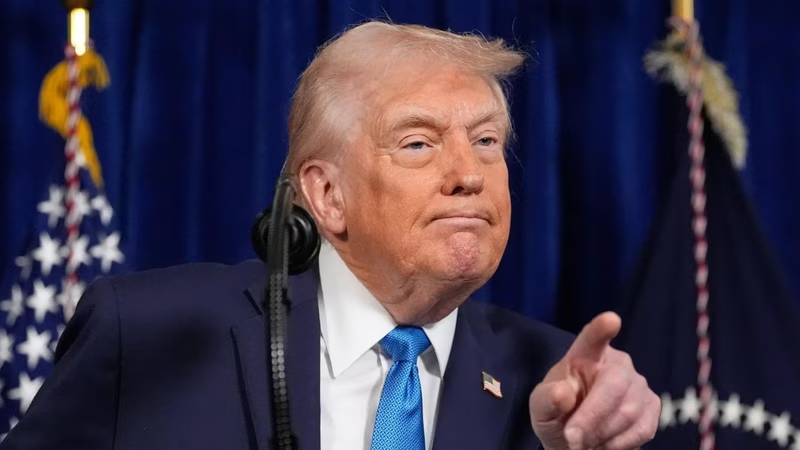
In a statement that has sent shockwaves through diplomatic circles and raised profound questions about the future of global order, former President Donald Trump has declared that the only thing limiting his power to wage war or coerce nations is his own personal sense of right and wrong. “I don’t need international law,” he asserted, adding, “My own morality. My own mind. It’s the only thing that can stop me” .
This declaration isn’t just rhetoric; it’s the philosophical bedrock of a series of aggressive actions taken by his administration since returning to office, including a military campaign in Venezuela and a renewed, serious push to acquire Greenland. This article dives deep into what has been dubbed the “Trump morality doctrine,” its real-world implications, and why the world should be paying close attention.
Table of Contents
- What is the Trump Morality Doctrine?
- From Words to Action: The Venezuela Campaign
- The Greenland Gambit: A Strategic or Ego-Driven Move?
- Why International Law Matters (And Why Trump Dismisses It)
- Global Reactions and Future Implications
- Conclusion
- Sources
What is the Trump Morality Doctrine?
The Trump morality doctrine represents a radical departure from decades of established US foreign policy, which, despite its flaws and contradictions, has at least nominally operated within the framework of international institutions and laws. By stating that his personal conscience is the sole check on his power as Commander-in-Chief, Trump effectively places himself above a system designed to prevent arbitrary and unchecked military aggression .
This philosophy aligns with his long-standing “America First” ideology, which prioritizes perceived US interests above all else, including alliances and multilateral agreements . It’s a form of hyper-personalized, autocratic decision-making where complex geopolitical strategies are filtered through the lens of one man’s judgment.
From Words to Action: The Venezuela Campaign
Trump’s words have quickly translated into decisive, and controversial, military action. In early January 2026, the United States launched a series of military strikes in Venezuela, culminating in the dramatic capture of President Nicolás Maduro and his wife in Caracas [[15], [18]]. This operation, part of a broader campaign dubbed “Operation Southern Spear,” began in September 2025 and has significantly escalated tensions across Latin America .
The justification provided by the administration hinges on national security and countering alleged threats, but the execution—bypassing traditional diplomatic channels and acting unilaterally—perfectly embodies the Trump morality doctrine. The message is clear: if the President deems an action necessary for America, no external legal framework will stand in his way.
What This Means for the Region
The fallout from the Venezuela operation is already being felt. Analysts warn that this aggressive posture could signal future campaigns against other nations in the region, such as Cuba, Colombia, or even Mexico . This has created a climate of fear and uncertainty among US neighbors, who now question the reliability of their most powerful ally.
The Greenland Gambit: A Strategic or Ego-Driven Move?
Parallel to his military adventurism, Trump has reignited his well-known desire for the United States to acquire Greenland. In January 2025, he called US ownership of the autonomous Danish territory an “absolute necessity” for national security and global freedom [[6], [9]]. He later doubled down, stating, “We need Greenland for national security, not for minerals” .
While proponents point to Greenland’s strategic location for space and defense infrastructure , critics dismiss the idea as a costly fantasy that would yield little operational value while creating immense political friction with a key NATO ally, Denmark . Regardless of its strategic merit, the push for Greenland is another manifestation of the same principle: a belief in the US’s unilateral right to claim territory it deems essential, regardless of the wishes of its current sovereign owners.
Why International Law Matters (And Why Trump Dismisses It)
International law, for all its imperfections, serves as a critical stabilizing force in global politics. It provides a common set of rules that help manage conflict, protect human rights, and facilitate cooperation between nations. Its core purpose is to prevent the very scenario Trump describes: a world where the most powerful actor acts solely on its own whim .
Trump’s dismissal of this system stems from a view that it constrains American power and sovereignty. His administration sees international agreements and institutions not as partners, but as potential cages that limit the US’s ability to act decisively in its own interest . This perspective has led to a consistent pattern of withdrawing from treaties and undermining global bodies, a trend that has only intensified in his second term.
Global Reactions and Future Implications
The international response to the Trump morality doctrine has been one of alarm and recalibration. Traditional allies in Europe are grappling with the reality that they can no longer rely on the US as a predictable partner committed to a rules-based order . Adversaries, meanwhile, are likely to accelerate their own efforts to build counter-balancing coalitions.
For the average citizen, both in the US and abroad, this shift means living in a more volatile and unpredictable world. The guardrails that have, however imperfectly, prevented major power conflicts for decades are being deliberately dismantled. The question now is not just what Trump will do next, but whether the international system can withstand this new era of personalized, unrestrained power.
Conclusion
Donald Trump’s assertion that his “own morality” is the only restraint on his global power is far more than a provocative soundbite. It is the guiding principle behind a sweeping and aggressive foreign policy that has already seen military intervention in Venezuela and a serious bid for Greenland. By explicitly rejecting the constraints of international law, the Trump administration has ushered in a period of profound uncertainty, forcing the world to confront a future where the actions of a single leader, guided only by his personal convictions, can reshape the global landscape. For anyone interested in geopolitics, national security, or the future of international cooperation, understanding this Trump morality doctrine is not just important—it’s essential.
Sources
- The Japan Times. “Trump lays out a vision of power restrained only by ‘my own morality’.”
- Viral quote from President Trump on his role as Commander-in-Chief.
- News report on Trump’s comments regarding Greenland as an “absolute necessity” (Jan 2025).
- Trump’s statement on needing Greenland for national security (Dec 2025).
- Statement on US interest in Greenland for national security and global freedom (Dec 2024).
- US Representative Mike Haridopolos on Greenland and space security (Jan 2025).
- Euroviews analysis on the feasibility of acquiring Greenland.
- Details on Operation Southern Spear in Venezuela.
- Report on the US military strikes in Venezuela and capture of Maduro (Jan 2026).
- Analysis on the potential for future US military campaigns in Latin America.
- House of Commons Library report on the capture of Nicolás Maduro.
- Commentary on the “Trump–Monroe doctrine” and its disregard for international law.
- Academic analysis on Trump’s challenge to the international legal system.
- Scholarly work on the importance of international law in constraining US foreign policy.
- Research on the “America First” ideology underpinning Trump’s foreign policy.