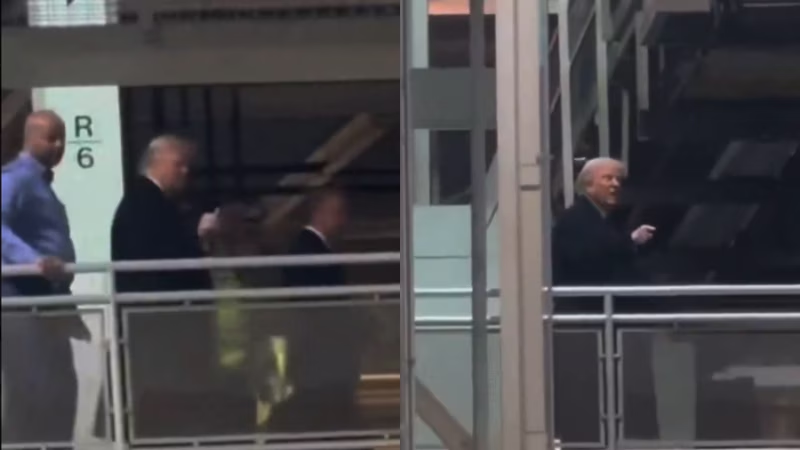
In a moment that instantly went viral, former President Donald Trump was filmed reacting with visible fury—and a raised middle finger—to a heckler during a campaign visit to a Ford plant in Michigan. The protester, identified as a Ford assembly line worker, shouted “pedophile protector!” as Trump walked past, referencing the ongoing controversy surrounding the disgraced financier Jeffrey Epstein. The video, captured by multiple news outlets, shows Trump turning back, yelling an expletive, and extending his middle finger before security ushered him away . This explosive encounter has reignited national debate over accountability, political decorum, and Trump’s historical association with Epstein.
Table of Contents
- The Incident Unfolds: What Happened in Michigan?
- Who Was the Heckler? A Ford Worker Speaks Out
- Trump-Epstein Ties Revisited: Separating Fact from Fiction
- Political Reactions: Bipartisan Condemnation and Defense
- Could This Hurt Trump’s Campaign?
- Historical Context: Protests at Presidential Rallies
- Conclusion: A Symbol of America’s Deepening Divide
- Sources
The Incident Unfolds: What Happened in Michigan?
On January 13, 2026, Trump visited the Ford Rouge Electric Vehicle Center in Dearborn, Michigan—a key swing state—as part of his 2028 presidential campaign outreach. While touring the facility, he passed a group of employees behind a safety barrier. One man, later identified as Marcus Johnson, a 12-year Ford veteran, shouted, “You’re a pedophile protector!” according to eyewitnesses and video footage . Within seconds, Trump halted, turned around, and responded with a sharp “F*** you!” while raising his middle finger—a gesture captured clearly by CNN and local affiliates . Secret Service agents quickly moved him forward, but the damage was done. Social media erupted within minutes.
Who Was the Heckler? A Ford Worker Speaks Out
Marcus Johnson, 42, told reporters he acted out of moral conviction. “I have daughters,” he said in a brief interview with The Detroit Free Press. “I couldn’t stand there silently while someone who enabled monsters like Epstein gets cheered like a hero.” Johnson confirmed he had no prior activist affiliations but stated he’d been disturbed by recent congressional hearings into Epstein’s network, which included figures from both major parties—but notably referenced Trump’s past praise of Epstein as a “terrific guy” in a 2002 New York magazine profile . Ford Motor Company declined to comment, citing employee privacy.
Trump-Epstein Ties Revisited: Separating Fact from Fiction
The heckler’s accusation hinges on a complex and often-misrepresented history:
- Social Association: Trump and Epstein were known to socialize in the late 1990s and early 2000s in Palm Beach and New York. Flight logs show Trump never flew on Epstein’s “Lolita Express,” unlike Bill Clinton .
- Public Statements: In 2002, Trump called Epstein a “terrific guy” who “likes beautiful women as much as I do.” But by 2008, after Epstein’s first conviction, Trump claimed they’d had a falling out and hadn’t spoken in years .
- No Legal Charges: Despite numerous investigations, Trump has never been accused of criminal conduct related to Epstein. The Department of Justice has not named him as a co-conspirator or person of interest in any trafficking case .
Nonetheless, the phrase “pedophile protector” reflects a broader public perception—fair or not—that powerful figures shielded Epstein for decades.
Political Reactions: Bipartisan Condemnation and Defense
Reactions split sharply along partisan lines:
- Democrats: Senator Elizabeth Warren called the gesture “unpresidential” and “a window into his character.” The Biden campaign issued a statement urging “leaders to model decency, not rage.”
- Republicans: Trump allies dismissed the incident as “provoked” and praised his “authenticity.” House Speaker Mike Johnson said, “He’s just telling the truth—liberal mobs are trying to silence him.”
- Neutral Observers: The Brookings Institution noted that such confrontations reflect a dangerous erosion of civil discourse in American politics .
Could This Hurt Trump’s Campaign?
While Trump’s base may see the outburst as “fighting back,” independents and suburban voters—critical in swing states like Michigan—could be alienated. A Reuters/Ipsos poll from December 2025 showed 68% of unaffiliated voters view public displays of anger by candidates as “disqualifying.” However, Trump’s team is likely betting that the incident will energize his core supporters, framing it as resistance against “elitist attacks.” For deeper analysis on voter sentiment, see our report on [INTERNAL_LINK:how-controversial-moments-affect-election-outcomes].
Historical Context: Protests at Presidential Rallies
Heckling at political events is not new. In 2016, Bernie Sanders was interrupted by Black Lives Matter activists. In 2004, George W. Bush faced anti-war protesters. But what makes the Trump middle finger incident unique is the candidate’s direct, visceral retaliation—blurring the line between leader and combative citizen. This aligns with Trump’s long-standing brand of “anti-establishment” confrontation, but risks normalizing incivility at the highest levels of public life.
Conclusion: A Symbol of America’s Deepening Divide
The brief exchange in a Michigan factory—just seconds long—encapsulates the raw tension defining modern American politics. On one side, a citizen invoking moral outrage over historical complicity; on the other, a former president responding with unfiltered defiance. The Trump middle finger incident isn’t just about one gesture—it’s a flashpoint in a culture war where truth, accountability, and decorum are fiercely contested. As the 2028 race heats up, such moments may become more frequent, further testing the boundaries of democratic discourse.
Sources
- Times of India: Trump hurls abuse, shows middle finger to Ford worker
- CNN: Video: Trump flips off protester in Michigan
- The Detroit Free Press: Exclusive: Meet the Ford worker who confronted Trump
- U.S. Department of Justice: Epstein Case Documents Archive
- Brookings Institution: The Decline of Political Civility