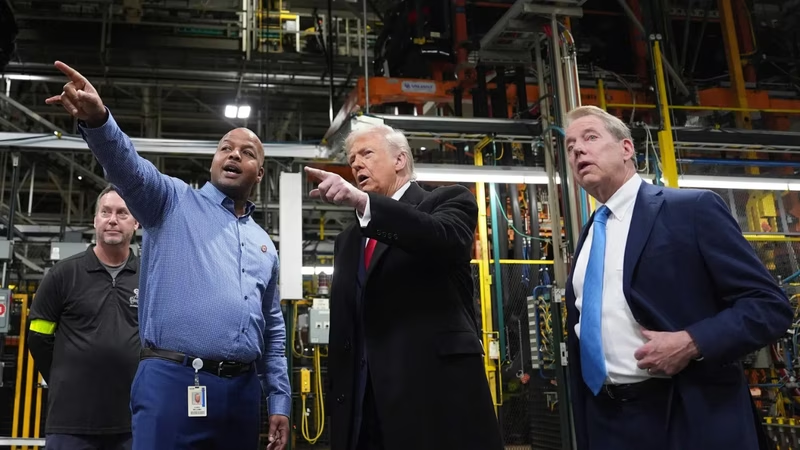
Hard hat on, sleeves rolled up, and standing proudly beside gleaming American-made trucks—Donald Trump returned to the factory floor this week in a calculated display of economic theater. His tour of the Ford Rouge Electric Vehicle Center in Dearborn, Michigan, wasn’t just a photo op. It was a full-throated revival of his signature Trump manufacturing agenda, aimed squarely at blue-collar voters who once powered his rise—and may hold the key to his political future.
With inflation still biting and recent election results hinting at voter fatigue over economic messaging, Trump’s message was clear: “I brought back jobs. I protected industry. And I’ll do it again.” But beneath the patriotic rhetoric lies a complex reality—of evolving auto markets, global supply chains, and a public increasingly skeptical of promises that sound more like reruns than roadmaps.
So what’s really driving this industrial pilgrimage? And does Trump’s vision for U.S. manufacturing still resonate in 2026?
Table of Contents
- Trump’s Manufacturing Agenda on Display in Michigan
- Economic Claims vs. Voter Reality: The Trust Gap
- Tariffs, Trade, and the Ford Factor
- EV Policy Shifts Complicate Trump’s Message
- Why Michigan Matters: The Electoral Stakes
- Expert Analysis: Is the Trump Manufacturing Agenda Still Viable?
- Conclusion: Nostalgia or Strategy?
- Sources
Trump’s Manufacturing Agenda on Display in Michigan
During his visit to the historic Ford plant—the same facility where he campaigned in 2016—Trump hammered home core tenets of his Trump manufacturing agenda:
- “Buy American, Hire American”: He praised Ford for keeping production in the U.S., contrasting it with companies that “ship jobs overseas.”
- Tariff Defense: He reiterated support for steel and aluminum tariffs, claiming they “saved the auto industry.”
- Energy Independence: He linked manufacturing strength to fossil fuel expansion, downplaying green transitions.
“Under my watch, factories came roaring back,” Trump declared to workers and reporters. “Now they’re trying to shut them down with regulations and electric mandates. Not on my watch!”
Economic Claims vs. Voter Reality: The Trust Gap
While Trump touts record-low unemployment and pre-pandemic growth during his term, many voters remain unconvinced. A January 2026 Pew Research poll found that only 39% of Americans believe the economy is heading in the right direction—with cost of living cited as the top concern across party lines .
In Michigan—a state that flipped narrowly in 2024—auto workers are torn. Many credit Trump-era tax cuts and deregulation for short-term gains, but worry about long-term competitiveness in an EV-dominated future. “He talks about jobs, but the world is changing,” said one UAW member who asked to remain anonymous. “We need training, not just slogans.”
Tariffs, Trade, and the Ford Factor
Trump’s reliance on tariffs remains central to his economic pitch. He claims his 25% steel tariffs protected U.S. mills and lowered input costs for automakers. Yet data tells a mixed story:
- Ford’s stock rose during Trump’s term but has since lagged behind Tesla and Rivian in EV innovation.
- U.S. auto production did increase post-2017, but much of the gain came from foreign-owned plants (e.g., Toyota, Honda) already operating stateside.
- Retaliatory tariffs from the EU and China hurt U.S. agricultural and machinery exports—hurting rural voters Trump once relied on .
Still, Ford’s decision to keep the F-150 Lightning EV in Michigan (after initially considering Mexico) gives Trump a tangible win to showcase.
EV Policy Shifts Complicate Trump’s Message
Here’s the irony: Trump is now praising a plant building electric vehicles—despite having mocked EVs as “ridiculous” and vowing to end Biden’s “EV mandate.”
This apparent contradiction highlights a strategic pivot. Rather than reject EVs outright, Trump is reframing them: “If we’re going to make electric cars, they’ll be made in America—with American steel, American batteries, and American workers.”
It’s a subtle but significant shift—one that acknowledges market reality while preserving his nationalist branding. For deeper insights, see our analysis on [INTERNAL_LINK:how-us-auto-policy-is-evolving-post-2024].
Why Michigan Matters: The Electoral Stakes
Michigan isn’t just any industrial state—it’s a bellwether. With 15 electoral votes and a diverse mix of urban, suburban, and rural voters, it’s ground zero for the battle over working-class allegiance.
Trump won Michigan in 2016 by less than 11,000 votes. He lost it in 2020 and 2024 by narrow margins. His 2026 strategy hinges on convincing disaffected union households that only he can shield them from globalization and bureaucratic overreach.
Expert Analysis: Is the Trump Manufacturing Agenda Still Viable?
Economists are divided. Supporters argue that reshoring and tariff protectionism can rebuild industrial capacity. Critics counter that automation—not offshoring—is the real job killer, and that isolationist trade policies risk triggering inflation and supply shortages.
“You can’t manufacture your way back to the 1950s,” says Dr. Lena Chen, an economist at Brookings Institution. “The future is in high-skill manufacturing, clean tech, and integrated global supply chains—not walls” .
Conclusion: Nostalgia or Strategy?
Trump’s Ford plant tour is more than a campaign stop—it’s a symbolic recommitment to the Trump manufacturing agenda that defined his first term. Whether this message resonates in 2026 depends on voters’ willingness to trade economic nostalgia for pragmatic solutions in a rapidly changing world.
One thing is certain: as long as factories hum in the Midwest, manufacturing will remain the heartbeat of America’s political battles.
Sources
- Times of India. “Trump tours Michigan Ford plant; pushes manufacturing agenda”. https://timesofindia.indiatimes.com/business/international-business/donald-trump-tours-michigan-ford-plant-us-president-pushes-manufacturing-agenda-brushes-off-lingering-economic-fears/articleshow/126512807.cms
- Pew Research Center. “Public Views on the Economy, January 2026”. https://www.pewresearch.org/
- Brookings Institution. “The Future of U.S. Manufacturing Policy”. https://www.brookings.edu/