Table of Contents
- The Escalating Rhetoric Between Washington and Tehran
- What Was Operation Midnight Hammer?
- Why Iran Rejects Talks Under Threat
- The High Geopolitical Stakes for 2026
- Conclusion: A Dangerous Game of Brinkmanship
- Sources
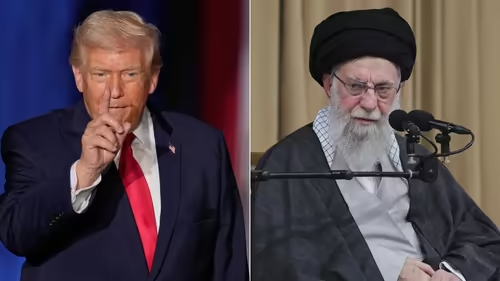
The geopolitical temperature in the Persian Gulf is rising again. In a move that has sent shockwaves through diplomatic circles, former President Donald Trump has issued a stark and unambiguous Trump Iran warning, declaring that any future military action against the Islamic Republic would be “far worse” than the devastating strikes of Operation Midnight Hammer. This aggressive posture comes at a time when [INTERNAL_LINK:middle-east-geopolitics] are already fraught with tension, leaving many to wonder if we are on the cusp of another major conflict.
The Escalating Rhetoric Between Washington and Tehran
Trump’s latest statement is not an isolated incident but a continuation of a high-stakes strategy of “maximum pressure.” He has publicly claimed that a massive US naval “Armada” is en route to the region, a clear show of force designed to compel Iran back to the negotiating table [[1]]. His message is simple: agree to a new, “equitable” deal that permanently strips Iran of its nuclear weapons capability, or face consequences of an unimaginable scale. This rhetoric is a deliberate echo of his first-term playbook, which saw the US withdraw from the JCPOA (the Iran nuclear deal) and impose crippling sanctions.
The timing of this Trump Iran warning is critical. It follows reports of internal unrest in Iran and growing international concern over its advanced uranium enrichment activities [[15]]. By framing the choice as one between diplomacy and total destruction, the Trump camp is attempting to box Tehran into a corner, hoping that the fear of overwhelming military power will override its long-standing resistance to US diktats.
What Was Operation Midnight Hammer?
To understand the gravity of Trump’s threat, one must look back at the June 2025 event he references: Operation Midnight Hammer. This was a large-scale, precision military operation conducted by the US Air Force and Navy, targeting key Iranian nuclear facilities, including the deeply buried Fordow site [[4], [6]]. The operation involved over 125 aircraft, a guided missile submarine, and dozens of support tankers, showcasing the full might of American military logistics and intelligence [[7]].
According to official US statements, the operation successfully “obliterated Iran’s nuclear capacity” [[2]]. While the true extent of the damage is debated, there’s no doubt it was a significant blow to Iran’s nuclear program. By invoking this operation, Trump is reminding the world—and especially Tehran—of America’s proven willingness and capability to execute such complex, high-risk missions. His promise of a “far worse” next attack suggests a potential escalation beyond just nuclear sites, possibly targeting the country’s broader military infrastructure or even its leadership.
Why Iran Rejects Talks Under Threat
Tehran’s response has been swift and resolute: a firm rejection of any negotiations. Iran’s Foreign Minister has stated unequivocally that talks are impossible in an “atmosphere of threats” [[8], [10]]. From the Iranian perspective, engaging in diplomacy while under the explicit threat of annihilation is not a negotiation; it is capitulation. They argue that genuine diplomacy requires mutual respect and a removal of coercive measures, not their intensification.
This stance is rooted in decades of mistrust between the two nations. Iran views the US as an unreliable partner that reneged on the JCPOA, and sees Trump’s current tactics as a form of blackmail. Their position is clear: they will not be coerced into a deal that sacrifices their national sovereignty and security interests. As one Iranian official put it, “negotiations don’t go along with threats” [[10]]. This creates a dangerous impasse where both sides are entrenched in their positions, with little room for compromise.
The High Geopolitical Stakes for 2026
The current standoff isn’t happening in a vacuum. The situation in 2026 is incredibly complex. The International Atomic Energy Agency (IAEA) has reported that Iran’s stockpiles of highly enriched uranium are sufficient to produce several nuclear warheads [[15]], a fact that fuels the urgency in Washington. Simultaneously, the US and its allies are pushing for the disarmament of Iran-backed groups across the region [[18]].
A new conflict would have catastrophic ripple effects:
- Global Oil Markets: Any disruption in the Strait of Hormuz would send oil prices soaring, impacting the global economy.
- Regional Alliances: Israel, Saudi Arabia, and other regional powers would be drawn into the conflict, potentially triggering a wider war.
- Humanitarian Crisis: The civilian cost of a major military campaign would be immense, creating a new wave of refugees and suffering.
For more on the economic implications, see our deep dive on [INTERNAL_LINK:global-oil-market-volatility]. The stakes couldn’t be higher, making this a pivotal moment for international diplomacy and security.
Conclusion: A Dangerous Game of Brinkmanship
The current exchange of threats between Trump and Tehran represents a perilous game of brinkmanship. The Trump Iran warning is a calculated gamble that the specter of a “far worse” Operation Midnight Hammer will force Iran’s hand. However, Iran’s principled stand against negotiating under duress suggests they may be willing to call that bluff. With a US “Armada” reportedly on the move and Iran’s nuclear program advancing, the window for a peaceful resolution is closing fast. The world can only hope that cooler heads prevail before this volatile situation spirals out of control. For authoritative insights on global security, the Council on Foreign Relations provides excellent ongoing analysis.
Sources
- [[1]] CNBC: “Trump warns Iran ‘armada’ is heading its way…”
- [[2]] The Jerusalem Post: “Donald Trump announces second US military armada…”
- [[4]] U.S. Congress: S.Res.307 – A resolution expressing the sense of…
- [[6]] Wikipedia: United States strikes on Iranian nuclear sites
- [[7]] Breaking Defense: “Operation Midnight Hammer: How the US conducted…”
- [[8]] Akhbar Al Yawm: “Iran rejects negotiations with US in ‘atmosphere of threats’…”
- [[10]] Asharq Al-Awsat: “Iran Rejects Negotiations with US in ‘Atmosphere of Threats’…”
- [[15]] Medium: “US–Iran Relations: 2026 — A New Geopolitical Order on a Powder Keg”
- [[18]] UK Parliament Library: “Iran: What challenges face the country in 2026?”