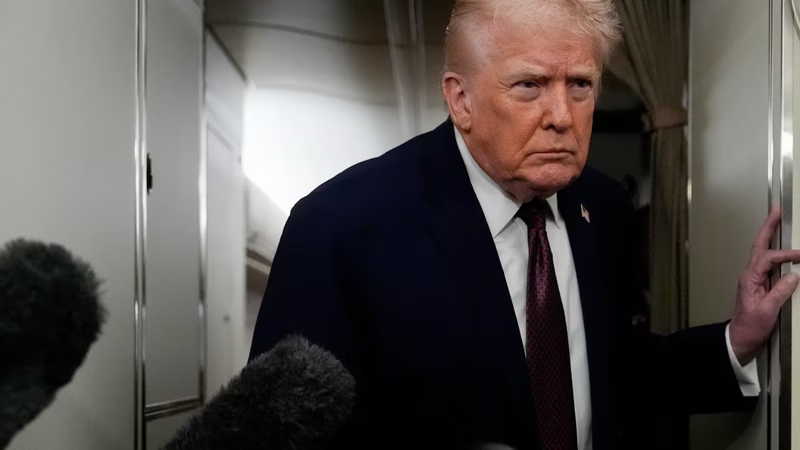
It started with Russia. Now, it’s Iran.
In a bold—and potentially destabilizing—move, former U.S. President Donald Trump has announced a new executive action imposing a **25% tariff on all goods imported into the United States from any country that trades with Iran**. Calling the directive “final and conclusive,” Trump framed it as a direct response to Tehran’s brutal suppression of anti-government protests and its alleged support for militant activities across the Middle East .
The announcement, made during a high-profile speech in Florida on January 10, 2026, marks a significant hardening of U.S. policy toward Iran—and sends shockwaves through global trade corridors. From China and India to Turkey and the UAE, dozens of nations could now face steep economic penalties simply for maintaining commercial ties with Tehran.
Table of Contents
- The Trump Iran Tariffs Explained
- Why Now? The Context Behind the Escalation
- Which Countries Are Most at Risk?
- Global Reactions and Economic Fallout
- Legal and Constitutional Questions
- Conclusion: A Dangerous New Chapter in US-Iran Relations
- Sources
The Trump Iran Tariffs Explained
Under the newly declared policy, any nation that exports goods to Iran—or imports Iranian oil, minerals, or manufactured products—will face an automatic **25% tariff** on all their exports to the United States. This is not a targeted sanction; it’s a blanket economic penalty designed to isolate Iran completely from the global trading system .
“If you do business with Tehran, you’re choosing Tehran over America,” Trump declared. “And there will be consequences.” He emphasized that the order is “final and conclusive,” suggesting no room for negotiation or exemption—even for traditional allies like South Korea or European Union members who have long sought to preserve limited trade under humanitarian carve-outs.
This goes far beyond existing U.S. sanctions. While previous administrations (including Trump’s first term) targeted specific Iranian entities or sectors, this new measure punishes third-party countries—a strategy reminiscent of “secondary sanctions” but applied through trade tariffs instead of financial blacklisting.
Why Now? The Context Behind the Escalation
The timing is no accident. In late December 2025, massive protests erupted across Iran following the death of a young activist in police custody. Security forces responded with live ammunition, internet blackouts, and mass arrests—drawing international condemnation .
Simultaneously, U.S. intelligence reports indicated that Iran was accelerating uranium enrichment and providing drones to Russian forces in Ukraine—actions Trump labeled “acts of war.” In his speech, he warned: “If Iran strikes one American base, they will pay a price they cannot imagine. They are nearing a red line.”
This dual threat—domestic repression and regional aggression—appears to have triggered Trump’s maximalist response. By targeting trade partners, he aims to cut off Iran’s last lifelines: oil revenue and access to critical technology.
Which Countries Are Most at Risk?
Several major economies could face immediate fallout:
- China: Iran’s largest trading partner, importing over $15 billion in oil annually—often disguised as Malaysian or Emirati shipments .
- India: Despite U.S. waivers in the past, India still purchases Iranian crude and exports pharmaceuticals and machinery.
- Turkey: A key conduit for Iranian gas and refined petroleum, with bilateral trade exceeding $10 billion in 2025.
- UAE: Dubai serves as a major transshipment hub for Iranian goods, including electronics and auto parts.
Even European firms operating under EU “blocking statutes” that prohibit compliance with U.S. extraterritorial sanctions may find themselves caught in the crossfire if their parent companies export to the U.S.
Global Reactions and Economic Fallout
Initial responses have been swift and critical:
- The **European Union** called the move “a dangerous overreach” that undermines multilateral diplomacy.
- **China’s Foreign Ministry** stated it “resolutely opposes unilateral sanctions” and vowed to protect its “lawful trade rights.”
- **India’s Commerce Ministry** expressed “deep concern” and hinted at potential WTO litigation.
Economically, the ripple effects could be severe. A 25% tariff on Chinese or Turkish goods would raise consumer prices in the U.S., fuel inflation, and disrupt supply chains already strained by geopolitical tensions. According to the Peterson Institute for International Economics, such a policy could cost the U.S. economy up to $80 billion annually in lost trade efficiency .
Legal and Constitutional Questions
Beyond economics, the order raises serious legal concerns. While presidents have broad authority under the International Emergency Economic Powers Act (IEEPA), applying tariffs based on a third country’s dealings with a sanctioned state may exceed statutory limits.
Legal scholars argue that Congress—not the executive—holds the constitutional power to regulate foreign commerce. As Brookings Institution fellow Thomas Wright notes, “This isn’t just aggressive foreign policy—it’s a potential power grab that courts may strike down” .
For more on how U.S. trade policy shapes global markets, see our analysis on [INTERNAL_LINK:us-trade-wars-global-impact].
Conclusion: A Dangerous New Chapter in US-Iran Relations
The Trump Iran tariffs represent more than economic policy—they’re a declaration of financial warfare. By threatening neutral nations with punitive duties, the U.S. risks alienating allies, empowering rivals like China, and pushing Iran deeper into isolation without guaranteeing behavioral change. While intended to protect American interests, this “final” ultimatum may instead ignite a broader trade conflict with unpredictable consequences for global stability.
Sources
- Times of India: First Russia, now Iran: Trump announces 25% tariffs on Tehran’s trade partners
- U.S. Department of Treasury: Iran Sanctions Overview
- Amnesty International: Iran: Security forces use lethal force against protesters
- International Energy Agency (IEA): Iran Energy Outlook 2025
- Peterson Institute for International Economics: The Economic Impact of U.S. Tariff Policy
- Brookings Institution: Executive Power and Trade Sanctions: Legal Limits