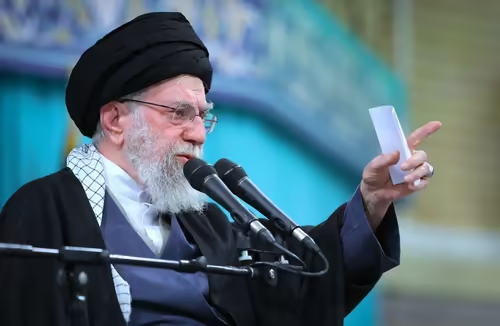
The Persian Gulf is a tinderbox, and a single spark could ignite a regional conflagration. In late January 2026, that spark appears to be President Donald Trump’s latest threat: a “beautiful armada” heading toward Iran, coupled with ominous hints of a decapitation strike on its most powerful figure, Supreme Leader Ayatollah Ali Khamenei [[1]]. The goal, according to reports, is nothing short of a Maduro-type attack on Iran to force regime change [[4]]. But what does this mean in reality, and what are the terrifying consequences?
Table of Contents
- The ‘Beautiful Armada’: A Show of Force
- The Khamenei Question: Targeting the Supreme Leader
- The Maduro Model: Is it Applicable to Iran?
- Regional Allies on Edge
- The Path Forward: Diplomacy or Disaster?
- Conclusion
- Sources
The ‘Beautiful Armada’: A Show of Force
On January 28, 2026, President Trump announced that a “massive armada” was en route to the Middle East, urging Iran to “make a deal” or face severe consequences [[5]]. This naval deployment is centered around the USS Abraham Lincoln carrier strike group, which has entered the region, significantly bolstering the US military presence [[18]]. The number of US warships in the area has reportedly swelled to ten, a clear and potent signal of American resolve [[20]].
This move is a classic show of force, designed to intimidate Tehran into concessions. However, such deployments are a double-edged sword. While they demonstrate power, they also dramatically increase the risk of an accidental clash that could spiral out of control.
The Khamenei Question: Targeting the Supreme Leader
The most alarming aspect of the current crisis is the direct threat to Iran’s leadership. Reports suggest the US is actively considering targeted strikes on top Iranian officials, with Khamenei himself as a potential target—a scenario described as a “Trump Iran strike” aimed at the heart of the regime [[4]].
However, the feasibility of such an operation is highly questionable. Iran’s Supreme Leader is one of the most heavily guarded individuals on the planet. In response to the escalating threats, credible reports indicate that Khamenei has been moved into a special, fortified underground shelter in Tehran, connected by a network of tunnels and under the protection of the elite Islamic Revolutionary Guard Corps (IRGC) [[9], [14]]. His security protocols are far more robust than those of leaders in other nations, making a successful strike an immense logistical and intelligence challenge.
The Maduro Model: Is it Applicable to Iran?
The White House’s apparent strategy draws a parallel with its approach to Venezuela, where efforts were made to oust President Nicolas Maduro. The idea of a “Maduro-type attack on Iran” implies a combination of crippling sanctions, support for internal opposition, and the threat of direct military action to inspire a popular uprising [[4]].
Yet, this comparison is deeply flawed. Iran is not Venezuela. It is a nation with a long history of resistance to foreign intervention, a powerful and deeply entrenched security apparatus, and a population that, while critical of its government, is fiercely nationalistic and unlikely to welcome an overtly American-backed coup. The Iranian state’s ability to control information and suppress dissent is also far more sophisticated than Caracas’s [[15]]. As one analysis bluntly states, “Why Iran is not Venezuela” is a critical question that US strategists must answer [[28]].
Regional Allies on Edge
The prospect of a major military confrontation between the US and Iran has sent shockwaves through the region. Neighboring countries, already grappling with their own complex security challenges, are deeply concerned about the potential for catastrophic spillover.
- Saudi Arabia and Israel: While both nations share a deep animosity toward the Iranian regime, they are also acutely aware of the devastating consequences of a full-scale war. Reports indicate that Saudi and Israeli officials have been in talks with the US, likely urging caution [[8]].
- Gulf States: Nations like the UAE and Bahrain, which host significant US military assets, fear becoming primary targets for Iranian retaliation in the form of missile and drone attacks on their critical infrastructure [[25]].
The Path Forward: Diplomacy or Disaster?
The current trajectory is perilous. The combination of maximalist US demands, existential threats to the Iranian leadership, and a massive military buildup creates a perfect storm for miscalculation. History is replete with examples of how such standoffs can lead to unintended, large-scale conflict.
The only viable path away from the brink is a return to serious, high-level diplomacy. This would require both sides to step back from their most inflammatory rhetoric and actions. For the US, this means recognizing that regime change is not a realistic short-term objective and focusing instead on verifiable constraints on Iran’s nuclear program and regional activities. For Iran, it means demonstrating a willingness to engage in good faith and address legitimate international concerns. The alternative—a Trump Iran strike that triggers a wider war—is a scenario the world simply cannot afford. For more on the complexities of Middle Eastern geopolitics, see our analysis on [INTERNAL_LINK:middle-east-power-plays].
Conclusion
Trump’s “beautiful armada” is a stark symbol of American power, but it is also a dangerous gamble. The notion of a surgical strike on Khamenei is likely more bluster than a practical plan, given the immense security surrounding him. The comparison to Venezuela ignores the fundamental differences in state structure and national identity. The real danger lies not in the success of a decapitation strike, but in the high probability that any military action, however limited in intent, could trigger an uncontrollable cycle of escalation with devastating global consequences. The window for diplomacy is closing fast, and the stakes have never been higher.
Sources
- [[1]] The National News: US President Donald Trump has threatened Iran with a “beautiful armada”
- [[4]] Times of India: The Khamenei question: Can Trump’s ‘beautiful armada’ take out Iran’s Supreme Leader?
- [[5]] Institute for the Study of War: Iran Update, January 28, 2026
- [[7]] Daily Mail: Donald Trump’s chilling threat to Iran
- [[8]] The Independent: Iran latest: Trump considering strikes ‘to inspire protests’
- [[9]] Iran International: Khamenei hiding in underground shelter in Tehran
- [[14]] Ynetnews: Iran’s Khamenei moved to fortified Tehran bunker amid US threats
- [[15]] Iran Wire: Ali Khamenei’s Security Measures Much Higher Than Predecessor
- [[18]] Caspian Post: US–Iran Standoff Enters Dangerous Phase With Carrier Deployment
- [[20]] Instagram: The number of US warships deployed in the region has risen to ten
- [[25]] Facebook: Gulf Shield 2026 features a series of drills, tests, and simulated scenarios
- [[28]] Iran International: Why Iran is not Venezuela