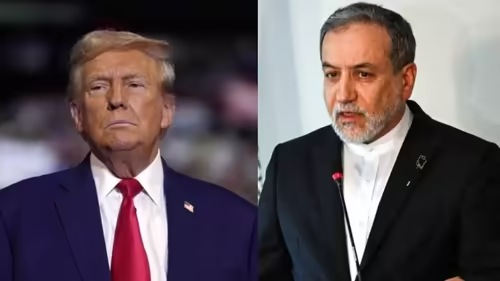
The fragile dance between Washington and Tehran just took another dramatic turn. Former President Donald Trump declared this week that Iran “does want to make a deal” to prevent potential U.S. military action—a bold claim that immediately drew a sharp rebuke from Tehran. The exchange underscores the deep mistrust and fundamentally different starting points that continue to block any path toward renewed Iran nuclear talks, even as regional tensions simmer and global powers watch closely [[2]].
Table of Contents
- Trump’s Claim: Iran Is Ready to Deal
- Tehran’s Firm Response: No Compromise on Missiles
- The Sticking Points in Iran Nuclear Talks
- Turkey’s Mediation Offer: A New Diplomatic Channel?
- Why This Standoff Matters for Global Security
- Conclusion: A Deal Remains Elusive
- Sources
Trump’s Claim: Iran Is Ready to Deal
Speaking at a campaign event, Trump asserted that Iranian leaders are privately signaling their willingness to negotiate a new agreement to replace the 2015 Joint Comprehensive Plan of Action (JCPOA), which he abandoned in 2018. “They do want to make a deal,” Trump said, suggesting that the threat of U.S. military force is compelling Tehran to the table [[2]]. Notably, he did not specify a deadline or outline what such a deal would entail—leaving his remarks open to interpretation and criticism.
This isn’t the first time Trump has used public statements to pressure Iran. His “maximum pressure” campaign, which included crippling sanctions and the assassination of Qasem Soleimani in 2020, aimed to force regime change or total capitulation. Yet, rather than bending, Iran accelerated its uranium enrichment and expanded its regional influence—suggesting that threats alone may not yield the desired outcome [[4]].
Tehran’s Firm Response: No Compromise on Missiles
Iran’s Foreign Minister, Abbas Araghchi, wasted no time in countering Trump’s narrative. In a strongly worded statement, he emphasized that any negotiation must be conducted “on equal footing and with mutual respect”—a clear rejection of the coercive diplomacy Trump champions [[2]]. More significantly, Araghchi drew a red line: “Iran’s missile capabilities and defense doctrine are not negotiable under any circumstances.”
This stance is consistent with Iran’s long-held position. For Tehran, ballistic missiles are not offensive weapons but essential deterrents against perceived threats from the U.S., Israel, and regional rivals like Saudi Arabia. Insisting on discussing them, Iranian officials argue, is tantamount to demanding unilateral disarmament—a non-starter [[6]].
The Sticking Points in Iran Nuclear Talks
Even if both sides expressed willingness to talk, major obstacles remain. The core issues blocking a return to the JCPOA—or a new framework—include:
- Sanctions Relief: Iran demands full, verifiable lifting of all U.S. sanctions before it reverses nuclear advances.
- Missile Program: The U.S. and allies insist Iran’s missile development must be curtailed; Iran refuses categorically.
- Regional Activities: Washington wants limits on Iran’s support for groups like Hezbollah and the Houthis; Tehran views this as interference in sovereign affairs.
- Guarantees: Iran seeks ironclad assurances that a future U.S. administration won’t abandon the deal again.
[INTERNAL_LINK:iran-nuclear-deal-history] Without movement on these fronts, any “deal” remains theoretical. Trump’s rhetoric may signal openness, but without concrete proposals, it risks being seen as political posturing ahead of the 2026 election.
Turkey’s Mediation Offer: A New Diplomatic Channel?
Amid the verbal sparring, Turkey has emerged as a potential bridge. Ankara, which maintains working relationships with both Washington and Tehran, has formally offered to mediate talks [[2]]. Turkish President Recep Tayyip Erdoğan has long advocated for regional dialogue and sees an opportunity to boost his country’s diplomatic clout.
While past mediation efforts by European powers have stalled, Turkey’s unique position—geographically, economically, and politically—could provide a neutral venue. However, success would require both sides to genuinely commit to compromise, not just use the channel for propaganda.
Why This Standoff Matters for Global Security
The U.S.-Iran impasse isn’t just a bilateral issue. It affects oil markets, regional stability in the Middle East, and the credibility of global non-proliferation efforts. With Iran enriching uranium to near-weapons-grade levels and the U.S. bolstering its military presence in the Gulf, the risk of miscalculation is real.
A breakdown in diplomacy could lead to either a covert conflict or, worse, open warfare—with catastrophic humanitarian and economic consequences. Conversely, a successful negotiation could de-escalate tensions and revive hopes for a more stable Middle East.
Conclusion: A Deal Remains Elusive
Trump’s assertion that Iran “wants a deal” may reflect wishful thinking more than reality. Tehran’s response—firm, principled, and uncompromising on core security issues—shows that any path to Iran nuclear talks will require far more than public declarations. It will demand genuine diplomacy, mutual concessions, and a willingness to move beyond the cycle of threats and defiance. Until then, the world remains on edge, watching as two nuclear-capable powers circle each other in a high-stakes game of brinkmanship.
Sources
- [[2]] Times of India: ‘They do want to make a deal’: Trump says Iran ready for nuclear talks — how Tehran responded
- [[4]] Council on Foreign Relations: U.S.-Iran Nuclear Deal Timeline
- [[6]] International Crisis Group: Why Iran’s Missiles Are Non-Negotiable