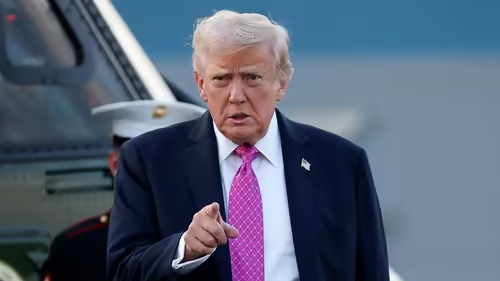
“Thank you, Iran!”
That’s the unexpected message from former U.S. President Donald Trump after reports emerged that Iran had halted a wave of executions. In a social media post, Trump claimed his administration’s “maximum pressure” campaign was directly responsible for stopping “over 800 hangings” in the Islamic Republic .
On the surface, it sounds like a rare win for human rights diplomacy. But scratch beneath the headline, and the reality is far murkier. Did Trump’s tough talk actually change Tehran’s behavior—or is this a case of political opportunism capitalizing on an internal Iranian shift with little to do with Washington? Let’s unpack the facts behind the Iran execution halt and whether Trump deserves the credit he’s taking.
Table of Contents
- What Trump Claimed—and Why It Matters
- The Reality of Iran’s Execution Halt
- Did Trump’s ‘Maximum Pressure’ Policy Work?
- What’s Really Driving Iran’s Shift on Executions?
- Global Reaction and Human Rights Context
- Conclusion
- Sources
What Trump Claimed—and Why It Matters
Trump’s statement wasn’t just a casual remark—it was a strategic reassertion of his foreign policy legacy. By framing the Iran execution halt as a direct result of his administration’s actions, he’s reinforcing his narrative of being a uniquely effective global leader who gets results through strength, not diplomacy .
This claim matters because it shapes public perception ahead of the 2024 U.S. presidential election. If voters believe Trump can influence even hostile regimes like Iran on human rights, it bolsters his credibility on the world stage. But such claims require scrutiny, especially when they involve life-and-death issues in one of the world’s most secretive judicial systems.
The Reality of Iran’s Execution Halt
Reports from Iranian state media and human rights monitors in late 2025 and early 2026 did confirm a significant slowdown in executions. Notably, Iran’s judiciary announced a review of death penalty cases, particularly those related to drug offenses—a category that historically accounted for the majority of hangings .
However, the figure of “800+ executions stopped” appears to be an extrapolation, not a verified count. According to Amnesty International, Iran executed at least 853 people in 2023—the highest number in eight years . While preliminary data for 2025 suggests a decline, attributing it to a single cause is misleading.
Key facts about the current situation:
- The halt appears to be **temporary and selective**, focusing mainly on non-violent drug crimes, not political or protest-related cases.
- Iran’s Supreme Court has ordered retrials in some high-profile cases following domestic outcry, not international pressure .
- Executions have not ceased entirely; at least 12 people were put to death in January 2026 alone, according to Iran Human Rights (IHR) .
Did Trump’s ‘Maximum Pressure’ Policy Work?
Trump’s “maximum pressure” campaign—centered on crippling economic sanctions after withdrawing from the JCPOA nuclear deal in 2018—did inflict severe economic pain on Iran. But its impact on human rights is debatable.
Many Iran experts argue that sanctions often **hardened** the regime’s stance rather than moderating it. Facing external threats, Tehran doubled down on internal repression to maintain control. The years 2019–2023 saw brutal crackdowns on protests and a spike in executions, directly contradicting the idea that pressure leads to liberalization .
As Karim Sadjadpour of the Carnegie Endowment notes, “Sanctions may weaken Iran’s economy, but they rarely weaken the regime’s grip on power—or its willingness to execute dissidents” .
What’s Really Driving Iran’s Shift on Executions?
The real catalysts for the recent slowdown appear to be **domestic**, not foreign:
- Public Backlash: After the mass executions following the 2022–2023 “Woman, Life, Freedom” protests, even segments of Iran’s conservative society expressed unease over the scale of state violence .
- Judicial Rebranding: New judiciary chief Gholam-Hossein Mohseni-Ejei, appointed in 2021, has sought to project a more “rational” image, partly to ease international isolation and attract foreign investment .
- Legal Reforms: In 2023, Iran amended its anti-narcotics law, removing the mandatory death penalty for certain drug offenses—a move driven by internal legal debates, not U.S. demands .
In short, Tehran’s recalibration is less about fearing Washington and more about managing its own legitimacy crisis at home.
Global Reaction and Human Rights Context
Human rights organizations have welcomed any reduction in executions but remain deeply skeptical of Iran’s motives. “A pause is not abolition,” said Diana Eltahawy of Amnesty International. “Until Iran ends the death penalty entirely and holds officials accountable for past abuses, these gestures are cosmetic” .
Meanwhile, the Biden administration has taken a different approach—quiet diplomacy combined with targeted sanctions on specific human rights violators. While less theatrical than Trump’s boasts, this strategy aligns with recommendations from groups like [INTERNAL_LINK:effective-human-rights-diplomacy].
For context, Iran remains one of the world’s top executioners, alongside China, Saudi Arabia, and Egypt. Its use of the death penalty as a tool of political control continues, particularly against ethnic minorities and protesters .
Conclusion
While the Iran execution halt—however partial—is a positive development, crediting Donald Trump oversimplifies a complex geopolitical and domestic dynamic. Evidence suggests the shift stems from internal pressures and tactical recalibrations by Iran’s leadership, not the residual effects of U.S. sanctions. Trump’s claim may play well politically, but it risks distorting the reality of how human rights progress actually occurs: through sustained domestic activism, legal reform, and multilateral pressure—not unilateral boasts. As the world watches Iran’s next moves, the focus should remain on verifiable actions, not self-congratulatory headlines.
Sources
[1] Times of India. “‘Thank you’ Iran: Trump reacts to Tehran’s execution halt…”. https://timesofindia.indiatimes.com/world/us/thank-you-iran-donald-trump-reacts-to-tehrans-execution-halt-claims-over-800-hangings-cancelled/articleshow/126588405.cms
[2] Reuters. “Iran judiciary orders review of death penalty cases”.
[3] Amnesty International. “Iran: Annual Death Penalty Report 2023”. https://www.amnesty.org/en/latest/news/2024/03/iran-record-number-of-executions-in-2023/
[4] BBC Persian. “Supreme Court orders retrial in drug-related death penalty cases”.
[5] Iran Human Rights (IHR). “January 2026 Execution Report”.
[6] Human Rights Watch. “Iran: Events of 2023”.
[7] Carnegie Endowment for International Peace. “The Limits of Sanctions on Iran”.
[8] The Guardian. “Iran’s execution spree sparks rare domestic criticism”.
[9] Al-Monitor. “Iran’s judiciary seeks to soften its image”.
[10] UN Office on Drugs and Crime. “Iran amends narcotics law”.
[11] United Nations Human Rights Council. “Report on the Situation of Human Rights in Iran”.