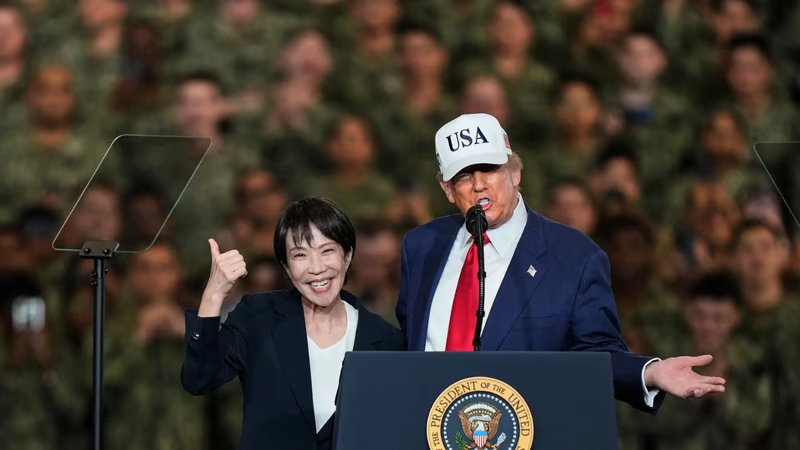
In a move that reshapes the geopolitical chessboard, former US President Donald Trump has extended a formal invitation to Japanese Prime Minister Sanae Takaichi for a state visit to the United States this spring—potentially as early as late March 2026. This isn’t just a routine diplomatic courtesy; it’s a calculated signal of renewed commitment to one of the world’s most critical strategic partnerships, with the Indo-Pacific firmly at its core . As China’s influence grows and regional flashpoints multiply, the Trump-Takaichi alliance could become the linchpin of a new security architecture built on democratic solidarity and economic resilience.
Table of Contents
- The Trump-Takaichi Call: Setting the Stage
- Why the Indo-Pacific Matters Now More Than Ever
- Takaichi’s Taiwan Stance and Regional Implications
- What to Expect from the Spring Summit
- The Role of “Like-Minded Nations” in Countering Coercion
- Strategic Ramifications for the Global Order
- Conclusion: A New Chapter in Alliance Diplomacy
- Sources
The Trump-Takaichi Call: Setting the Stage
Following a high-level telephone conversation on January 2, 2026, both leaders confirmed their mutual intent to deepen cooperation . Prime Minister Takaichi told reporters that she and Trump “confirmed the strength of the Japan-US alliance and agreed to promote a free and open Indo-Pacific” . The timing is no coincidence—coming on the heels of Takaichi’s recent public remarks on Taiwan and amid escalating maritime disputes in the East and South China Seas. This call wasn’t just about scheduling a visit; it was a strategic alignment of vision and urgency.
Why the Indo-Pacific Matters Now More Than Ever
The Indo-Pacific—spanning from the eastern shores of Africa to the western coasts of the Americas—is the world’s most dynamic economic corridor and its most contested security theater. Home to over 60% of the global population and generating nearly two-thirds of global GDP, its stability is non-negotiable for democratic nations .
A “free and open Indo-Pacific,” a phrase championed first by Japan and later adopted by the US, rests on three pillars:
- Rule of law and freedom of navigation: Ensuring international waters remain open to all, not just the powerful.
- Economic connectivity: Promoting infrastructure and digital partnerships that aren’t debt traps.
- Security cooperation: Building interoperable defense networks among democratic allies.
For more on how this vision counters authoritarian expansionism, see the U.S. Department of State’s official Indo-Pacific strategy.
Takaichi’s Taiwan Stance and Regional Implications
Prime Minister Takaichi has notably taken a firmer stance on Taiwan than many of her predecessors, describing its security as “inseparable from Japan’s own” in recent statements . While Japan maintains its official “One China” policy, her rhetoric reflects a growing consensus in Tokyo: a Chinese military action against Taiwan would destabilize the entire region and directly threaten Japanese interests. Trump, known for his transactional but assertive foreign policy, appears to welcome this alignment. Their upcoming meeting will likely explore tacit coordination on deterrence, even if formal military commitments remain off the table.
What to Expect from the Spring Summit
The proposed visit—reportedly slated for late March—could yield several concrete outcomes:
- Joint Statement on Indo-Pacific Security: A reaffirmation of the U.S.-Japan Security Treaty with explicit reference to maritime challenges.
- Technology and Supply Chain Pacts: Agreements on semiconductors, AI governance, and critical mineral partnerships to reduce reliance on adversarial economies.
- Trilateral Coordination Boost: Enhanced cooperation with third partners like Australia, India (via the Quad), or even South Korea.
The Role of “Like-Minded Nations” in Countering Coercion
Both leaders emphasized “cooperation among like-minded countries” as a cornerstone of their Indo-Pacific strategy . This isn’t just diplomatic jargon—it’s a deliberate framework to build a coalition of democracies that share values on trade, human rights, and security. Nations like India, Australia, the Philippines, and even the UK are expected to play increasingly coordinated roles. The goal? To create a resilient network that can collectively resist economic coercion and military intimidation.
Strategic Ramifications for the Global Order
A strengthened Trump-Takaichi alliance sends a clear message to Beijing: unilateral dominance in the Indo-Pacific will be met with united democratic resistance. It also challenges the narrative that U.S. engagement in Asia is waning. For Japan, it’s an opportunity to step out of America’s shadow and assert itself as a proactive security architect. For Trump, it’s a chance to cement a legacy as a builder of strategic alliances—even outside traditional NATO frameworks.
Conclusion: A New Chapter in Alliance Diplomacy
The invitation from Trump to Takaichi is far more than a photo op in the making. It’s a strategic recalibration at a pivotal moment. As the Indo-Pacific becomes the epicenter of 21st-century power competition, the U.S.-Japan bond is evolving from a patron-client relationship into a true partnership of equals. The spring summit could mark the beginning of a new era—one where democratic resilience, not authoritarian coercion, defines the region’s future. [INTERNAL_LINK:quad-alliance-indo-pacific] explores how this fits into broader multilateral efforts.