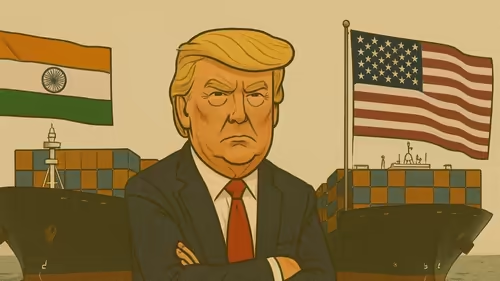
The world of international trade is abuzz with a single, powerful statement from none other than US President Donald Trump. At the World Economic Forum in Davos, Trump confidently declared, “We’re going to have a good deal” with India, injecting a fresh wave of optimism into the long-stalled negotiations between the two economic giants . This isn’t just another diplomatic nicety; it’s a signal that a breakthrough may be on the horizon.
But what’s behind this sudden surge of confidence? And what does it mean for businesses, investors, and the average citizen in both countries? Let’s dive deep into the details of this potential landmark agreement.
Table of Contents
- Trump’s Davos Declaration and Praise for Modi
- The Long Road to an India-US Trade Deal
- What Could the Deal Actually Look Like?
- Why This Matters for Global Markets
- Conclusion: The Future of Bilateral Ties
- Sources
Trump’s Davos Declaration and Praise for Modi
President Trump didn’t just hint at progress; he made a direct and optimistic statement to Moneycontrol during his Davos 2026 appearance. He emphasized that the two nations are “on track” for a significant agreement . Central to his positive outlook is his personal rapport with Indian Prime Minister Narendra Modi, whom he repeatedly referred to as a “great friend” and a leader he holds in high regard .
This personal chemistry between the two leaders has often been cited as a key driver in navigating the complex political and economic landscapes of their respective countries. Trump’s praise for Modi isn’t new, but its timing—amidst active trade talks—suggests a strategic alignment at the highest levels .
The Long Road to an India-US Trade Deal
The path to a comprehensive India-US trade deal has been anything but smooth. For years, negotiations have been hampered by disagreements over tariffs, market access for dairy and agricultural products, and data localization policies. Both sides have accused the other of protectionism, leading to a stalemate that frustrated businesses on both continents.
However, recent developments suggest a thaw. Officials from both governments have confirmed they are “actively engaged” in finalizing the agreement, with a high-level call scheduled to push the process forward . The US Ambassador to India, Sergio Gor, has also expressed confidence that all outstanding differences will be resolved . This shift from public sparring to private negotiation is a classic sign that a deal is nearing completion.
What Could the Deal Actually Look Like?
While the full text of the agreement remains under wraps, experts and officials have dropped several clues about its potential scope. It’s widely expected to be a limited, initial pact rather than a sweeping, comprehensive treaty. This “first phase” approach is a common strategy to build trust and momentum.
Potential components of the deal could include:
- Tariff Reductions: India may agree to lower tariffs on a select list of US goods, such as medical devices and certain agricultural products, in exchange for concessions on Indian exports like textiles and gems & jewelry.
- Digital Trade Framework: Establishing clear rules for cross-border data flows and e-commerce, which is a critical issue for American tech giants operating in India.
- Intellectual Property Protections: Strengthening IP laws to provide greater security for US innovators and pharmaceutical companies.
Commerce Secretary Rajesh Agrawal has stated that India is “very close” to signing major trade deals not only with the US but also with the European Union, indicating a broader strategic pivot in New Delhi’s trade policy .
Why This Matters for Global Markets
A successful India-US trade deal would be a geopolitical and economic earthquake. It would solidify a strategic alliance between the world’s oldest and largest democracies, creating a powerful counterbalance in a multipolar world. For investors, it signals a more stable and predictable business environment in two of the world’s fastest-growing major economies.
Indian markets are already poised for a reaction, with analysts predicting a potential boost for export-oriented sectors . Furthermore, this deal comes at a time when India is also finalizing a historic pact with the EU, which would create a combined market of over 2 billion people . This dual-track strategy positions India as a central hub in the new global supply chain.
For the US, the deal offers access to a vast consumer market of 1.4 billion people and a reliable manufacturing partner, a key pillar of its efforts to diversify away from other regions. You can learn more about the broader implications of US trade policy on our [INTERNAL_LINK:us-trade-policy] page.
Conclusion: The Future of Bilateral Ties
President Trump’s confident assertion that a “good deal” is coming is more than just rhetoric. It’s a reflection of serious, behind-the-scenes progress between Washington and New Delhi. While challenges remain, the mutual desire for a stronger economic partnership, fueled by a strong personal relationship between the two leaders, has never been clearer.
If finalized, this India-US trade deal will mark a new chapter in bilateral relations, unlocking significant economic potential and reshaping the global trade landscape for years to come. The world will be watching closely as the final details are hammered out.
Sources
- Moneycontrol. “Davos 2026 | Trump to Moneycontrol: ‘We’re going to have a good deal with India’.” https://www.moneycontrol.com/news/world/davos-2026-trump-to-moneycontrol-were-going-to-have-a-good-deal-with-india-12987654.html
- The Times of India. “‘We’re going to have a good deal’: Trump shares update on India-US trade talks; praises PM Modi.” https://timesofindia.indiatimes.com/business/india-business/we-are-going-to-have-a-good-deal-donald-trump-shares-update-on-india-us-trade-talks-praises-pm-modi/articleshow/127014321.cms
- Reuters. “US Envoy Says Trade Deal Differences With India Will Be Resolved.” https://www.reuters.com/world/india/us-envoy-says-trade-deal-differences-with-india-will-be-resolved-2026-01-12/
- Bloomberg. “India, US actively engaged on trade deal; next call on Jan 13.” https://www.bloomberg.com/news/articles/2026-01-12/india-us-actively-engaged-on-trade-deal-next-call-on-jan-13