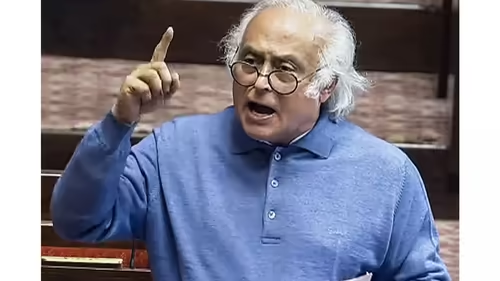
Political fireworks have erupted in New Delhi after former U.S. President Donald Trump once again claimed credit for averting a full-scale war between India and Pakistan in 2019. In response, the Congress party didn’t just push back—they mocked Prime Minister Narendra Modi with a biting jab: “Count now 70.”
The controversy centers on Trump’s repeated assertion that he personally intervened to stop a nuclear escalation between the two South Asian rivals following the Balakot airstrikes. But India has consistently maintained that no external mediation took place—and that its actions were sovereign, strategic, and entirely independent. Now, with Trump reviving the claim, opposition leaders are using it to question Modi’s foreign policy credibility and his much-touted “friendship” with the former U.S. leader.
Table of Contents
- What Did Trump Actually Say?
- India’s Official Stance: No Third-Party Mediation
- Congress Attacks Modi Over Trump Remarks
- The Politics of the Modi-Trump Friendship
- Why Trump’s Claim Doesn’t Hold Water
- Broader Implications for India-US Relations
- Conclusion: A Domestic Battle with Global Echoes
- Sources
What Did Trump Actually Say?
In a recent public appearance, Donald Trump reiterated a claim he first made in 2019: that he played a decisive role in de-escalating tensions between India and Pakistan after the Pulwama attack and India’s retaliatory airstrike on Balakot.
“I stopped a war,” Trump said. “Millions of people would have died… I called both [Modi and Imran Khan], and I got them to stand down.” He went on to describe himself as a “peacemaker” who saved the region from nuclear catastrophe .
This isn’t the first time Trump has made such a statement. Similar remarks in 2019 during a meeting with then-Pakistani PM Imran Khan sparked immediate denial from New Delhi. Yet, the latest repetition—amplified by global media—has reignited the debate, especially in an election-sensitive climate in India.
India’s Official Stance: No Third-Party Mediation
From day one, the Indian government has categorically rejected any notion of external mediation in its dealings with Pakistan. Following Trump’s initial 2019 comment, then-MEA spokesperson Raveesh Kumar stated plainly: “There is no such thing as Trump’s mediation.”
India’s position is rooted in decades of foreign policy doctrine: the Kashmir issue and India-Pakistan disputes are strictly bilateral matters. Allowing a third party—even a superpower like the U.S.—to mediate would undermine India’s sovereignty and set a dangerous precedent.
Moreover, Indian officials have pointed out that de-escalation in 2019 followed a carefully calibrated sequence of military and diplomatic moves by New Delhi itself—not a phone call from Mar-a-Lago. The capture and return of Wing Commander Abhinandan Varthaman, for instance, was framed as a gesture of peace by India, not a concession extracted by foreign pressure.
Congress Attacks Modi Over Trump Remarks
Seizing the moment, the Congress party launched a blistering critique of PM Modi. Senior leader Jairam Ramesh quipped on social media: “In 2019, Trump said he stopped a war between India and Pakistan. Modi remained silent. Today, Trump repeats it. Still silent? Count now 70.”
The “70” reference is a sharp allusion to the 70th anniversary of the U.S.-Pakistan alliance—a relationship India has long viewed with suspicion. The implication? That Modi’s silence legitimizes Trump’s narrative and indirectly aligns India with a U.S.-brokered framework that treats India and Pakistan as equals in conflict resolution, despite Pakistan’s history of sponsoring cross-border terrorism.
Congress leaders argue that Modi’s failure to publicly correct Trump—especially given their frequent photo-ops and declarations of “great friendship”—undermines India’s strategic autonomy and projects weakness on the global stage.
The Politics of the Modi-Trump Friendship
The Modi-Trump bromance was a centerpiece of India’s U.S. outreach between 2017 and 2020. From “Howdy, Modi!” rallies in Houston to White House handshakes, the optics were carefully curated to signal a new era in Indo-U.S. ties.
But this relationship had its contradictions. While Trump praised Modi as a “friend,” his administration also imposed tariffs on Indian steel, tightened H-1B visa rules affecting Indian tech workers, and, most controversially, floated the idea of mediating on Kashmir—something New Delhi found unacceptable.
Now, with Trump potentially returning to power in 2026, Indian policymakers face a dilemma: how to manage a leader whose transactional style and penchant for self-aggrandizement can distort diplomatic realities. The current controversy highlights the risks of over-personalizing foreign policy.
Why Trump’s Claim Doesn’t Hold Water
Experts and historians have widely dismissed Trump’s mediation narrative for several reasons:
- No official record: Neither the U.S. State Department nor Indian or Pakistani archives show evidence of a formal U.S.-led de-escalation process.
- Timeline mismatch: India’s de-escalatory move (returning Abhinandan) came before Trump’s reported calls, suggesting internal decision-making.
- Pakistan’s own stance: Even Imran Khan later clarified that Trump “offered” help but wasn’t actively mediating.
- Strategic autonomy: India’s military and diplomatic establishment operates on principles of non-alignment and self-reliance—especially in national security matters.
Broader Implications for India-US Relations
While the Biden administration has taken a more measured approach to South Asia, the Trump episode serves as a cautionary tale. It underscores the need for India to:
- Clearly articulate its red lines on third-party involvement in regional disputes.
- Diversify its strategic partnerships beyond personality-driven diplomacy.
- Strengthen institutional channels (not just leader-to-leader rapport) with key allies.
As [INTERNAL_LINK:india-us-strategic-partnership] evolves, managing unpredictable narratives from foreign leaders will remain a critical challenge.
Conclusion: A Domestic Battle with Global Echoes
At its core, the Trump India Pakistan conflict controversy is less about historical accuracy and more about political theater in India. The Congress is using Trump’s words to paint Modi as subservient to foreign powers, while the BJP defends his diplomatic pragmatism. But beyond the partisan noise lies a serious question: how should India navigate relationships with volatile global leaders without compromising its sovereignty? The answer will shape not just domestic politics, but India’s standing in the world for years to come.
Sources
- Times of India: Congress takes jibe at PM Modi over ‘good friend’ Trump’s Ind-Pak remarks
- Ministry of External Affairs, India: Response to Trump’s Mediation Remarks (2019)
- Brookings Institution: What Really Happened Between India and Pakistan in 2019?
- [INTERNAL_LINK:modi-trump-relationship-timeline]
- [INTERNAL_LINK:balakot-strike-aftermath-analysis]