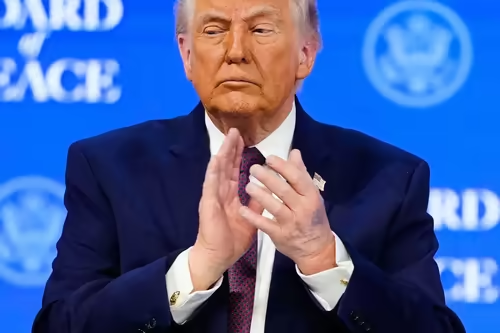
It was a moment that caught the world’s attention: a deep, unmistakable bruise on former President Donald Trump’s left hand during a high-profile signing ceremony in Davos. The image sparked a familiar wave of speculation and concern about his health. His response? A casual, “I clippled it,” and a quick pivot to his daily aspirin habit as the real reason for the dramatic discoloration [[1], [3]].
But for many, this brief explanation wasn’t enough. In an era where public trust is paramount, the incident has reignited a long-standing debate about transparency, aging leaders, and the very real medical side effects of common medications. So, what’s the truth behind the Trump hand bruise?
Table of Contents
- The Davos Incident and Trump’s Explanation
- The Science Behind Aspirin and Bruising
- A History of Health Transparency Concerns
- What Experts Say About Daily Aspirin Use
- Conclusion: Is the Aspirin Explanation Enough?
- Sources
The Davos Incident and Trump’s Explanation
The bruise became visible about ten minutes into the “Board of Peace” signing event in Switzerland, a stark contrast against Trump’s skin as he sat at the table . The internet, of course, exploded with theories—from a simple bump to something far more serious.
Trump’s team quickly moved to quell the rumors. He told reporters he had simply “clippled” his hand—a folksy term for a minor bump or scrape—and directly linked the severity of the bruising to his regular intake of a “big aspirin” [[3], [4]]. The White House later confirmed his statement, framing it as a straightforward case of a common medication side effect .
The Science Behind Aspirin and Bruising
Here’s the thing: Trump’s explanation is actually grounded in solid medical science. Aspirin, particularly when taken daily, is a well-known blood thinner. It works by inhibiting the function of platelets, the tiny blood cells responsible for clotting.
When your blood doesn’t clot as efficiently, even a minor impact can cause capillaries under the skin to break, leading to a bruise that is larger and more pronounced than it would be otherwise. This is a standard, documented side effect.
According to medical sources, “People taking daily aspirin therapy […] may notice more frequent or larger bruises” . Another source confirms, “Because aspirin helps to stop your blood from clotting, it can sometimes make you bleed more easily. For example, you may get nosebleeds and bruise more easily” . So, from a purely physiological standpoint, his claim holds water.
Common Side Effects of Daily Aspirin Therapy
Beyond bruising, daily aspirin use can come with a range of potential side effects:
- Gastrointestinal issues: Indigestion, stomach aches, and in severe cases, ulcers [[19], [20]].
- Increased bleeding risk: From minor cuts to more serious internal bleeding events .
- Kidney problems: A less common but serious potential side effect .
A History of Health Transparency Concerns
While the aspirin explanation is medically plausible, it lands in a context of deep-seated skepticism. Throughout his presidency and now his 2026 campaign, Trump has been notably opaque about his health. His campaign has yet to release any basic health data for the current election cycle .
This lack of transparency isn’t new. Historically, U.S. presidents have often obscured the full truth about their health, but in Trump’s case, the combination of his age and past incidents—like his battle with COVID-19 in 2020 —has made the public and press particularly vigilant. The recurring appearance of bruises on his hands between late 2024 and early 2025 has only fueled this ongoing narrative .
For many voters, the issue isn’t just about one bruise; it’s about a pattern of withholding information that they feel is crucial for a candidate seeking the highest office in the land. You can read more about the broader implications of this in our analysis on [INTERNAL_LINK:presidential-candidates-health-disclosure].
What Experts Say About Daily Aspirin Use
Medical experts generally agree that while low-dose aspirin (often 81mg) can be beneficial for certain individuals with a high risk of heart attack or stroke, it is not a one-size-fits-all solution. In fact, for many healthy older adults, the risks of bleeding can outweigh the potential benefits .
Trump’s reference to a “big aspirin” suggests he might be on a higher dose, which could further increase his susceptibility to bruising and other bleeding-related side effects . The key takeaway from the medical community is that such a regimen should always be managed and monitored by a physician, with a clear understanding of the individual’s specific risk factors.
Conclusion: Is the Aspirin Explanation Enough?
Medically speaking, yes. The link between daily aspirin use and easy bruising is a well-established fact. It’s entirely possible that a simple bump, amplified by his medication, caused the Trump hand bruise seen in Davos.
However, politically and in the court of public opinion, the explanation feels incomplete. It exists within a vacuum of broader health information that many Americans are demanding. Until there is greater transparency, every physical sign, no matter how innocuous its medical cause, will be scrutinized as a potential clue. The bruise itself may be from aspirin, but the controversy surrounding it is rooted in a much deeper issue of trust and accountability.
Sources
- Photos reveal deep bruise on Trump hand at Davos. Times of India.
- US President Donald Trump blamed a noticeable bruise on his left hand on his high intake of aspirin. Reuters.
- President Trump blamed a noticeable bruise on his left hand on his daily aspirin use. Associated Press.
- Age and health concerns about Donald Trump. The Guardian.
- What we know about Trump’s medical history. CNN.
- Trump’s Aspirin Dose and Hand Bruising Highlight Risks of Daily Therapy. JAMA Network.
- Can aspirin (acetylsalicylic acid) cause bruising? Mayo Clinic.
- Side effects of low-dose aspirin. NHS UK.
- Aspirin. MedlinePlus.