Introduction: When a ‘Joke’ Reveals a National Reflex
In 2019, Donald Trump shocked the world by suggesting the United States should buy Greenland. Denmark’s prime minister called the idea “absurd.” Pundits laughed it off as another presidential gaffe. But what if it wasn’t madness at all? What if the Trump Greenland threat—renewed in early 2026 amid Arctic security concerns—wasn’t an anomaly, but a modern echo of America’s oldest playbook: relentless territorial and strategic expansion?
From its colonial infancy to its superpower adolescence, the United States didn’t accidentally become a global hegemon. It engineered its rise through war, purchase, diplomacy, and ideological projection. Greenland—a vast, resource-rich Arctic island sitting atop key shipping lanes and military corridors—is precisely the kind of strategic asset America has historically coveted. Far from being “un-American,” Trump’s ambition is deeply, even uncomfortably, American.
Table of Contents
- The Trump Greenland Threat: What Happened?
- Trump Greenland Threat as Historical Continuity
- How America Grew: Land by Land
- Manifest Destiny in the 21st Century
- Why Greenland Matters Today
- Global Reactions and Sovereignty Concerns
- Is Expansionism Still America’s Default Mode?
- Conclusion: The Empire That Doesn’t Sleep
- Sources
The Trump Greenland Threat: What Happened?
In 2019, during a state visit planning session, Trump reportedly asked aides about purchasing Greenland, citing its strategic value. When Denmark (which handles Greenland’s foreign policy) rejected the notion, Trump canceled his Copenhagen trip, calling the idea “not ridiculous.” In early 2026, as Arctic ice melts and great-power competition intensifies, Trump revived the concept, this time framing it as a national security imperative.
While framed as real estate speculation, the subtext was clear: control of Greenland means control of the North Atlantic, missile defense corridors, rare earth minerals, and future sea routes. It’s less “buying an island” and more “securing a geopolitical fortress.”
Trump Greenland Threat as Historical Continuity
To dismiss Trump’s ambition as eccentric is to ignore America’s DNA. The U.S. has never been content with its borders. Its growth wasn’t organic—it was aggressive, calculated, and often unilateral. The Trump Greenland threat fits neatly into a 250-year pattern of expansionist behavior.
How America Grew: Land by Land
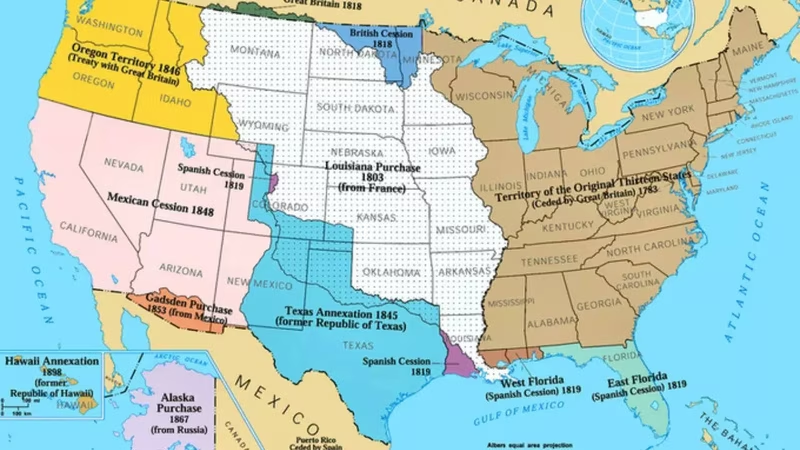
Consider the U.S. map in 1783: a narrow strip along the Atlantic. Today, it spans oceans and hemispheres. Here’s how it happened:
- 1803 – Louisiana Purchase: Bought 828,000 sq mi from France for $15 million—doubling the nation overnight.
- 1819 – Adams-Onís Treaty: Acquired Florida from Spain through diplomatic pressure.
- 1845–1854 – Texas Annexation & Mexican Cession: War with Mexico yielded California, Arizona, New Mexico, and more.
- 1867 – Alaska Purchase: “Seward’s Folly” bought from Russia for $7.2 million—now a critical Arctic stronghold.
- 1898 – Spanish-American War: Seized Puerto Rico, Guam, and the Philippines, launching America as a colonial power.
- 1946 – Attempted Purchase of Greenland: Yes, this isn’t new—President Truman offered Denmark $100 million post-WWII. They refused.
Each move was justified as “destiny,” “security,” or “civilization.” The methods varied—cash, cannon, or coercion—but the goal remained: more influence, more resources, more control.
Manifest Destiny in the 21st Century
“Manifest Destiny” was the 19th-century belief that America was divinely ordained to spread democracy across the continent. Today, that ideology has evolved—not disappeared. It now manifests as:
- Military Basing: Over 750 U.S. bases in 80+ countries, from Qatar to Okinawa.
- Economic Leverage: Using sanctions, trade deals, and dollar dominance to shape global policy.
- Strategic Acquisitions: Securing undersea cables, satellite orbits, and Arctic real estate.
Greenland, with Thule Air Base already hosting U.S. early-warning systems, is a natural next step in this continuum—whether through lease, partnership, or, in Trump’s vision, outright purchase.
Why Greenland Matters Today
Climate change is turning the Arctic into the new geopolitical hotspot:
- Shipping Lanes: The Northern Sea Route could cut Asia-Europe transit time by 40%.
- Rare Earth Minerals: Greenland holds vast deposits critical for EVs and defense tech.
- Military Positioning: Proximity to Russia and control over North Atlantic airspace.
China and Russia are already investing heavily. For the U.S., ceding influence here is not an option—hence the renewed interest.
Global Reactions and Sovereignty Concerns
Greenland is a self-governing territory of the Kingdom of Denmark, but its people have full control over natural resources and domestic policy. Many Greenlanders resent being treated as a commodity.
“We are not for sale,” declared former Greenlandic Premier Kim Kielsen in 2019. Still, some local politicians see U.S. investment as a path to greater independence from Copenhagen—a nuanced reality often missed in Western media.
For more on Arctic sovereignty, see our deep dive on [INTERNAL_LINK:arctic-geopolitics-and-resource-race].
Is Expansionism Still America’s Default Mode?
Not all Americans support this legacy. Critics call it imperialism disguised as benevolence. Yet, from the Monroe Doctrine to the Iraq War to AUKUS, the impulse to project power remains bipartisan.
What’s changed is the method: less outright annexation, more “strategic partnerships” and economic statecraft. But the end goal—extending American reach—endures.
Conclusion: The Empire That Doesn’t Sleep
The Trump Greenland threat isn’t a bizarre outlier. It’s a raw, unfiltered expression of America’s foundational instinct: to grow, to secure, to dominate. Whether through Jefferson’s diplomacy, Polk’s wars, or Trump’s blunt offers, the U.S. has always sought to shape the world in its image. Greenland may never fly the Stars and Stripes—but the fact that a U.S. president thinks it should tells us everything we need to know about the quiet, enduring engine of American power.