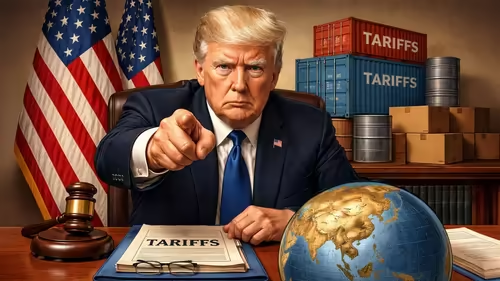
Donald Trump doesn’t just negotiate; he weaponizes trade. His recent threat to slap 10% tariffs on eight nations—including key European allies—over the remote Arctic island of Greenland isn’t just a bizarre headline. It’s a calculated demonstration of raw power that has sent shockwaves through global markets [[1], [2]]. And for India, which is in the final, delicate stages of its own India US trade deal, the message is as clear as it is urgent: never let a trade agreement compromise your strategic autonomy.
Table of Contents
- Trump’s Greenland Power Play: More Than Just Real Estate
- The EU in Crisis Mode: A Cautionary Tale
- Why India Must Pay Attention to the India US Trade Deal
- Defining Strategic Autonomy for India’s Trade Future
- Key Lessons for New Delhi’s Negotiators
- Conclusion: A Sovereign Path Forward
- Sources
Trump’s Greenland Power Play: More Than Just Real Estate
On the surface, Trump’s fixation on Greenland—a Danish territory rich in rare earth minerals and strategically positioned in the Arctic—seems like an eccentric billionaire’s whim. But his demand that Denmark provide “more military protection” for the island, backed by the threat of sweeping tariffs, reveals a deeper, more dangerous strategy . This isn’t about buying land; it’s about leveraging economic coercion to achieve geopolitical ends. The move builds on a pattern of aggressive trade actions Trump has rolled out since early 2025, using tariffs not as a last resort, but as a primary tool of statecraft .
The EU in Crisis Mode: A Cautionary Tale
The European Union’s response has been one of unified alarm. An emergency meeting of all 27 member states was called to formulate a counter-strategy, and officials have bluntly stated that their recently announced US trade deal is now “not possible at this stage” [[3], [6]]. This is the core vulnerability Trump exploits: the assumption that deep economic interdependence creates a shield against political aggression. The EU’s predicament proves otherwise. Their extensive trade relationship with the US has not granted them immunity; instead, it has become a point of leverage for Washington. For any nation, including India, this is a stark reminder that a trade pact is a contract, not a covenant of friendship.
Why India Must Pay Attention to the India US Trade Deal
India’s situation is strikingly parallel. After years of stalled talks, negotiations for the India US trade deal have recently accelerated. On January 15, 2026, India’s Commerce Secretary confirmed that negotiating teams are actively engaged in virtual talks, with an interim pact appearing “very near” [[7], [10], [12]]. While the mood in New Delhi is optimistic, the Greenland fiasco should inject a heavy dose of realism into the process. The US, under a potential second Trump term, has shown it will subordinate commercial agreements to its immediate strategic objectives. India must ask itself: what happens if a future US administration decides that a critical Indian policy—on Iran, Russia, or even its own domestic digital regulations—clashes with American interests? Would the trade deal be used as a bargaining chip?
Defining Strategic Autonomy for India’s Trade Future
This is where the concept of strategic autonomy in trade becomes non-negotiable. It’s not about isolationism or autarky. As experts define it, strategic autonomy is a state’s “ability to pursue its national interests and adopt its preferred foreign policy without depending heavily on other countries” . In practical trade terms, this means:
- Identifying and mitigating supply chain vulnerabilities in critical sectors like pharmaceuticals and electronics .
- Diversifying trade partnerships beyond a single dominant partner to avoid over-reliance .
- Maintaining regulatory independence to set its own standards on data, environment, and intellectual property, even if they differ from a trading partner’s.
The European Union’s own shift towards a policy of “Open Strategic Autonomy” underscores this global trend [[18], [21]]. They aim to be “open for business” while being “self-reliant in a number of strategic areas” . India must craft its own version of this doctrine.
Key Lessons for New Delhi’s Negotiators
As India’s trade team prepares for its final rounds of negotiation, they should keep these critical takeaways from the Greenland row in mind:
- Never Conflate Trade with Trust: A signed deal is a legal document, not a guarantee of political goodwill. The EU’s experience is proof.
- Bake in Flexibility: Ensure the agreement has clear, sovereign exit ramps or review clauses that allow India to act in its national interest without facing disproportionate penalties.
- Prioritize Diversification: Use the India US trade deal as one pillar of a broader strategy that includes strengthening ties with the EU, UAE, and ASEAN .
- Protect the Digital Realm: Given the US’s history of demanding data access, India must fiercely guard its digital sovereignty and the framework of its Digital Personal Data Protection Act.
Conclusion: A Sovereign Path Forward
Trump’s Greenland gambit is a masterclass in 21st-century power politics. It demonstrates that in a world of great-power competition, trade is just another battlefield. For India, the path forward is clear. The pursuit of an India US trade deal is economically sensible, but it must be anchored in an unwavering commitment to strategic autonomy. New Delhi’s negotiators must ensure that any agreement enhances India’s economic resilience without chaining its foreign policy freedom. The goal isn’t just a deal; it’s a deal that allows India to remain the master of its own destiny. To learn more about India’s evolving trade landscape, see our analysis on [INTERNAL_LINK:india-trade-policy-2026].
Sources
[1] “Trump threatens tariffs on 8 countries in push for Greenland,” Times of India.
[2] “Trump threatens 10pc tariff against UK, EU members,” Reuters.
[3] “EU set to halt U.S. trade deal over Trump’s latest tariff threat,” Financial Times.
[6] “EU Warns of Downward Spiral After Trump Threatens…,” QNA.
[7] “Engagements On, Negotiating Teams Talking Virtually,” The Economic Times, Jan 15, 2026.
[10] “India-US trade deal ‘very near’ but can’t put deadline,” India Shipping News, Jan 16, 2026.
[12] “India engaging with US online, trade deal likely soon, says commerce secy,” Business Standard, Jan 16, 2026.
[13] “How Budget 2026 can help India strike the right balance in…,” The Hindu.
[15] “Strategic autonomy in trade,” Peterson Institute for International Economics.
[18] “The EU Stuck Between Trade Openness and Strategic…,” Chatham House.
[19] “Strategic autonomy,” Oxford Research Encyclopedia of International Studies.
[21] “Open Strategic Autonomy – making Europe a stronger…,” European Commission.
[22] “Pursuing an Open Strategic Autonomy trade policy against…,” Bruegel.