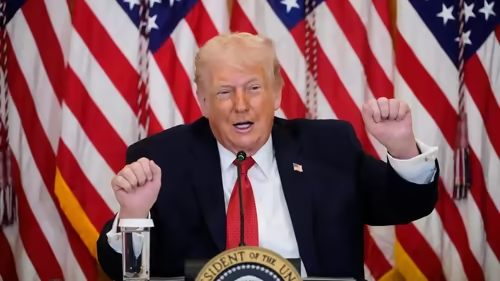
In a move that feels ripped from the pages of a geopolitical thriller, Donald Trump has reignited his long-standing desire for the United States to acquire Greenland, but this time with a potent new weapon: sweeping tariffs on European allies. The announcement of a Trump Greenland tariff isn’t just a trade policy; it’s a high-stakes ultimatum that could reshape transatlantic relations and send ripples through the global economy.
According to reports, Trump has declared a 10% import tax on goods from eight European countries, effective immediately, citing their opposition to his plan for US control of the Arctic island. The stakes are set to rise dramatically on June 1, 2026, when the tariff is slated to jump to a punishing 25%—unless Denmark agrees to a deal .
Table of Contents
- The Greenland Obsession: A Strategic Imperative
- The Trump Greenland Tariff: Mechanics and Targets
- Economic Fallout for Europe and the US
- Denmark’s Dilemma and Global Repercussions
- Conclusion: A New Era of Economic Coercion?
- Sources
The Greenland Obsession: A Strategic Imperative
Trump’s fixation on Greenland is not a new phenomenon, but its current framing as a matter of national security and a prerequisite for fair trade is unprecedented. His argument hinges on decades of what he perceives as inadequate “remuneration” from allies for the US security umbrella. He demands that Denmark “give back” for past subsidies, positioning the acquisition of Greenland as a form of long-overdue payment .
This perspective, however, ignores a deep and complex history. The strategic importance of Greenland to the United States dates back to World War II. In 1951, the US and Denmark signed a pivotal defense agreement, granting America the right to operate and establish military bases on the island, most notably the Thule Air Base . This base has been a cornerstone of US early-warning radar and space surveillance systems for decades. The relationship is formalized and based on mutual defense, not a transactional debt .
Today, Greenland’s value has only increased. It sits at the nexus of emerging Arctic shipping lanes, holds vast reserves of rare earth minerals critical for modern technology, and offers a commanding position in an increasingly contested polar region . For the US, maintaining influence there is a strategic imperative, but the idea of purchasing a sovereign territory from a NATO ally in the 21st century is a diplomatic non-starter for most of the international community.
The Trump Greenland Tariff: Mechanics and Targets
The core of this crisis is the newly announced Trump Greenland tariff. The policy is a blunt instrument of economic coercion designed to pressure not just Denmark, but a broader coalition of European nations perceived as standing in the way of American interests.
Key details of the tariff include:
- Initial Rate: A 10% tariff on a wide range of goods from eight European countries.
- Escalation Clause: The rate will increase to 25% on June 1, 2026, if no deal for Greenland is reached .
- Rationale: The tariff is explicitly tied to these nations’ opposition to US control of Greenland .
This approach marks a significant evolution in Trump’s use of tariffs. Previously used primarily as a tool to address perceived trade imbalances (like with China), they are now being wielded as a direct lever for territorial acquisition—a move that blurs the lines between trade policy and foreign policy in a dangerous way.
Economic Fallout for Europe and the US
The imposition of such tariffs would have immediate and severe consequences. Before recent trade skirmishes, the average US tariff rate on EU imports was a modest 1.47% . A sudden jump to 10% or 25% would be a massive shock.
For European exporters, the impact would be a direct squeeze on profit margins. While some of the cost might be absorbed by US importers and consumers, the overall effect would be a reduction in trade volume and increased prices for American shoppers . Historically, US tariffs on non-EU countries have led to trade diversion, which can deepen short-term economic losses in Europe .
Furthermore, the EU is unlikely to stand idle. The bloc has a history of retaliating with its own targeted tariffs, which could spark a full-blown transatlantic trade war. Such a conflict would disrupt global supply chains, dampen economic growth on both sides of the Atlantic, and create significant uncertainty for businesses and investors worldwide. The OEC Tariff Simulator even forecasts a potential 46% drop in global exports to the US by 2027 under aggressive tariff regimes .
Denmark’s Dilemma and Global Repercussions
Denmark finds itself in an impossible position. On one hand, it faces immense economic pressure from its largest ally. On the other, selling Greenland is politically and legally untenable. Greenland is a self-governing territory within the Kingdom of Denmark, and its people have consistently expressed a desire for greater autonomy, not a change of colonial master. Any attempt by Copenhagen to negotiate a sale would be met with fierce domestic opposition and a global outcry over the commodification of sovereign land.
The broader implications are even more alarming. By linking trade policy to a demand for territorial control, the US is setting a dangerous precedent. It signals to the world that economic power can be used to strong-arm smaller nations into ceding sovereignty. This undermines the very foundations of the rules-based international order that the US itself helped build after World War II. The phrase “world peace at stake,” while hyperbolic, captures the genuine fear that this kind of unilateral, coercive action can erode trust between allies and embolden other global powers to pursue their own aggressive agendas.
Conclusion: A New Era of Economic Coercion?
The Trump Greenland tariff ultimatum is more than a trade dispute; it’s a fundamental challenge to the norms of international diplomacy. It forces a choice between upholding the principle of national sovereignty and succumbing to raw economic power. While the immediate focus is on a remote Arctic island, the real battle is over the future of the global system. Will trade remain a tool for mutual benefit, or will it become the primary weapon in a new era of great-power coercion? The answer to that question will have far-reaching consequences for every nation on Earth.
Sources
- Times of India: ‘World peace at stake’: Trump charges Europe with 10% tariff; charged over Greenland control
- Strategic Importance of Greenland: Atlantic Council – Why Greenland Matters
- US-Denmark Defense Agreement: Foreign Relations of the United States, 1951
- Economic Impact of US Tariffs: J.P. Morgan Global Research – US Tariffs: What’s the Impact?