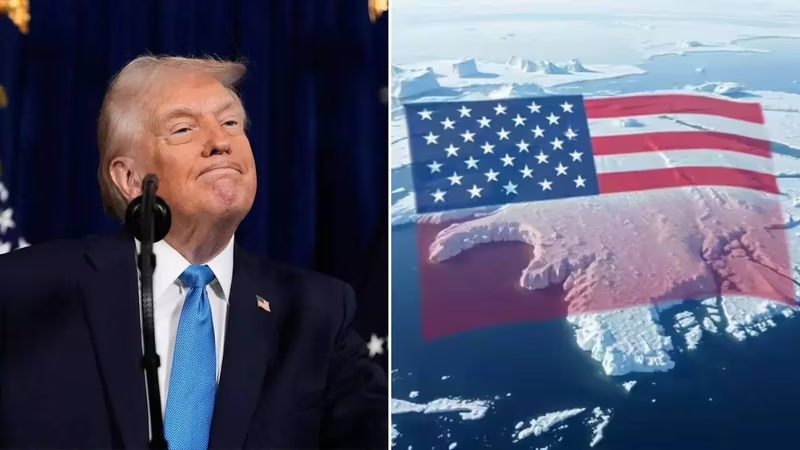
The Arctic just got a lot more tense. In a move that has shocked the international community, former U.S. President Donald Trump has doubled down on his long-standing desire to acquire Greenland, declaring the United States will take control of the island “one way or the other” . This stark statement isn’t just political bluster; it’s a direct challenge to the core principles of national sovereignty and international law, and the world is pushing back hard.
European leaders, led by Denmark’s Prime Minister Mette Frederiksen, have issued a unified and forceful rebuttal. Their message is clear: Greenland is not a piece of real estate to be bought or seized. It belongs to its people.
Table of Contents
- Trump’s Greenland Takeover Threat: A Rekindled Obsession
- The European and Danish Response: A Sovereignty Firewall
- Who Owns Greenland? Unpacking Its Unique Self-Governance
- NATO’s Arctic Stance: Security Through Collective Defense
- The Bigger Picture: Geopolitical Implications for the Arctic
- Conclusion: A Defining Moment for Arctic Sovereignty
- Sources
Trump’s Greenland Takeover Threat: A Rekindled Obsession
Trump’s fascination with Greenland isn’t new. During his first term, he floated the idea of purchasing the island, a proposal that was swiftly and famously rebuffed by Prime Minister Frederiksen as “an absurd discussion” . However, his recent comments have escalated from a curious inquiry to an overt threat. He has framed the Greenland takeover as a necessity for “world peace” and U.S. national security, even promising Greenlanders that America would “keep you safe, we will make you rich” . This paternalistic and transactional view of a self-governing territory has been met with widespread condemnation.
The European and Danish Response: A Sovereignty Firewall
Denmark’s response has been swift and unequivocal. Prime Minister Mette Frederiksen has publicly urged Trump to “stop the threats” over acquiring Greenland . She and other European leaders have jointly affirmed that any decisions regarding Greenland’s future must be made collectively by Denmark and Greenland itself, with the utmost respect for international law. The Danish government has made it clear that the United States has no right to annex the territory . This isn’t just a Danish issue; it’s a matter of principle for the entire European community, which sees such threats as a dangerous precedent that undermines the post-war international order.
Who Owns Greenland? Unpacking Its Unique Self-Governance
At the heart of this controversy is a fundamental misunderstanding of Greenland’s political status. Greenland is not a colony or a possession of Denmark in the traditional sense. Since 2009, it has been a self-governing country within the Kingdom of Denmark under the Self-Government Act . This act granted Greenland extensive autonomy over its internal affairs, including its natural resources, judicial system, and policing.
While Denmark retains control over foreign policy, defense, and monetary affairs, the path toward greater independence is a recognized and ongoing political process. The idea that a foreign power could simply take over this self-governing nation is not only illegal but also a profound insult to the Greenlandic people’s right to self-governance .
NATO’s Arctic Stance: Security Through Collective Defense
This dispute has immediate and serious implications for NATO, of which both the United States and Denmark are founding members. NATO has explicitly stated that the defense of the ‘High North’ is a strategic imperative for the alliance . However, this defense is predicated on the principle of collective security among its members, not on one member threatening to seize the territory of another.
In fact, an attack by one NATO ally on another would constitute a fundamental breach of the alliance’s core tenets . Instead, NATO’s strategy in the Arctic focuses on a holistic security approach that emphasizes cooperation among its Arctic member states—Norway, Denmark (for Greenland and the Faroe Islands), Iceland, Canada, and the United States—alongside its new members, Finland and Sweden . The alliance’s mission is to “prevent others from militarizing, uphold stability, [and] guarantee freedom of navigation” , a goal that is directly contradicted by Trump’s aggressive rhetoric.
The Bigger Picture: Geopolitical Implications for the Arctic
Trump’s Greenland takeover threat is a symptom of a larger geopolitical scramble for the Arctic. As climate change melts sea ice, the region is opening up to new shipping routes and vast, untapped reserves of oil, gas, and minerals. This has heightened strategic interest from global powers, not just the U.S., but also Russia and China.
However, the established framework for managing the Arctic has been one of peaceful cooperation through bodies like the Arctic Council. Trump’s unilateral and coercive approach threatens to destabilize this delicate balance and usher in a new era of great-power competition in one of the world’s most fragile environments. The unified European and NATO response is a clear signal that this path will not be tolerated.
Conclusion: A Defining Moment for Arctic Sovereignty
The controversy surrounding Trump’s Greenland takeover threat is far more than a bizarre political headline. It is a critical test of the international community’s commitment to the foundational principles of sovereignty and self-determination. The strong, coordinated pushback from Denmark, its European partners, and NATO itself demonstrates a resolve to defend the rules-based order in the Arctic. The message to any power with similar ambitions is clear: Greenland’s future will be decided in Nuuk and Copenhagen, not in Washington, D.C. The Arctic’s security and stability depend on respecting this fundamental truth.
Sources
[INTERNAL_LINK:greenland-politics]
[INTERNAL_LINK:nato-arctic-strategy]
Times of India: Greenland row: European leaders push back on Trump’s threat of US takeover
Government of Greenland: Self-Government Act
NATO: Defence of the High North is a strategic imperative