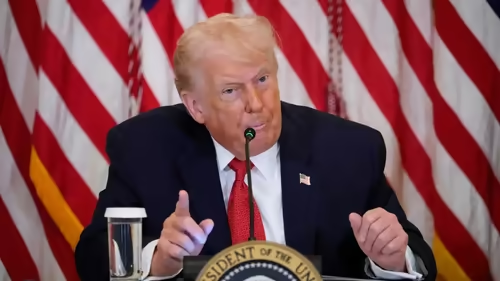
“It is time—and it will be done.”
With those five words, former President Donald Trump has reignited one of the most audacious—and widely ridiculed—foreign policy proposals of his presidency: the U.S. acquisition of Greenland. But this time, he’s not just floating a real estate idea. He’s framing it as a national security imperative, citing what he calls a looming Russian threat in the Arctic.
The renewed push comes on the heels of a U.S. military strike in Venezuela, adding to a pattern of assertive, transactional diplomacy that has defined Trump’s approach to global power. Yet the reaction from Copenhagen, Nuuk, and Brussels has been swift and unified: no sale.
Table of Contents
- What Trump Said About Greenland
- The ‘Russian Threat’ Argument
- Denmark and Greenland’s Firm Rejection
- Why Greenland Matters Strategically
- Historical Context of the Trump Greenland Proposal
- Global Reactions and Geopolitical Implications
- Conclusion: Is the Trump Greenland Dream Dead?
- Sources
What Trump Said About Greenland
In a recent statement that echoes his 2019 comments, Trump declared that acquiring Greenland is no longer just a possibility—it’s an inevitability. “It is time & it will be done,” he asserted, signaling a shift from suggestion to declaration .
He accused Denmark—the sovereign nation that governs Greenland’s foreign and defense policy—of failing to protect the island from external threats, particularly from Russia and China. According to Trump, this alleged negligence puts U.S. national security at risk, given Greenland’s proximity to North America and its strategic location in the Arctic Circle.
This isn’t the first time Trump has expressed interest in the world’s largest island. In 2019, he reportedly asked aides about purchasing Greenland, leading to a diplomatic spat that culminated in Denmark’s prime minister calling the idea “absurd.” Trump responded by canceling a state visit to Copenhagen—a move widely seen as petulant but revealing of his seriousness .
The ‘Russian Threat’ Argument
Trump’s latest pitch hinges on a growing concern among Western defense experts: increased Russian military activity in the Arctic. Russia has reopened Soviet-era air bases, expanded its icebreaker fleet, and conducted large-scale military drills above the Arctic Circle .
Greenland sits directly in this contested zone. The U.S. already operates Thule Air Base in northern Greenland—one of its most critical early-warning radar sites for missile defense. Trump argues that full control would allow the U.S. to better secure this asset and counterbalance Russian influence.
However, critics point out that Denmark and Greenland are NATO allies, and Thule operates under a 1951 defense agreement. There’s no evidence that Copenhagen is “failing” to address the Russian presence; in fact, Denmark has increased its own Arctic defense spending in recent years .
Denmark and Greenland’s Firm Rejection
Both the Danish government and Greenland’s self-governing administration have issued strong rebukes. “Greenland is not for sale,” said Danish Prime Minister Mette Frederiksen, echoing her 2019 response .
But the most powerful opposition is coming from Greenlanders themselves. Protests erupted in Nuuk, the capital, with citizens holding signs reading “We are not a commodity” and “Greenland belongs to Greenlanders.” The island, home to about 56,000 people—mostly Inuit—has been pushing for greater autonomy and eventual independence from Denmark.
For them, Trump’s proposal isn’t just offensive—it’s colonialist. As one protester told reporters: “We decide our future, not Washington or Copenhagen.”
Why Greenland Matters Strategically
Beyond the rhetoric, there are real reasons why Greenland is on the global radar:
- Arctic Shipping Routes: Melting ice is opening new sea lanes that could cut Asia-Europe transit times by days.
- Mineral Wealth: Greenland holds vast reserves of rare earth elements critical for electronics and green tech—resources China has heavily invested in.
- Military Positioning: Its location offers unparalleled surveillance and missile-tracking capabilities over the North Pole.
- <Climate Science Hub: Ice core data from Greenland is vital for understanding global warming trends.
These factors make Greenland a geopolitical prize—but one that cannot be bought like a luxury resort.
Historical Context of the Trump Greenland Proposal
While Trump’s 2019 comments shocked the world, the U.S. has long had an interest in Greenland. In 1946, President Harry Truman actually offered Denmark $100 million to buy the island—an offer that was politely declined .
During the Cold War, Thule Air Base became a linchpin of U.S. defense strategy. Today, the U.S. maintains a strong presence there under the existing bilateral agreement. The idea of outright ownership, however, has never gained traction in modern diplomacy—where sovereignty and self-determination are foundational principles.
Trump’s approach, which treats territory as a transactional asset, stands in stark contrast to this norm. It reflects a worldview where power is measured in dollars and square miles, not alliances or international law.
Global Reactions and Geopolitical Implications
The European Union has backed Denmark, with EU foreign policy chief Josep Borrell stating that “territorial integrity is non-negotiable.” Even traditional U.S. allies see Trump’s remarks as destabilizing.
Meanwhile, Russia and China are watching closely. Moscow may use the episode to portray the U.S. as an imperialist power, while Beijing—which has sought “observer” status in Arctic Council talks—could leverage anti-American sentiment to deepen its economic ties in Nuuk.
For the U.S., the biggest risk may be reputational. Pushing to “buy” a populated territory in the 21st century undermines its moral authority on issues like Ukraine’s sovereignty or Taiwan’s self-rule.
Conclusion: Is the Trump Greenland Dream Dead?
Despite Trump’s confident declaration that his Trump Greenland plan “will be done,” the reality is far more complicated. Legally, politically, and morally, the path to U.S. ownership is nonexistent. Greenland is not a piece of property—it’s a nation with its own culture, government, and aspirations.
That said, Trump’s fixation highlights a deeper truth: the Arctic is the next frontier of global competition. Rather than trying to purchase land, the smarter U.S. strategy may be to strengthen partnerships with Denmark and Greenland through investment, climate cooperation, and respectful diplomacy. After all, you can’t buy trust—but you can earn it.
Sources
- Times of India: ‘It is time & it will be done’: Trump sharpens Greenland pitch
- Reuters: Trump renews call for U.S. to take over Greenland, citing Russian threat
- U.S. Department of State: U.S. Relations With Denmark
- Council on Foreign Relations: Why the Arctic Matters for U.S. Foreign Policy
- Greenland Government: Naalakkersuisut – Government of Greenland