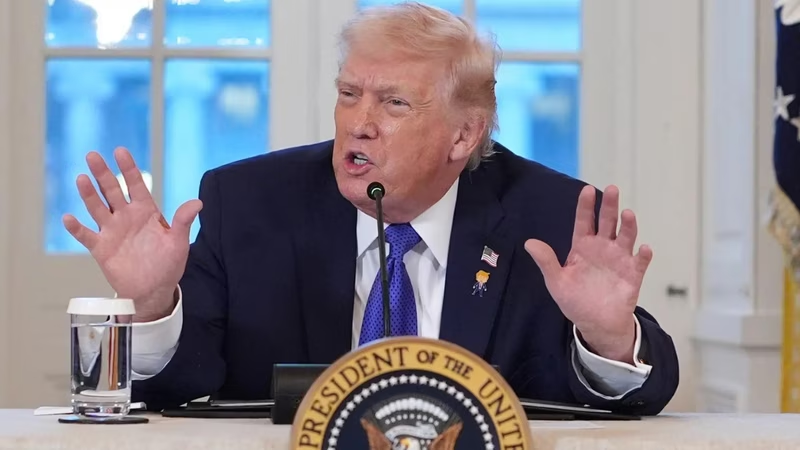
In a statement that has sent shockwaves through the international community, President Donald Trump has doubled down on his long-standing desire to acquire Greenland, bluntly declaring, “I would like to make a deal the easy way but if we don’t do it the easy way, we’re going to do it the hard way” . This isn’t just a throwback to his first term; it’s a renewed and seemingly more urgent campaign with profound implications for global security, Arctic sovereignty, and the future of the transatlantic alliance.
But why is this remote, ice-covered island so important to the United States? And what does “the hard way” actually mean? Let’s dive into the complex web of military strategy, great power competition, and diplomatic fallout surrounding the Trump Greenland saga.
Table of Contents
- Why Trump Wants Greenland: More Than Just Real Estate
- The Strategic Heart of the Arctic: Thule Air Base
- Denmark’s Fierce and Unified Rejection
- The Russia and China Card: Justifying the Push
- Conclusion: A Dangerous New Chapter in Geopolitics
- Sources
Why Trump Wants Greenland: More Than Just Real Estate
For President Trump, Greenland has never been just a piece of land. He views it as a critical strategic asset for the United States. In his own words, the U.S. “needs to own Greenland to deter Russia and China,” moving beyond the current lease agreements to establish full ownership for national defense . The White House has officially acknowledged that it is actively discussing options to acquire the territory, including potential diplomatic transactions . This marks a significant escalation from his previous, more casual inquiries about purchasing the island.
The core of his argument rests on the belief that the current arrangement—a defense agreement with Denmark—is insufficient in an era of heightened global tensions. Full control, he argues, would provide the U.S. with unassailable leverage in the rapidly warming Arctic, a region becoming a new frontier for resource extraction and military dominance.
The Strategic Heart of the Arctic: Thule Air Base
At the center of America’s existing interest in Greenland is the Thule Air Base, now officially known as Pituffik Space Base. Located a staggering 750 miles north of the Arctic Circle, it is the U.S.’s northernmost military installation .
Operated under the 1951 U.S.-Denmark Defence Agreement, Thule serves as a vital hub for space surveillance, missile warning systems, and satellite tracking . Its location provides an unparalleled vantage point for monitoring activity across the polar region. However, the base operates on a lease, and its future is ultimately tied to Danish sovereignty. For a president who prioritizes absolute control, this dependency is a strategic vulnerability.
A table comparing the current status with a hypothetical acquisition scenario can help illustrate the stakes:
| Aspect | Current Status (Lease) | Under Full U.S. Control |
|---|---|---|
| Strategic Autonomy | Limited by Danish oversight and treaty terms | Complete and unchallenged |
| Military Expansion | Requires Danish approval | Unrestricted |
| Geopolitical Leverage | Shared with Denmark | Solely held by the U.S. |
Denmark’s Fierce and Unified Rejection
The reaction from Copenhagen has been swift, unequivocal, and deeply alarmed. Danish Prime Minister Mette Frederiksen has publicly urged Trump to “stop the threats,” framing the U.S. president’s comments as a direct challenge to European sovereignty . The sentiment is clear: “Greenland is not for sale,” a stance echoed by lawmakers across the political spectrum .
This isn’t just diplomatic posturing. The situation has escalated to the point where Denmark is taking concrete defensive measures. Reports confirm that Danish military drills are currently underway in Greenland, a clear signal of their resolve to defend their territory . The message from Europe is unified: “Threats of military force have no place in Europe and no place in the 21st century” . The idea of a NATO ally contemplating the forcible seizure of another ally’s territory has created a profound crisis of trust within the alliance.
The Russia and China Card: Justifying the Push
To justify this aggressive stance, the Trump administration points to the growing ambitions of its strategic rivals in the Arctic. China has declared itself a “near-Arctic state” and is deepening its cooperation with Russia in the region, seeking to establish port-related partnerships and expand its influence [[16], [18]].
While Moscow has been relatively quiet on Trump’s specific threat, its own extensive military build-up in the Arctic gives weight to the broader concern . The administration’s narrative is that if the U.S. doesn’t secure Greenland, it leaves a vacuum that Beijing and Moscow are eager to fill. Critics, however, argue that this is a “made-up excuse attempting to justify its hegemonic claims” and that the existing cooperative framework at Thule is more than sufficient for defense needs . They warn that the real race in the Arctic is one that risks shutting out regional stakeholders and ignoring the interests of Indigenous peoples .
Conclusion: A Dangerous New Chapter in Geopolitics
The Trump Greenland ultimatum is far more than a bizarre headline. It represents a fundamental shift in U.S. foreign policy—one that prioritizes unilateral action and territorial acquisition over long-standing alliances and international law. The strategic value of Greenland, centered on the Thule Air Base, is undeniable in the context of 21st-century great power competition. However, the method of acquisition—especially the threat of the “hard way”—threatens to fracture the Western alliance at a time when unity is most needed. As Denmark fortifies its position and Europe rallies in support, the world watches to see whether this is a negotiating tactic or the opening move in a dangerous new chapter of global politics.
Sources
- White House Draws Up Plans to Acquire Greenland
- ‘Greenland is not for sale,’ lawmaker says amid Trump’s…
- Trump says to make deal to acquire Greenland in “easy way”…
- Trump says U.S. needs to own Greenland to deter Russia…
- Trump’s team races to come up with a Greenland takeover…
- European Greens slam Trump’s Greenland threats…
- Danes warn they would start shooting if US invaded…
- US Military Option in Greenland: Strategic Analysis
- On Thule Time: The Story of the 821st Space Base Group
- The Arctic, outer space and influence-building
- What is Russia’s reaction to Trump’s Greenland bid?
- China’s Strategic Role in Arctic Environmental Governance
- Vance’s hype of Greenland’s role for defense against…
- As the Arctic warms up, the race to control the region is…