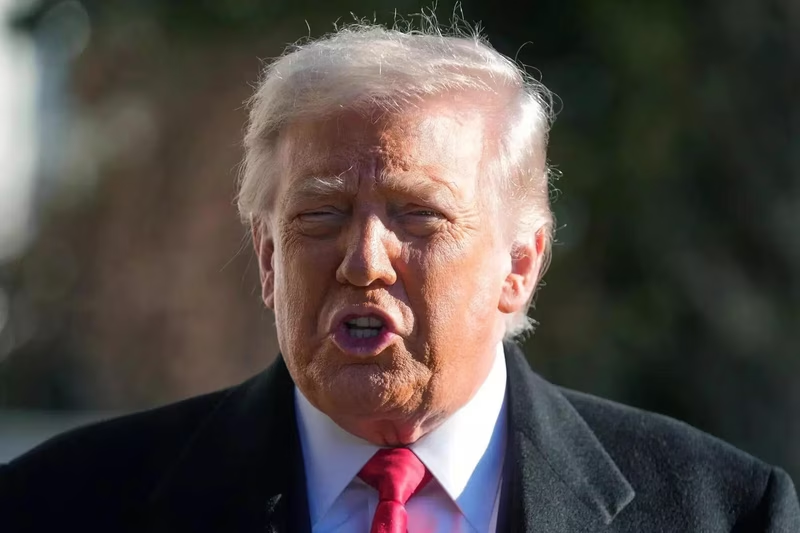
“Who is he?” That’s how former President Donald Trump dismissed Greenland’s Prime Minister when asked about the island’s recent declaration that it stands firmly with Denmark—not the United States. The offhand remark isn’t just political theater; it’s the latest salvo in Trump’s long-running—and deeply serious—campaign to bring Greenland under American control. Welcome to the new Cold War, where the battlefield isn’t ideological but icy, and the prize is one of Earth’s last untapped strategic frontiers.
Table of Contents
- Trump’s Greenland Obsession: From Joke to Policy
- “We Choose Denmark”: Greenland’s Defiant Stance
- Trump Greenland Deal: Why This Frozen Island Is Worth Billions
- The Real Geopolitical Stakes: Russia, China, and the Arctic Race
- Can the U.S. Actually Buy Greenland? Legal Realities
- Global Reactions: From Ridicule to Alarm
- Conclusion: More Than a Real Estate Deal
- Sources
Trump’s Greenland Obsession: From Joke to Policy
Back in 2019, headlines mocked Trump for allegedly wanting to “buy Greenland” like a piece of Manhattan real estate. But insiders knew he was dead serious. He even floated the idea of a land swap or massive financial offer, and when Denmark (which handles Greenland’s foreign and defense policy) politely declined, he canceled a state visit in protest.
Now, as he campaigns for a potential 2026 return to the White House, Trump is reviving the idea with renewed vigor. In a recent interview, when pressed on whether he’d made a formal offer, he replied: “I haven’t done that. But Greenland should make the deal because Greenland does not want to see Russia or China take over.” The message is clear: this isn’t whimsy—it’s strategy wrapped in bravado.
“We Choose Denmark”: Greenland’s Defiant Stance
Greenland, a self-governing territory within the Kingdom of Denmark, has consistently rejected U.S. acquisition attempts. Its leadership emphasizes autonomy within the Danish framework, not independence or annexation by another power. When asked about Trump’s remarks, Greenland’s Prime Minister reaffirmed: “We are part of the Danish Realm. We choose Denmark.”
This isn’t just loyalty—it’s pragmatism. Denmark provides critical subsidies (roughly $500 million annually), security guarantees, and international representation. For Greenlanders, swapping Danish stewardship for American ownership offers little upside and immense cultural risk.
Trump Greenland Deal: Why This Frozen Island Is Worth Billions
Forget jokes about polar bears and icebergs. Greenland is a geostrategic goldmine:
- Mineral Wealth: It holds vast reserves of rare earth elements—essential for smartphones, electric vehicles, and defense tech—currently dominated by China.
- Arctic Positioning: As climate change melts sea ice, new shipping lanes are opening. Control over Greenland means influence over the Northwest Passage and North Atlantic security.
- Military Advantage: The U.S. already operates Thule Air Base in northern Greenland—one of its most northerly military installations, vital for missile detection and space surveillance.
A report from the Center for Strategic and International Studies (CSIS) confirms that Greenland’s location makes it “indispensable to U.S. Arctic and global defense strategy.”
The Real Geopolitical Stakes: Russia, China, and the Arctic Race
Trump’s warning about Russian or Chinese dominance isn’t fearmongering—it’s grounded in reality. Both nations are aggressively expanding their Arctic presence:
- Russia has reopened Soviet-era military bases along its Arctic coast and deployed advanced air defense systems.
- China, though not an Arctic nation, declared itself a “near-Arctic state” and has invested heavily in Greenlandic mining projects, raising U.S. national security concerns.
For Washington, letting Greenland drift toward non-Western influence is unacceptable. Hence, Trump’s blunt calculus: if Denmark won’t secure it firmly in the Western camp, maybe the U.S. should just own it outright.
Can the U.S. Actually Buy Greenland? Legal Realities
Legally, the path is nearly impossible. Greenland is not Denmark’s property to sell. Under the 2009 Self-Government Act, Greenland has the right to declare independence—but any transfer of sovereignty would require approval from both the Greenlandic parliament (Inatsisartut) and the Danish Folketing.
Even if such a deal were politically feasible—which it isn’t—the optics would be disastrous. It would echo colonial land grabs, drawing condemnation from the UN and allies alike. The U.S. is far more likely to deepen its existing partnership through investment, security cooperation, and support for Greenlandic autonomy—short of ownership.
Global Reactions: From Ridicule to Alarm
European leaders have largely rolled their eyes, recalling Trump’s 2019 outburst. But behind closed doors, there’s concern. NATO allies worry that erratic U.S. demands could destabilize transatlantic unity, especially as Russia watches closely.
Meanwhile, in Beijing and Moscow, Trump’s comments are likely seen as validation of their own Arctic ambitions—a sign that even America’s top leaders view the region as a zero-sum contest.
Conclusion: More Than a Real Estate Deal
The “Trump Greenland deal” is less about buying an island and more about signaling America’s intent to dominate the next frontier of global power. While the chances of actual acquisition remain near zero, the episode underscores a critical truth: the Arctic is no longer a frozen backwater. It’s the epicenter of a 21st-century scramble for resources, routes, and strategic supremacy. And whether Trump likes it or not, Greenland—and its people—will decide their own future.
Sources
[1] Times of India: “’Who is he?’: Trump’s dig at Greenland PM as he ‘chooses’ Denmark over US” – https://timesofindia.indiatimes.com/world/us/big-problem-for-him-trump-threatens-greenland-pm-over-we-choose-denmark-remark/articleshow/126518236.cms
[2] Center for Strategic and International Studies (CSIS): “Greenland’s Strategic Value” – https://www.csis.org/analysis/greenlands-strategic-value
[3] Government of Greenland: Self-Government Act (2009)
[4] NATO Arctic Security Reports