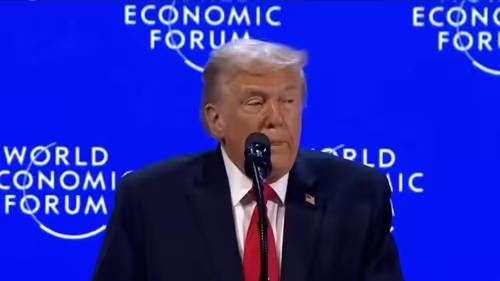
In a move that has once again sent shockwaves through the international community, former President Donald Trump has staked a claim over Greenland, bluntly referring to the vast Arctic island as “our territory.” This isn’t the first time Trump has floated the idea—his 2019 offer to buy Greenland from Denmark was met with a swift and public rebuke—but his renewed interest in 2026 suggests a deeper, more calculated strategy is at play .
So, why is Trump so fixated on this remote, ice-covered landmass? The answer lies at the intersection of geopolitics, untapped wealth, and future global power dynamics. It’s far more than just a “large real estate deal,” as he once quipped .
Table of Contents
- Why Trump Wants Greenland: More Than Just Real Estate
- The Immense Strategic and Military Value of Greenland
- Greenland: An Economic Treasure Trove of Critical Resources
- Denmark’s Sovereignty and Greenland’s Political Status
- Conclusion: A Geopolitical Flashpoint for the Future
- Sources
Why Trump Wants Greenland: More Than Just Real Estate
The Trump Greenland narrative is often oversimplified as a billionaire’s eccentric whim. However, experts agree that his interest is rooted in a clear-eyed assessment of America’s long-term strategic needs. During his first term, Trump became increasingly convinced of Greenland’s importance after learning about its pivotal role in the Arctic’s future .
A primary driver of this interest is the fear of rival powers, particularly China, gaining a foothold in the region. The Trump administration viewed China’s commercial and infrastructure interests in Greenland as having potential hidden military motives, a concern that has only intensified in recent years . By asserting U.S. control, Trump aims to prevent any non-NATO power from establishing a strategic presence so close to North American shores.
The Immense Strategic and Military Value of Greenland
Greenland’s location is its most valuable asset. Sitting at the crossroads of North America, Europe, and the Arctic, it serves as a critical vantage point for monitoring air, sea, and even space-based activities . For the United States, which already operates the Thule Air Base in northern Greenland, full control would solidify its dominance over the North Atlantic and the emerging Arctic theater.
As climate change opens new shipping lanes and makes the Arctic more accessible, its importance for global trade and military logistics is skyrocketing. Greenland acts as a “northern sentry and logistical hub for nations seeking to control these emerging routes” . In an era of great power competition, ceding influence in this region is not an option for a nation like the U.S. that seeks to maintain its global military edge .
Greenland: An Economic Treasure Trove of Critical Resources
Beyond its military clout, Greenland is sitting on a potential economic goldmine. Its vast, largely unexplored territory is believed to hold enormous reserves of oil, natural gas, and, most critically, rare earth elements . These minerals are essential for manufacturing everything from smartphones and electric vehicles to advanced defense systems like precision-guided missiles and radar technology .
Currently, China dominates the global supply chain for these critical minerals, giving it significant leverage over Western economies. Securing a domestic or allied source of these materials is a top national security priority for the United States. Acquiring Greenland would provide direct access to these resources, reducing dependence on geopolitical rivals and fueling a new era of American industrial and technological independence .
Denmark’s Sovereignty and Greenland’s Political Status
Of course, any discussion of a U.S. acquisition of Greenland must confront the reality of its current political status. Greenland is not a colony but a self-governing territory within the Kingdom of Denmark, with extensive autonomy over its internal affairs . Denmark declared full sovereignty over the island in 1921, and this status has been reinforced by its integration into the Danish state in 1953 and the establishment of home rule in 1979 [[16], [21]].
While Greenland has the legal right to declare full independence through a referendum, its relationship with Denmark remains strong, particularly concerning defense and foreign policy, which are still managed by Copenhagen. The idea that the U.S. could simply purchase the island, as Trump has suggested, ignores this complex legal and political framework and has been firmly rejected by Danish officials as a non-starter .
Conclusion: A Geopolitical Flashpoint for the Future
The Trump Greenland saga is far more than a political sideshow. It’s a stark indicator of the shifting tides of global power. The Arctic is no longer a frozen frontier but a central arena for 21st-century competition over resources, trade routes, and military supremacy. Whether through a formal acquisition, increased diplomatic pressure, or a strengthened partnership with a future independent Greenland, the United States is determined to secure its interests in this critical region. As Trump himself argues, Denmark may be unable to defend Greenland’s strategic position in the long run, making a stronger U.S. role seem inevitable to some in Washington .
For now, Greenland remains a Danish territory, but its future is a topic of intense global speculation. One thing is certain: its fate will have profound implications for the balance of power in the decades to come.
Sources
- Times of India: ‘Our territory’: Trump stakes claim over Greenland – key reasons why he wants control
- Various sources on Greenland’s strategic importance and history [[1]-[21]]