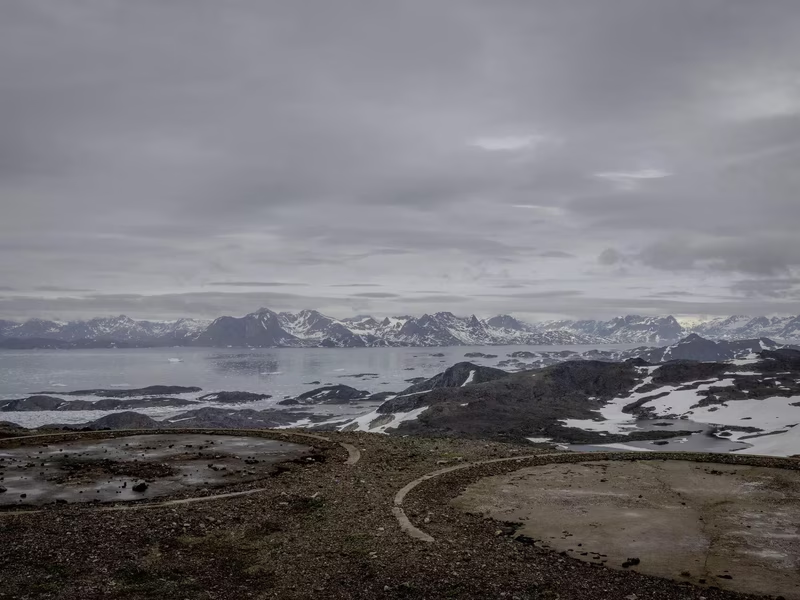
For years, former President Donald Trump’s offhand remark about *buying Greenland* has been dismissed as a geopolitical fantasy. But as rumors of renewed interest swirl, a critical reality check emerges: the United States already possesses near-total strategic control over the Arctic island—thanks to a little-known 1951 defense treaty. So why does Trump still talk about taking or purchasing Greenland? And why are Greenlanders and Denmark so fiercely opposed?
The answer lies at the intersection of Cold War legacy, modern Arctic ambitions, and a fundamental clash over self-determination. While Trump frames Greenland as a strategic asset ripe for American ownership, the reality is far more complex—and the idea is not just legally dubious, but politically toxic.
Table of Contents
- The 1951 Defense Pact: What the U.S. Already Owns
- Trump’s Greenland Fixation: A Recurrent Theme
- Why Greenlanders Say No to Any Sale
- Denmark’s Constitutional Stance
- The Strategic Value of Greenland in 2026
- Could the U.S. Really “Take” Greenland by Force?
- Conclusion: A Solution in Search of a Problem
- Sources
The 1951 Defense Pact: What the U.S. Already Owns
Few Americans know it, but the U.S. doesn’t just have a military presence in Greenland—it has **unilateral rights** to build, operate, and expand bases across the island under the 1951 Agreement on the Defense of Greenland between Washington and Copenhagen.
Key provisions include:
- The U.S. can establish “such defense areas as it may require” anywhere in Greenland.
- Full jurisdiction and control over these areas, including criminal and civil authority.
- No requirement to consult Denmark or Greenlandic authorities on base operations.
This is how the U.S. operates the strategically vital Thule Air Base—the northernmost U.S. military installation, critical for missile warning, space surveillance, and Arctic defense. In essence, the U.S. already enjoys *de facto* strategic control without owning an inch of land .
Trump’s Greenland Fixation: A Recurrent Theme
Trump first floated the idea of purchasing Greenland in 2019, calling it a “large real estate deal.” The comment sparked international ridicule, and Denmark’s Prime Minister Mette Frederiksen bluntly called it “absurd.” Trump responded by canceling a state visit.
Yet the idea hasn’t died. In recent months, Trump allies have revived the narrative, framing Greenland as essential to counter Chinese and Russian influence in the Arctic. But experts argue this ignores the existing legal framework. “He doesn’t need to buy it,” says Arctic policy scholar Dr. Elizabeth Buchanan. “The 1951 pact already gives the U.S. everything it needs for defense” .
Why Greenlanders Say No to Any Sale
Greenland, a self-governing territory within the Kingdom of Denmark, has a population of just 56,000—nearly 90% Indigenous Inuit. For them, Trump’s comments are not just offensive; they’re a colonial throwback.
“We are not for sale,” declared Greenland’s Premier Múte Bourup Egede. “Greenland belongs to the Greenlandic people.” The island has been moving steadily toward full independence, and any talk of being “bought” or “taken” strikes at the heart of their national identity and right to self-determination .
A 2023 public opinion poll found that **over 85% of Greenlanders oppose any transfer of sovereignty to another country**—especially the U.S.
Denmark’s Constitutional Stance
Denmark’s position is equally firm. The Danish Constitution explicitly states that no part of the Realm—including Greenland—can be ceded without the consent of its people through a referendum. Even if Denmark wanted to sell (which it doesn’t), it legally cannot.
Former Danish Foreign Minister Jeppe Kofod summed it up: “Greenland is not Danish property. It is a people with a right to determine its own future.”
The Strategic Value of Greenland in 2026
Trump’s interest isn’t baseless. Greenland sits at the gateway to the Arctic, a region rich in rare earth minerals, oil, and emerging shipping lanes. As ice melts, its geopolitical importance grows.
However, the U.S. already leverages this via Thule. Recent upgrades—like a $1.5 billion radar modernization—show the U.S. is deepening, not expanding, its existing footprint. As noted by the U.S. Department of State’s Arctic Strategy, the focus is on “cooperation with allies,” not annexation .
Could the U.S. Really “Take” Greenland by Force?
Trump once mused, “You can’t explain why. Maybe we’ll take it.” But legally and politically, such a move is unthinkable. Denmark is a NATO ally. An invasion would shatter the alliance, trigger global condemnation, and violate international law.
More realistically, the U.S. is increasing diplomatic engagement and investment in Greenland—funding renewable energy, education, and infrastructure—to counter Chinese influence *without* threatening sovereignty.
Conclusion: A Solution in Search of a Problem
The **Trump Greenland** fantasy persists not because it’s practical, but because it fits a narrative of transactional nationalism. Yet the facts are clear: a 70-year-old pact already secures U.S. military interests, while Greenlanders and Denmark stand united against any notion of sale or seizure. In the Arctic, influence will be won through partnership—not purchase.
Sources
- The Times of India: Why an old pact gives Trump a free hand on Greenland
- Center for Strategic and International Studies (CSIS): Greenland’s Strategic Importance
- Government of Greenland: “Greenland is not for sale” Official Statement
- U.S. Department of State: U.S. Arctic Policy
- NATO: Denmark and Greenland’s Defense Relationship