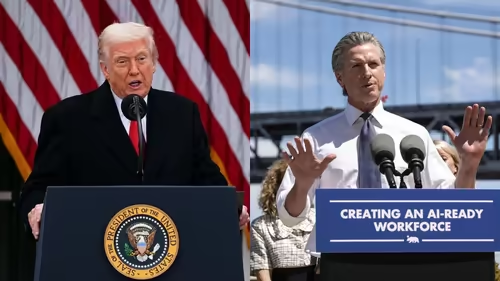
‘He’s a T-rex’: The Global Backlash Against Trump’s Greenland Ambitions
The snowy halls of the World Economic Forum (WEF) in Davos became the stage for a fierce geopolitical debate this week, all centered on one man’s long-standing desire: Donald Trump’s ambition to buy Greenland. The former U.S. President’s renewed comments have sparked a wave of international condemnation, with leaders from Europe to North America warning that such rhetoric signals a dangerous return to colonial-era power politics. The most scathing critique came from French President Emmanuel Macron, who labeled the approach as nothing short of a threat to the global order.
Table of Contents
- Macron’s Stark Warning: A “New Colonial Approach”
- Newsom’s Call to Action: “Grow a Backbone”
- The “T-rex” Comment and the Global Mood
- Why Greenland? Why Now?
- The Broader Implications for US Foreign Policy
- Conclusion: A World at a Crossroads
- Sources
Macron’s Stark Warning: A “New Colonial Approach”
French President Emmanuel Macron was unequivocal in his assessment of Trump’s Trump Greenland ambitions. Speaking at the WEF, Macron warned of a “new colonial approach” that he believes is fundamentally undermining the rules-based international system that has been painstakingly built over decades . He argued that accepting such a transactional and power-driven view of global relations “doesn’t make sense” and poses a direct threat to international cooperation .
Macron’s comments were not just a rebuke of a single policy idea but a broader critique of a shift in global power dynamics. He framed the issue as a choice between a world governed by agreed-upon rules and one dictated by the whims of the strongest, a sentiment that resonated deeply with many European allies concerned about the stability of the transatlantic partnership .
Newsom’s Call to Action: “Grow a Backbone”
Adding to the chorus of criticism was California Governor Gavin Newsom, who took a more direct and personal tone. Frustrated with what he perceived as a lack of resolve from European leaders, Newsom urged them to “stop playing nice” with Trump and to “develop a backbone” in the face of his aggressive trade and territorial threats .
Newsom went so far as to criticize the culture of the WEF itself, suggesting that too many leaders were guilty of “sucking up to him” rather than standing up for their own nations’ interests and the principles of international law . His message was clear: passive diplomacy is no longer an option in the face of what he sees as a direct challenge to the post-war global order.
The “T-rex” Comment and the Global Mood
The now-infamous description of Trump as a “T-rex” perfectly encapsulates the mood among many global leaders. The image of a powerful but outdated creature, driven by instinct and territoriality, seems to be how they view his foreign policy strategy. This isn’t just about a piece of Arctic real estate; it’s about a fundamental philosophy that views international relations as a zero-sum game of acquisition and dominance, a stark contrast to the collaborative spirit that forums like the WEF are meant to foster .
Why Greenland? Why Now?
Trump’s fascination with Greenland is not new. He first floated the idea during his previous term, a proposal that was swiftly and firmly rejected by Denmark, which holds sovereignty over the autonomous territory. However, his renewed focus on the island at the WEF is widely seen as a strategic move to reassert his “America First” agenda on the global stage .
Greenland’s strategic importance cannot be overstated. It sits at a critical juncture in the Arctic, a region rich in untapped natural resources and increasingly vital shipping lanes due to climate change. For a leader focused on national security and resource independence, Greenland represents a significant geopolitical prize. Yet, the manner in which Trump pursues it—through public threats and transactional language—has alienated potential allies and reignited fears of a neo-colonial mindset .
The Broader Implications for US Foreign Policy
The international reaction to Trump’s Trump Greenland ambitions is a bellwether for how his potential return to the White House would be received abroad. The strong, unified pushback from key allies like France signals a deep anxiety about a future where U.S. foreign policy is driven by personal whim rather than strategic alliance and mutual respect.
This moment at the WEF highlights a critical question for the future: will the world continue to operate under a framework of shared rules and norms, or will it devolve into a contest of raw power? The answers to that question will shape global security and economic stability for years to come.
Conclusion: A World at a Crossroads
The debate sparked by Trump’s Greenland comments at the World Economic Forum is far more than a diplomatic spat. It is a defining moment that forces a global reckoning with the principles that will guide international relations in the coming decade. With leaders like Macron and Newsom drawing a line in the snow, the world is being asked to choose between a cooperative future and a return to a more brutish past. The stakes, as they say, couldn’t be higher.
Sources
- Times of India: ‘He’s a T-rex’: Global leaders react to Trump’s Greenland threats – watch
- Reuters: Macron warns against ‘new colonial approach’ at Davos
- The Guardian: Gavin Newsom urges Europe to stand up to Trump over Greenland
- [INTERNAL_LINK:us-foreign-policy-under-trump]
- [INTERNAL_LINK:arctic-geopolitics-and-climate-change]