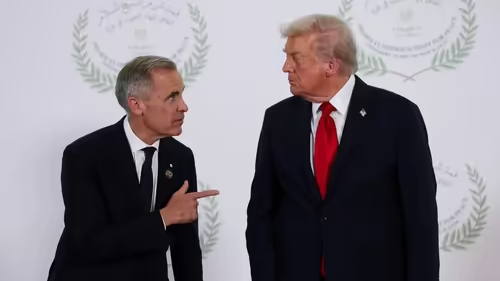
Trump’s ‘Golden Dome’ Feud: A New Front in North American Tensions
In a dramatic escalation of transatlantic tensions, former U.S. President Donald Trump has unleashed a scathing critique of Canada, accusing its leadership of jeopardizing its own security by opposing his signature Golden Dome missile defense initiative over Greenland. The core of Trump’s argument? That Canada’s pursuit of economic ties with China blinds it to its fundamental reliance on American military might—a claim that has been met with fierce rebuttal from Ottawa.
This isn’t just a policy disagreement; it’s a fundamental clash of worldviews that threatens to reshape the North American security architecture. At its heart lies the icy, mineral-rich territory of Greenland, whose strategic location has become the focal point of a new geopolitical chess game.
Table of Contents
- Trump’s ‘Golden Dome’ Accusation and the China Warning
- Canada’s Sovereign Rebuttal from PM Carney
- Why Greenland is the Key to the Golden Dome
- The Strategic Stakes for North America
- Conclusion: A Future of Fractured Alliances?
- Sources
Trump’s ‘Golden Dome’ Accusation and the China Warning
On his Truth Social platform, Trump laid out his case with characteristic bluntness: “Canada is against The Golden Dome being built over Greenland, even though The Golden Dome would protect Canada. Instead, they voted in a government that is all about China,” he declared . His central thesis is that the Golden Dome, a proposed multi-billion dollar missile defense shield, is a gift to Canada’s security, one that Ottawa is foolishly rejecting in favor of lucrative but risky trade deals with Beijing.
He capped off his argument with a stark warning: “China will eat them up” . This phrase encapsulates Trump’s transactional view of international relations, where alliances are contingent on immediate, tangible benefits and any perceived disloyalty is met with sharp rebuke. For Trump, Canada’s independent foreign policy, particularly its engagement with China, is not just a diplomatic misstep but an existential threat to its own future.
Canada’s Sovereign Rebuttal from PM Carney
Canadian Prime Minister Mark Carney has categorically rejected Trump’s narrative. In a direct response, Carney emphasized Canada’s right to chart its own course in the world. He dismissed the notion that Canada is ungrateful or dependent, instead framing the country as a capable, sovereign nation that can thrive independently while maintaining its alliance with the United States .
Carney’s stance is a clear assertion of Canadian sovereignty. He argues that a nation’s foreign policy should be based on its own national interests and values, not dictated by the demands of its larger neighbor. This pushback is not just about a missile shield; it’s about Canada’s identity and its place in a multipolar world. The Prime Minister’s position resonates with a Canadian public that is wary of being drawn into great power conflicts and is committed to a more diversified international strategy.
Why Greenland is the Key to the Golden Dome
The entire dispute hinges on Greenland’s unique geography. Its position in the Arctic makes it a critical vantage point for monitoring air, sea, and space activities across the Northern Hemisphere . For a continental missile defense system like the Golden Dome to be effective, it needs sensors and interceptors placed in the far north to provide the earliest possible warning and the best chance of interception.
Under a 1951 defense agreement with Denmark, the U.S. already maintains the Thule Air Base in Greenland, a key node in its existing missile warning network . Trump’s vision, however, appears to be far more ambitious, potentially involving a massive expansion of this infrastructure into a comprehensive, layered defense shield. Analysts note that Greenland could serve as a vital staging ground for a greater U.S. defensive presence in the rapidly militarizing Arctic region .
The Strategic Stakes for North America
This feud exposes a growing rift in North American defense strategy:
- Differing Threat Perceptions: The U.S., under a potential second Trump term, views China as an existential, monolithic threat requiring a massive, unilateral defense build-up. Canada, while acknowledging the challenge, prefers a more nuanced, multilateral approach through NATO and other alliances.
- Sovereignty vs. Security: The conflict pits Canada’s desire for an independent foreign policy against the U.S. expectation of unwavering alignment from its closest ally. The Golden Dome has become a symbol of this tension.
- The Arctic’s Rising Importance: As climate change opens new shipping lanes and unlocks vast mineral resources, the Arctic is becoming a new frontier for great power competition. Control over its strategic points, like Greenland, is paramount .
This isn’t merely a bilateral spat. It has profound implications for NATO cohesion and the broader Western alliance’s ability to present a united front in an increasingly unstable world.
Conclusion: A Future of Fractured Alliances?
The battle over the Golden Dome is a microcosm of a larger global shift. It reveals the fragility of long-standing alliances in the face of rising nationalism and divergent strategic priorities. While Trump frames the issue as a simple matter of protection versus betrayal, the reality is far more complex, involving questions of national sovereignty, economic interdependence, and the future of collective security in the 21st century. How Canada and the U.S. navigate this crisis will set a precedent for their relationship for years to come—and may signal whether the era of unquestioned Western unity is truly over. For more on how global politics are reshaping defense strategies, see our analysis on [INTERNAL_LINK:arctic-geopolitics].
Sources
- Times of India: ‘China will eat them up’: Trump slams Canada over pushback on ‘Golden Dome’ plan in Greenland
- Council on Foreign Relations: Greenland Is Strategic. Annexation Is Not.
- Reuters: Carney’s straightforward response after Trump offers to buy Greenland