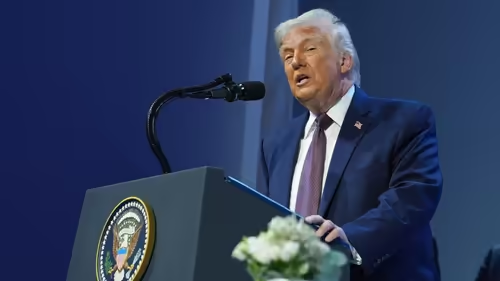
When Donald Trump says he’s a “real estate person at heart,” few expected him to apply that mindset to one of the world’s most volatile conflict zones. Yet at a recent Board of Peace event, the former U.S. president stunned attendees—and the global community—by describing the Gaza Strip as a “beautiful piece of property.”
The remark, delivered with trademark casualness, instantly went viral, sparking condemnation from diplomats, human rights advocates, and Middle East analysts. Critics argue that reducing Gaza—a densely populated, war-ravaged territory home to 2.3 million Palestinians—to a speculative asset not only trivializes immense human suffering but also reveals a troubling blind spot in Trump’s foreign policy worldview .
Table of Contents
- What Did Trump Say—and Where?
- Why the Trump Gaza Real Estate Comment Sparked Outrage
- Historical Context: Trump’s Middle East Record
- Gaza Beyond Bricks and Dirt: The Human Reality
- Diplomatic Fallout and Global Reactions
- What This Means for U.S. Foreign Policy
- Conclusion: Rhetoric vs. Responsibility
- Sources
What Did Trump Say—and Where?
The comment came during Trump’s appearance at the Board of Peace summit, an event aimed at promoting dialogue on international stability. While discussing post-conflict reconstruction, Trump remarked: “I’ve always said, I’m a real estate person at heart. And you look at Gaza—it’s a beautiful piece of property. Great location, right on the Mediterranean. With the right investment, it could be something special.”
He added that “after they clean it up,” the area could become a “tremendous opportunity” for development—a statement that ignored the fact that much of Gaza’s destruction stems from repeated military assaults and an ongoing blockade, not neglect .
Why the Trump Gaza Real Estate Comment Sparked Outrage
The backlash was swift and multifaceted. At its core, critics argue that the Trump Gaza real estate comment exemplifies a dehumanizing approach to geopolitics—one that views land as a commodity rather than a homeland.
Gaza is not an undeveloped plot waiting for investors. It is one of the most densely populated places on Earth, with over 70% of its residents being refugees displaced during the 1948 Arab-Israeli war. Decades of conflict, economic siege, and infrastructure collapse have left deep scars. To call it a “beautiful piece of property” while ignoring this history struck many as tone-deaf at best, and colonialist at worst .
As Palestinian journalist Rami Almeghari put it: “Gaza isn’t real estate. It’s where my grandmother was born, where my cousins still live without electricity for 12 hours a day. You can’t ‘flip’ a homeland.”
Historical Context: Trump’s Middle East Record
This isn’t the first time Trump’s business-first language has clashed with diplomatic nuance. During his presidency (2017–2021), his administration took several controversial steps in the region:
- Moved the U.S. embassy to Jerusalem, recognizing it as Israel’s capital—breaking decades of U.S. neutrality.
- Cut all aid to Palestinians, including funding for UNRWA, the UN agency supporting refugees.
- Unveiled the “Deal of the Century,” a peace plan widely seen as favoring Israel and offering Palestinians limited sovereignty.
- Normalized relations between Israel and several Arab states via the Abraham Accords—without addressing Palestinian statehood.
Supporters credit Trump with advancing regional cooperation; critics say he sacrificed Palestinian rights for photo-op diplomacy .
Gaza Beyond Bricks and Dirt: The Human Reality
To understand why Trump’s comment stung so deeply, consider these facts about Gaza:
- Over 80% of the population relies on humanitarian aid to survive.
- Unemployment hovers around 45%, the highest in the world.
- Only 3% of water is safe for human consumption.
- Repeated wars have destroyed hospitals, schools, and power plants.
These aren’t “fixer-upper” issues—they’re systemic crises rooted in occupation, blockade, and political fragmentation. Framing Gaza as a future resort or luxury development ignores the urgent need for justice, self-determination, and basic human dignity .
For more on the humanitarian situation, see reports from [INTERNAL_LINK:palestinian-refugee-crisis-explained] or the UN Office for the Coordination of Humanitarian Affairs (https://www.ochaopt.org).
Diplomatic Fallout and Global Reactions
International responses ranged from dismay to fury:
- Palestinian Authority: Called the remarks “insulting and detached from reality.”
- UN Human Rights Office: Warned against “commodifying occupied territories.”
- European Union diplomats: Expressed concern over “reductionist narratives” undermining peace efforts.
- U.S. State Department (under Biden): Declined to comment directly but reaffirmed support for a two-state solution.
Notably, some pro-Israel commentators defended Trump, arguing that post-war reconstruction will require massive investment—and that his “developer mindset” could be an asset. But even many Israeli peace activists rejected the framing, saying sustainable peace requires political solutions, not property deals .
What This Means for U.S. Foreign Policy
As the 2024 U.S. election approaches, Trump’s comments signal a potential return to his transactional foreign policy style. If re-elected, he may push for large-scale private investment in Gaza—but likely without addressing core issues like borders, refugees, or sovereignty.
Experts warn this approach risks perpetuating instability. As Brookings Institution fellow Natan Sachs notes: “You can’t build a mall on top of unresolved trauma. Peace isn’t a zoning permit—it’s a political agreement.”
Conclusion: Rhetoric vs. Responsibility
The Trump Gaza real estate comment may have been offhand, but its implications are profound. It reflects a worldview where value is measured in square footage and profit margins—not in lives, histories, or rights. In a region scarred by displacement and denial, such language doesn’t just offend—it erases. As the world watches America’s next political turn, the stakes for Gaza—and for responsible diplomacy—have never been higher.
Sources
- Times of India. “‘Real estate person at heart’: At Board of Peace event, Trump calls Gaza beautiful piece of property.” https://timesofindia.indiatimes.com/world/us/real-estate-person-at-heart-at-board-of-peace-event-trump-calls-gaza-beautiful-piece-of-property/articleshow/127152204.cms
- United Nations OCHA. “Gaza Strip: Humanitarian Situation Report.” https://www.ochaopt.org
- Brookings Institution. “The Limits of Transactional Diplomacy in the Middle East.” https://www.brookings.edu
- U.S. Department of State. “U.S. Relations With Israel and the Palestinian Territories.” https://www.state.gov