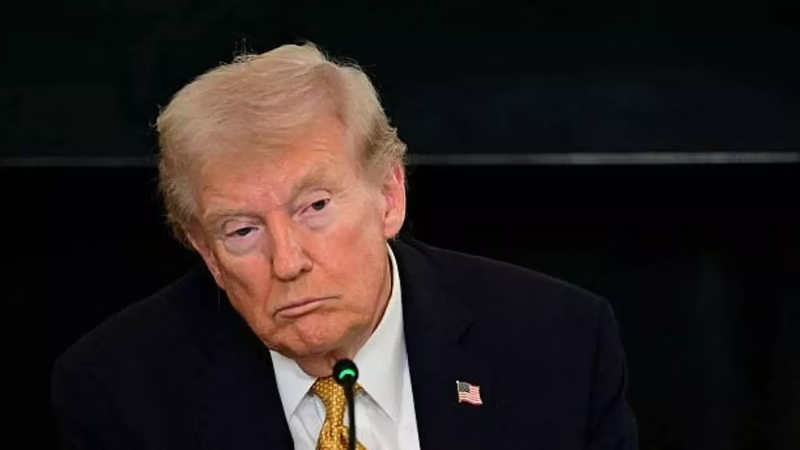
In the high-stakes world of American political fundraising, drama is often the currency. But Donald Trump’s latest email to his base may have crossed a line for many observers. The subject line alone—“I’m alone in the dark”—set a tone of desperate urgency that quickly went viral, not for its effectiveness, but for the wave of criticism it triggered across social media and political commentary circles .
Table of Contents
- The Content of the Controversial Email
- Trump Fundraising Email: A History of Dramatic Appeals
- Online Backlash and Criticism
- The Strategy Behind the Fear
- How This Fits into the 2026 Political Landscape
- Conclusion: A Tactic That Divides
- Sources
The Content of the Controversial Email
The email, sent to millions of Trump supporters, paints a dire picture of the former president’s current situation. It claims he is facing a renewed, politically motivated push for impeachment by his enemies in Washington. The message warns that if he fails to meet an immediate fundraising deadline, the consequences will be catastrophic—not just for him, but for the entire nation. It suggests that American lives, freedoms, and the future of the country hang in the balance based on whether his supporters can send money right now .
This blend of personal vulnerability (“I’m alone in the dark”) and apocalyptic national stakes is a classic hallmark of high-pressure fundraising, but its execution in this instance struck many as particularly overwrought.
Trump Fundraising Email: A History of Dramatic Appeals
This is far from the first time the Trump campaign apparatus has used such language. Since his 2016 presidential run, his team has perfected a fundraising model built on constant crisis messaging. Emails with subject lines like “They’re coming for me!” or “We’re being erased!” have been a staple of his digital strategy .
While these tactics have proven incredibly lucrative—raising hundreds of millions of dollars—they have also drawn consistent criticism for blurring the line between genuine political threats and manufactured panic designed solely to open donors’ wallets. The “alone in the dark” email is simply the latest, and perhaps most theatrical, iteration of this long-standing playbook.
Online Backlash and Criticism
The reaction on platforms like X (formerly Twitter) and Reddit was swift and scathing. Critics, including prominent journalists, political opponents, and even some former supporters, labeled the email as “emotional blackmail,” “fear-mongering,” and “a cry for help disguised as a call to action.” Memes mocking the phrase “I’m alone in the dark” proliferated, turning the serious plea into internet fodder .
Many pointed out the irony of a billionaire former president, with a massive political movement behind him, claiming to be “alone.” The disconnect between the message and the reality of Trump’s immense political and financial infrastructure fueled much of the derision.
The Strategy Behind the Fear
Despite the backlash, there’s a cold, hard logic to this approach from a fundraising perspective. Political strategists know that fear and urgency are two of the most powerful motivators for immediate action, especially when it comes to opening a wallet. By framing a donation not as a choice but as a necessary act of defense against an existential threat, campaigns can dramatically increase their conversion rates .
The goal isn’t necessarily to win over new supporters with nuance; it’s to activate the existing base to give, and give now. For the Trump operation, which relies heavily on small-dollar donations, this method has been a financial engine, even if it comes at the cost of public perception among non-supporters.
How This Fits into the 2026 Political Landscape
As the U.S. heads towards the 2026 midterm elections, both parties are in a perpetual state of fundraising. For Trump, who remains the de facto leader of the Republican Party, maintaining a war chest is crucial not only for his own potential 2028 presidential bid but also to support allied candidates and exert influence over the party’s direction .
The mention of a potential second impeachment, while legally improbable given the current political makeup of Congress, serves as a potent symbol of the “persecution” narrative that is central to his brand. It reinforces the idea among his base that he is a martyr fighting a corrupt system, a narrative that is key to his enduring political power.
Conclusion: A Tactic That Divides
The “I’m alone in the dark” Trump fundraising email perfectly encapsulates the polarizing nature of his political style. To his loyal supporters, it’s a heartfelt and urgent call to arms from their champion under siege. To his critics, it’s a cynical and manipulative ploy that exploits emotion for financial gain. Regardless of where one stands, the email’s viral notoriety underscores a fundamental truth about modern American politics: in the attention economy, drama is a powerful, if controversial, tool. Whether this specific tactic will yield the desired funds or further alienate the broader public remains to be seen.
Sources
- Federal Election Commission (FEC) – Campaign Finance Data: https://www.fec.gov/
- The Times of India – US News Section: https://timesofindia.indiatimes.com/world/us
- [INTERNAL_LINK:us-politics-news]
- [INTERNAL_LINK:donald-trump-latest]