Introduction: A High-Stakes Power Shift at the Fed
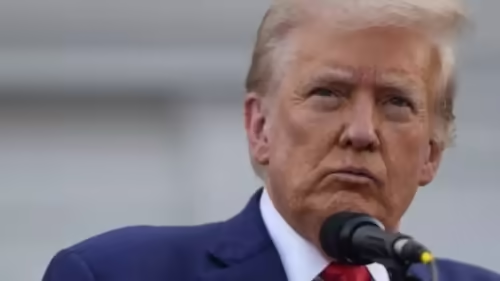
In a move that could send shockwaves through global markets, former President Donald Trump has announced he will name his pick for the next Fed chair nominee as early as next week—effectively sidelining current Chair Jerome Powell, whom Trump once appointed but now openly criticizes. The core grievance? “We’re paying too much interest,” Trump declared in a recent rally, arguing that elevated rates are stifling growth, crushing small businesses, and threatening his 2026 economic legacy [[1]].
This isn’t just a personnel change—it’s a direct challenge to the Federal Reserve’s long-standing independence. By prioritizing a dovish (rate-cutting) stance over inflation vigilance, Trump’s selection could mark a dramatic pivot in U.S. monetary policy, with profound implications for mortgages, credit cards, investments, and the dollar itself.
Table of Contents
- Why Trump Wants Powell Gone
- The Four Contenders for Fed Chair
- What the Fed Chair Actually Controls
- Market Reactions and Economic Risks
- Historical Precedent: Political Pressure on the Fed
- What This Means for Average Americans
- Conclusion: Monetary Policy or Political Tool?
- Sources
Why Trump Wants Powell Gone
Despite appointing Powell in 2018, Trump has grown increasingly hostile toward the Fed chief, especially after Powell raised rates aggressively in 2022–2024 to combat inflation. Trump blames those hikes for slowing GDP growth and raising borrowing costs for consumers and businesses.
“He’s got us paying interest we don’t need to pay,” Trump said, framing high rates as a self-inflicted wound. His ideal Fed chair nominee would be someone willing to cut rates swiftly—even if inflation hasn’t fully retreated to the Fed’s 2% target—aligning monetary policy with his pro-growth, low-rate economic vision.
The Four Contenders for Fed Chair
While Trump hasn’t named names publicly, insiders point to four leading candidates, each representing a different philosophy:
- Stephen Moore: A conservative economist and longtime Trump advisor. He’s advocated for immediate rate cuts and has questioned the Fed’s independence. Critics argue he lacks central banking experience.
- Larry Kudlow: Former director of the National Economic Council under Trump. Though more moderate, he supports looser monetary policy and has strong Wall Street ties.
- Nomi Prins: A former Goldman Sachs executive turned progressive critic of the Fed. While unlikely, her inclusion signals Trump’s openness to anti-establishment voices.
- Arthur Laffer: The “father of supply-side economics.” At 85, he’s a symbolic choice, but his influence on Trump’s tax policy makes him a dark horse candidate.
Whoever is chosen will face Senate confirmation—a process that could be contentious if the nominee is seen as too political.
What the Fed Chair Actually Controls
The Federal Reserve Chair doesn’t set rates alone but leads the Federal Open Market Committee (FOMC), which votes on monetary policy. Key powers include:
- Setting the federal funds rate (which influences all other interest rates)
- Overseeing bank regulation and financial stability
- Acting as the public face of U.S. monetary policy
- Managing the Fed’s $7.5 trillion balance sheet
Traditionally, chairs like Alan Greenspan or Ben Bernanke maintained distance from politics. Trump’s push for a loyalist threatens that norm.
Market Reactions and Economic Risks
Investors are already on edge. A dovish Fed chair could spark a short-term stock rally but risk reigniting inflation. The Federal Reserve’s own research shows that premature rate cuts in the 1970s led to a decade of stagflation [[2]].
Credit markets may cheer lower borrowing costs, but the dollar could weaken, making imports more expensive. Long-term, politicizing the Fed could erode global confidence in U.S. institutions—a risk many economists warn against.
Historical Precedent: Political Pressure on the Fed
While presidents have always wanted lower rates, few have attacked the Fed so openly. Lyndon B. Johnson pressured Chair William McChesney Martin in the 1960s, contributing to inflationary pressures. Richard Nixon famously recorded conversations scheming to influence the Fed.
But since the 1980s, Fed independence has been sacrosanct. Trump’s move—replacing a sitting chair mid-term—would break modern precedent and set a dangerous template for future administrations.
What This Means for Average Americans
Your wallet will feel the impact:
- Mortgages: Lower rates could make home loans cheaper—but only if inflation stays tame.
- Savings Accounts: Returns on CDs and savings may drop further.
- Job Market: Stimulus from rate cuts could boost hiring—but at the risk of future layoffs if inflation returns.
- Retirement Accounts: Stock markets may rise short-term, but volatility could increase.
For deeper insights, explore our guide on [INTERNAL_LINK:how-fed-decisions-affect-your-personal-finance].
Conclusion: Monetary Policy or Political Tool?
Trump’s search for a new Fed chair nominee isn’t just about replacing Jerome Powell—it’s about redefining the Fed’s mission. If he installs a chair who prioritizes political goals over economic data, it could undermine one of America’s most vital independent institutions. The world will be watching next week not just for a name, but for a signal: Is the Fed still a guardian of stability, or has it become another lever of power? The answer will shape the economy for a generation.
Sources
- [[1]] Times of India. (2026, January). ‘Paying too much interest’: Trump to announce Fed chair nominee next week. https://timesofindia.indiatimes.com/…/articleshow/127783476.cms
- [[2]] Board of Governors of the Federal Reserve System. (2025). Monetary Policy and Inflation Control: Lessons from History. https://www.federalreserve.gov/
- Peterson Institute for International Economics. (2026). The Risks of Politicizing the Federal Reserve.
- U.S. Senate Committee on Banking, Housing, and Urban Affairs. (2026). Confirmation Hearing Guidelines.