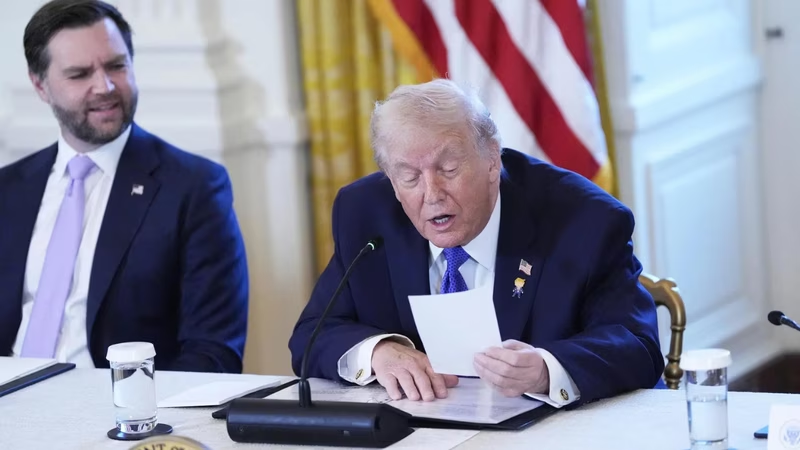
In a move that blurred the lines between political satire, disinformation, and outright fantasy, former U.S. President Donald Trump recently posted a doctored image on social media claiming he is the “Acting President of Venezuela.” The fabricated Wikipedia-style graphic, dated “Incumbent from January 2026,” also listed Senator JD Vance as his “Deputy President” .
The post—widely shared and swiftly debunked—arrived at a moment of extraordinary volatility in Venezuela. It followed unverified but persistent reports that former Venezuelan leader Nicolás Maduro had been apprehended by U.S. forces and flown to New York to face long-standing drug trafficking and narco-terrorism charges . In Caracas, Delcy Rodríguez, Maduro’s longtime vice president, was reportedly sworn in as interim head of state, plunging the oil-rich nation into deeper constitutional uncertainty .
Trump’s post, however, has no basis in reality. The United States does not appoint foreign heads of state—especially not through social media memes. Yet the image’s rapid spread highlights how easily digital fabrication can exploit real geopolitical chaos to sow confusion and amplify conspiracy theories.
Table of Contents
- The Fake Post: Breaking Down Trump’s Venezuela Claim
- What Really Happened: The Maduro Arrest and Venezuelan Transition
- Why Trump Would Make This Claim: Political Theater or Strategy?
- International Reaction and Diplomatic Fallout
- The Danger of Fake Leadership Narratives
- Conclusion: Fact vs. Fiction in a Geopolitical Crisis
- Sources
The Fake Post: Breaking Down Trump’s Venezuela Claim
The image Trump shared mimicked the clean layout of a Wikipedia infobox, complete with a presidential seal and official-sounding text. It read:
“Acting President of Venezuela
Incumbent: Donald J. Trump
Deputy: JD Vance
Assumed office: January 20, 2025”
Within hours, fact-checkers from Snopes, Reuters, and AFP confirmed the image was entirely fabricated. Wikipedia itself issued a statement clarifying that no such page exists and that the design was a crude imitation .
Notably, the date “January 20, 2025” aligns with the scheduled U.S. presidential inauguration day—suggesting Trump may be conflating his potential return to the White House with an imagined role in Venezuelan regime change.
What Really Happened: The Maduro Arrest and Venezuelan Transition
While Trump’s claim is false, it piggybacks on a kernel of truth. On January 10, 2026, multiple international news outlets reported that Nicolás Maduro had been taken into U.S. custody during a covert operation near the Colombian border . He is now in federal detention in New York, facing a 2019 indictment that accuses him of conspiring to import cocaine into the United States .
In response, Venezuela’s National Constituent Assembly swiftly swore in Delcy Rodríguez—the current vice president and a sanctioned figure herself—as interim president. Her legitimacy is contested both domestically and internationally, with opposition leaders calling the move unconstitutional .
This power vacuum has created fertile ground for speculation, which figures like Trump are eager to exploit.
Why Trump Would Make This Claim: Political Theater or Strategy?
Experts suggest several motives behind Trump’s post:
- Domestic Grandstanding: By portraying himself as a global strongman who can “take over” a foreign country, Trump reinforces his “America First” brand among his base.
- Distracting from Legal Woes: With multiple court cases pending, outrageous posts can shift media focus away from legal vulnerabilities.
- Testing Narrative Control: In the age of AI and deepfakes, planting absurd but emotionally resonant ideas can desensitize the public to factual boundaries—a tactic observed in hybrid warfare strategies .
International Reaction and Diplomatic Fallout
The post drew swift condemnation. Venezuela’s new interim government called it “imperialist delusion,” while Colombia’s president warned against “unilateral fantasies that destabilize our region” .
Even U.S. allies expressed concern. A spokesperson for the European Union stated, “Democratic transitions must be led by Venezuelans, not dictated by foreign social media posts” .
Within the U.S., the State Department distanced itself from Trump’s remarks, reiterating that American policy supports a “peaceful, democratic, and Venezuelan-led solution” to the crisis .
The Danger of Fake Leadership Narratives
While seemingly absurd, posts like Trump’s carry real risk. They can:
- Fuel conspiracy theories that justify foreign intervention.
- Undermine legitimate diplomatic efforts by creating parallel realities.
- Erode public trust in institutions when falsehoods are repeated without consequence.
As digital manipulation becomes more sophisticated, distinguishing between satire, propaganda, and genuine policy becomes increasingly difficult for the average citizen.
For more on how disinformation shapes modern politics, see our analysis on [INTERNAL_LINK:disinformation-in-global-elections].
Conclusion: Fact vs. Fiction in a Geopolitical Crisis
Donald Trump is not the Acting President of Venezuela. That much is clear. But his fabricated claim thrives in a moment of genuine chaos—a captured dictator, a contested succession, and a nation at a crossroads. While the image is fake, the underlying tensions are real. And in that gap between fact and fiction, dangerous narratives can take root. As Venezuela navigates its uncertain future, the world must remain vigilant against those who would use lies to shape reality.
Sources
- Times of India: ‘Incumbent January 2026’: Trump posts fake image
- Reuters: Maduro reportedly in U.S. custody facing drug charges
- Wikipedia Foundation: Official Statement on Fabricated Content
- U.S. Department of Justice: Indictment of Nicolás Maduro
- Council on Foreign Relations: The Crisis in Venezuela