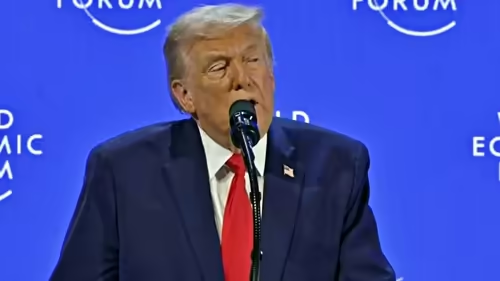
In a virtual address that cut through the rarefied air of the World Economic Forum in Davos, newly inaugurated President Donald Trump delivered a characteristically bold message: the United States is back, and its economy is now the undisputed engine of the global system. He framed it as a dramatic rescue mission, pulling the nation from a so-called ‘dead’ economy to the ‘hottest’ on the planet .
But for anyone watching from their screen, a critical question lingers: Is this a genuine economic renaissance, or is it a masterclass in political narrative? Let’s dive deep into the claims, the context, and the cold, hard data.
Table of Contents
- Trump’s Davos Declaration: The Core Message
- Fact-Checking the “Trump Economy” Narrative
- The Real US Economic Outlook for 2025
- Davos 2025: A Stage for Global Economic Vision
- Conclusion: Beyond the Rhetoric
- Sources
Trump’s Davos Declaration: The Core Message
Speaking just days after his second inauguration on January 20, 2025, Trump used the prestigious WEF platform to set the tone for his new administration . His central thesis was one of stark contrast: he had inherited an economic disaster and was already engineering a miraculous recovery.
He pointed to specific metrics to bolster his case, including a reported surge in small-business optimism, which he claimed skyrocketed by 41 points in a single month—the highest ever . He also highlighted early executive actions, such as lifting over 1.2 million people off food stamps, a claim that initial data appears to support .
This address wasn’t just about numbers; it was a strategic repositioning of America on the world stage. At a summit themed “Collaboration for the Intelligent Age,” Trump’s message was one of assertive, America-first leadership .
Fact-Checking the “Trump Economy” Narrative
While some of Trump’s early administrative claims hold water, others have been met with significant scrutiny. For instance, his assertion that he “inherited the worst inflation” in U.S. history is demonstrably false. While inflation was a concern, it pales in comparison to the double-digit rates seen in the 1970s and early 1980s .
Furthermore, his claim that inflation has simply “stopped” since his return is an oversimplification. Economic data shows that while inflation has cooled from its 2022 peak, it remains a persistent factor in the economy .
The challenge with the Trump economy narrative is its tendency to blend verifiable early wins with sweeping, often exaggerated, historical comparisons. It’s a powerful political tool, but it requires a discerning eye from the public and the press.
The Real US Economic Outlook for 2025
To understand the true state of play, we need to look beyond the political theater and at the consensus among economists and forecasters. The picture is far more nuanced than a simple binary of ‘dead’ or ‘hottest.’
Leading up to 2025, the U.S. economy showed resilience. In 2024, it expanded by a solid 2.8%, primarily driven by robust consumer spending . However, there were clear signs of a slowdown, with job creation cooling and the unemployment rate ticking up to 4.1% .
Looking ahead, most major forecasting bodies predict a continued, albeit slower, growth trajectory for 2025:
- GDP Growth: Forecasts range from a modest 1.6% (EIU) to a more optimistic 2.1% (Professional Forecasters) [[13], [9]].
- Unemployment: The jobless rate is expected to continue its gradual climb, potentially reaching 4.5% by 2026 .
- Inflation: While no longer in crisis territory, inflation is expected to remain around 2.7%, above the Federal Reserve’s long-term target .
This data paints a picture of a mature, stable, but not explosively hot economy. It’s an economy navigating a complex transition, not one experiencing a sudden, miraculous rebirth.
Davos 2025: A Stage for Global Economic Vision
Trump’s speech was just one voice in a much larger global conversation at Davos. The 2025 summit, with its theme of “Collaboration for the Intelligent Age,” brought together nearly 3,000 leaders from over 130 countries to tackle issues like AI governance, climate action, and rebuilding trust in institutions [[17], [22]].
While Trump’s message was one of national resurgence, the broader WEF agenda emphasized cross-border cooperation and shared challenges. This contrast highlights a fundamental tension in the current global economic order: the pull between nationalist agendas and the need for collective solutions to problems like technological disruption and sustainability .
For readers interested in the future of global markets, understanding this dynamic is crucial. You can explore more on how these themes are shaping international business in our guide on [INTERNAL_LINK:global-economic-trends].
Conclusion: Beyond the Rhetoric
Donald Trump’s declaration of the US as the world’s “hottest economy” at Davos is a potent piece of political messaging. It leverages a few early, positive data points to craft a compelling story of rescue and revival. However, a deeper look at the economic indicators reveals a more complex reality—a stable, resilient economy facing a period of moderated growth, not a supernova.
As consumers and citizens, our job is to move beyond the headline-grabbing soundbites and engage with the underlying data. The true health of the Trump economy in 2025 will be measured not by its launch-day promises, but by its sustained performance on jobs, inflation, and inclusive growth over the coming quarters. For a balanced view on fiscal policy, the non-partisan analysis from the Congressional Budget Office is an invaluable resource.
Sources
- Live fact-checking Donald Trump’s Davos speech, Various Media Outlets.
- FactChecking Trump’s Economic Speech, FactCheck.org.
- Davos 2025: Special address by US President Donald Trump, WEF Official Site.
- Remarks by President Trump at the World Economic Forum, White House Briefing.
- Professional Forecasters’ Past Performance and the 2025, Federal Reserve Bank of Philadelphia.
- 2024 year-in-review and first half of 2025 | Economic, Bureau of Economic Analysis.
- United States Indicators, Trading Economics.
- U.S. Economic Forecast Q4 2025, The Economist Intelligence Unit (EIU).
- US Economic Forecast Q4 2025 | Deloitte Insights, Deloitte.
- Over 50 heads of state and government gathered in Davos, World Economic Forum Annual Report.
- Debt, defense, AI: Key themes shaping WEF 2025 in Davos, Reuters.
- WEF: What’s on the Agenda at Davos 2025?, World Economic Forum.