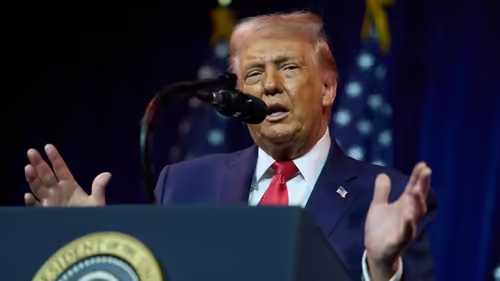
From Greenland to the Indian Ocean—Donald Trump’s territorial obsessions are going global. Fresh off his controversial remarks about Greenland, the former U.S. president has now turned his attention to Diego Garcia, calling the UK’s potential handover of the island to Mauritius “great stupidity.” But this isn’t just another Trump tantrum. Diego Garcia is home to one of America’s most strategically vital overseas military bases, and its future sits at the heart of a high-stakes geopolitical contest—one where India has quietly but firmly taken a stand. For New Delhi, this isn’t about real estate; it’s about securing its backyard in an increasingly contested Indo-Pacific.
Table of Contents
- What Is Diego Garcia—and Why Does It Matter?
- Trump vs. the UK: The Sovereignty Dispute Explained
- India’s Strategic Position: Supporting Mauritius, Not Just Morality
- The Role of the US Military Base in Regional Security
- The Bigger Game: China, India, and the Battle for the Indian Ocean
- India’s Soft Power Move: Aid Over Arms
- Conclusion: Sovereignty, Strategy, and the Future of the Indo-Pacific
- Sources
What Is Diego Garcia—and Why Does It Matter?
Diego Garcia is the largest island in the Chagos Archipelago, a remote chain of coral atolls in the central Indian Ocean. Though tiny in size (just 17 sq mi), its location—midway between Africa and Indonesia—makes it a linchpin for power projection across Asia, the Middle East, and East Africa. Since the 1970s, the U.S. has operated a massive naval and air base there under a lease agreement with the UK, which administers the territory as the British Indian Ocean Territory (BIOT). The base played crucial roles in the Gulf War, Afghanistan, and Iraq campaigns, and remains essential for monitoring Chinese naval movements today.
Trump vs. the UK: The Sovereignty Dispute Explained
In 2024, the UK announced it was in “advanced talks” to return the Chagos Archipelago—including Diego Garcia—to Mauritius, ending decades of colonial control. The move aligns with a 2019 International Court of Justice (ICJ) advisory opinion and a UN General Assembly resolution affirming Mauritius’ sovereignty. But Trump sees it differently. Calling the potential transfer “great stupidity,” he argues it would jeopardize U.S. military access and embolden adversaries like China . His stance puts him at odds not only with London but also with international law—and with India, which has long championed Mauritius’ cause.
India’s Strategic Position: Supporting Mauritius, Not Just Morality
India’s backing of Mauritius isn’t merely altruistic—it’s deeply strategic. As a fellow former British colony and close partner in the Indian Ocean Region (IOR), India views the Chagos issue through the lens of decolonization and regional stability. More importantly, a sovereign Mauritius aligned with New Delhi offers India a trusted foothold near critical sea lanes. India has already pledged significant development aid to the archipelago, including infrastructure, healthcare, and maritime security support. This “aid diplomacy” strengthens ties without triggering the kind of backlash that overt military presence might provoke—especially given China’s growing influence in the region via ports in Sri Lanka and the Maldives.
The Role of the US Military Base in Regional Security
The U.S. base on Diego Garcia hosts bombers, surveillance aircraft, and prepositioned naval assets. Its deep-water harbor can accommodate aircraft carriers, making it irreplaceable for rapid response operations. Crucially, the current UK-Mauritius negotiations include assurances that the U.S. lease will continue uninterrupted—even after sovereignty transfers. So why is Trump so alarmed? Experts suggest it’s less about logistics and more about precedent: conceding territory, even symbolically, could signal Western retreat in an era of great-power competition. Yet, as the EU and others note, respecting international law often strengthens, rather than weakens, long-term alliances.
The Bigger Game: China, India, and the Battle for the Indian Ocean
This dispute is a microcosm of a larger struggle. China’s “String of Pearls” strategy—establishing naval access points from Pakistan to Myanmar—has put India on high alert. In response, India has deepened its “Neighborhood First” and “SAGAR” (Security and Growth for All in the Region) doctrines, boosting partnerships with Seychelles, Maldives, and Mauritius. Diego Garcia’s fate influences this balance: if Mauritius gains full control with India’s support, it could become a democratic counterweight to Chinese expansionism. Conversely, if the U.S. alienates regional partners by opposing decolonization, it risks pushing nations toward Beijing’s orbit.
India’s Soft Power Move: Aid Over Arms
Rather than matching China’s checkbook diplomacy with loans, India is offering grants and capacity-building:
- $100 million credit line for Mauritius’ defense modernization
- Coastal radar network installation across Chagos islands
- Training programs for Mauritian coast guard personnel
- Renewable energy projects to reduce archipelago’s fossil fuel dependence
This approach builds goodwill while advancing India’s maritime domain awareness—critical for tracking illegal fishing, piracy, and foreign naval activity.
Conclusion: Sovereignty, Strategy, and the Future of the Indo-Pacific
Trump’s outburst over Diego Garcia may sound like bluster, but it reveals a deeper anxiety: the West’s grip on global chokepoints is no longer unchallenged. For India, this moment is an opportunity—not to confront, but to collaborate. By standing with Mauritius on principle while delivering tangible development support, New Delhi is crafting a new model of regional leadership: one rooted in mutual respect, not dominance. As the Indo-Pacific becomes the world’s most contested theater, who controls the narrative around places like Diego Garcia may matter as much as who controls the runways. Stay updated on India’s oceanic strategy with our [INTERNAL_LINK:india-indian-ocean-policy-2026].