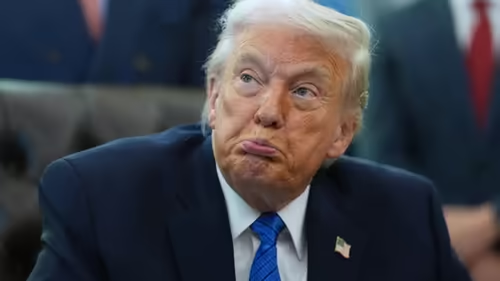
He yawns in high-stakes Cabinet meetings. He tweets at 3 a.m. about enemies real and imagined. He pivots from scandal to spectacle with the finesse of a seasoned showman. Love him or loathe him, Donald Trump has perfected a political survival strategy that hinges on one core principle: deflection.
More than policy, more than legislation, it’s this relentless redirection of attention—away from scrutiny, toward chaos, controversy, or outright fabrication—that has defined his time in office. As he faces mounting criticism over his response to nationwide protests, aggressive immigration enforcement, and even attempts to strong-arm the Federal Reserve, understanding his Trump deflection tactics isn’t just political analysis—it’s essential to decoding modern American governance.
Table of Contents
- The Theater of Power: Trump in Cabinet Meetings
- Trump Deflection Tactics: A Playbook for Chaos
- Immigration Crackdowns and Public Perception
- Pressuring the Fed: A Dangerous Game?
- The Protest Response and Polarized Narratives
- Why Supporters See Vision, Not Chaos
- Conclusion: The Enduring Logic of Deflection
- Sources
The Theater of Power: Trump in Cabinet Meetings
Remember the viral photo? President Trump, eyes half-closed, chin dipping toward his chest during a supposedly critical Cabinet meeting. Critics called it a sign of disengagement. Supporters dismissed it as a tired leader working around the clock.
But in the Trumpian universe, even boredom is strategic. These meetings often double as media events—staged performances where loyalty is tested, rivals are sidelined, and headlines are manufactured. The substance matters less than the optics. And if the optics include a bored-looking president, so be it—because within hours, a tweetstorm or a rally will shift the narrative entirely.
Trump Deflection Tactics: A Playbook for Chaos
At the heart of Trump’s approach lies a well-worn set of Trump deflection tactics. These aren’t accidental; they’re deliberate instruments of control:
- The Counter-Accusation: When accused of wrongdoing, immediately accuse the accuser of far worse. (“They’re the real corrupt ones!”)
- The Culture War Gambit: Shift focus from policy failures to divisive social issues—flags, anthems, monuments—to energize the base.
- The Media Villain: Label any critical outlet as “fake news,” thereby inoculating supporters against factual reporting.
- The Spectacle Diversion: Announce a shocking policy (e.g., sudden troop withdrawals, trade tariffs) to drown out negative coverage.
This playbook ensures that no single crisis lingers long enough to gain traction. By the time the public processes one controversy, three new ones have erupted.
Immigration Crackdowns and Public Perception
Take immigration. Facing backlash over family separations or detention conditions, the administration doesn’t typically offer nuanced policy corrections. Instead, it doubles down with rhetoric: “We’re stopping an invasion!” or “They’re bringing drugs and crime!”
This isn’t just policy—it’s narrative warfare. By framing immigration as an existential threat, the conversation shifts from humanitarian concerns to national security. The Trump deflection tactics here are textbook: replace accountability with fear, and fear with action—even if that action is performative.
Pressuring the Fed: A Dangerous Game?
Perhaps most alarmingly, Trump has repeatedly pressured the Federal Reserve to lower interest rates—a move that breaks with decades of precedent safeguarding the central bank’s independence.
When economists warned this could politicize monetary policy and trigger market instability, Trump didn’t back down. He escalated. He called Fed Chair Jerome Powell a “bonehead” and suggested the real problem was weak leadership—not economic fundamentals [[1]].
Again, the goal isn’t policy coherence. It’s to create a new villain (Powell), a new crisis (economic slowdown), and a new solution (more Trump). The deflection loop continues.
The Protest Response and Polarized Narratives
During nationwide protests—whether over racial injustice or election integrity—Trump’s response has followed a similar arc. Initial silence, followed by inflammatory rhetoric (“When the looting starts, the shooting starts”), then a pivot to law-and-order imagery: military vehicles, federal agents, and calls for “dominance.”
Critics see authoritarianism. Supporters see strength. But both sides are reacting to a narrative carefully constructed to avoid deeper questions about systemic issues or presidential responsibility. The focus isn’t on solutions—it’s on who’s “winning” the cultural battle.
Why Supporters See Vision, Not Chaos
To dismiss Trump’s style as mere chaos is to miss its appeal. For millions of Americans, his unfiltered speech, his disdain for political correctness, and his willingness to “fight” represent authenticity in a system they view as rigged.
Where critics see deflection, supporters see disruption. They don’t want polished technocrats—they want a leader who “tells it like it is,” even if “it” is a manufactured crisis. This emotional resonance is why Trump deflection tactics work: they’re not meant to convince the opposition, but to galvanize the base.
Conclusion: The Enduring Logic of Deflection
Donald Trump’s presidency may be unconventional, but it’s not irrational. His use of deflection is a calculated strategy designed for a media-saturated, attention-scarce world. By constantly shifting the battlefield, he ensures that no single issue can define—or end—his political relevance.
Whether this approach is sustainable in the long term remains to be seen. But for now, it’s clear: in the theater of modern politics, Trump isn’t just a player—he’s the director, the star, and the scriptwriter, all rolled into one. And the show, for better or worse, goes on.
Sources
- Times of India. “Trumpiana: Bored Donnie and his forty winks!” https://timesofindia.indiatimes.com/world/us/trumpiana-bored-donnie-and-his-forty-winks/articleshow/127823060.cms
- Brookings Institution. “The dangers of politicizing the Federal Reserve.” https://www.brookings.edu
- [INTERNAL_LINK:us-politics-analysis] [INTERNAL_LINK:trump-presidency-legacy] [INTERNAL_LINK:american-protests-2020]