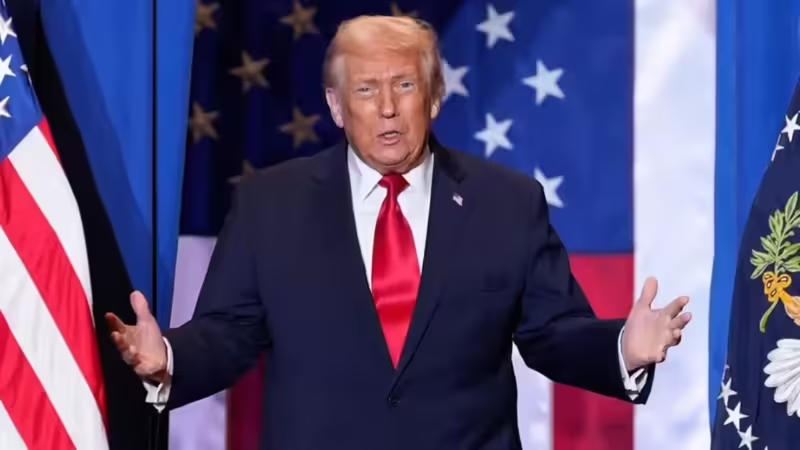
Trump’s $1.5 Trillion ‘Dream Military’ Budget: A Bold Gamble or Fiscal Fantasy?
In a move that has sent shockwaves through Washington and global capitals alike, former President Donald Trump has proposed a jaw-dropping Trump defense budget of $1.5 trillion for the year 2027. This isn’t just a modest bump; it’s a colossal 50% leap from the current trajectory, aimed squarely at building what he calls a “Dream Military” [[1], [3]]. The most controversial aspect? Trump claims this massive spending spree will be entirely bankrolled by a surge in tariff revenue. But can tariffs really foot this astronomical bill, or is this an economic pipe dream?
Table of Contents
- The ‘Dream Military’ Blueprint
- Historical Context: US Defense Spending Evolution
- The Tariff Financing Casino
- Expert Reactions and Global Implications
- Conclusion
- Sources
The ‘Dream Military’ Blueprint
Trump’s vision, announced in a recent post, frames the world as being in “troubled and dangerous times,” necessitating an unprecedented military buildup . The proposed $1.5 trillion outlay for 2027 dwarfs the Department of Defense’s (DoD) $892.6 billion request for fiscal year 2026 . This expansion isn’t just about more boots on the ground; it’s a comprehensive overhaul aimed at dominating every domain of warfare—from next-generation air and naval power to cyber and space capabilities.
The core argument is one of deterrence through overwhelming strength. The logic posits that a military so technologically advanced and financially robust that no adversary would dare challenge it, thereby ensuring long-term peace and security for the United States.
Historical Context: US Defense Spending Evolution
To grasp the scale of this proposal, it’s crucial to look at recent history. During his first term, Trump’s FY2020 defense budget request was a hefty $718 billion . Since then, US defense spending has continued on a steady, if not explosive, upward path.
A Look at Recent US Defense Budgets:
| Fiscal Year | Approx. Defense Budget |
|---|---|
| 2020 | $718 billion |
| 2021 | $733 billion |
| 2026 (Requested) | $892.6 billion |
| 2027 (Proposed) | $1.5 trillion |
The jump from the projected 2026 budget to the proposed 2027 figure is a staggering $607 billion. For perspective, that’s more than the entire GDP of many G20 nations. This historical context makes it clear that the Trump defense budget proposal isn’t an incremental step—it’s a revolutionary leap.
The Tariff Financing Casino
The most contentious and arguably unrealistic pillar of Trump’s plan is its financing. He has directly linked the massive defense expenditure to revenues generated from his aggressive tariff policies . The idea is seductive in its simplicity: slap tariffs on imports, collect the cash, and pour it directly into the military.
However, the reality of federal budgeting is far more complex. Tariff revenue doesn’t go into a special “military fund.” Instead, it flows into the US Treasury’s general fund, which is used to pay for everything from Social Security and Medicare to infrastructure and education . The notion that a specific revenue stream can be earmarked for a single, massive expenditure like this is a fundamental misunderstanding—or a deliberate misrepresentation—of how the US government’s finances work.
Even the scale of tariff revenue falls woefully short. In 2024, the US collected a total of $77 billion in tariff revenue . While this figure is expected to rise, it is nowhere near the hundreds of billions of dollars in *new* annual revenue that would be required to cover a $600+ billion budget increase. To put it bluntly, current tariff income covers less than 10% of the proposed budget hike. Relying on it as the sole funding mechanism is, at best, a high-stakes gamble with the nation’s fiscal health.
Expert Reactions and Global Implications
Unsurprisingly, the proposal has drawn a wide range of reactions. Supporters hail it as a necessary return to “peace through strength,” arguing that a dominant US military is the ultimate guarantor of global order. They see it as a direct response to the growing military capabilities of China and Russia.
Critics, however, are far more skeptical. They point to several major concerns:
- Fiscal Irresponsibility: Adding $1.5 trillion to the defense budget without a credible, broad-based funding plan would dramatically inflate the national debt.
- Trade Wars: The aggressive tariffs needed to (theoretically) fund this would likely trigger retaliatory measures from US allies and adversaries alike, damaging the global economy.
- Opportunity Cost: Such a massive allocation to defense would inevitably starve other critical areas like healthcare, education, and climate change mitigation.
Globally, this move could signal a return to a more unilateral and aggressive US foreign policy. Allies might feel pressured to increase their own defense spending, while adversaries would see it as a direct provocation, potentially accelerating their own arms buildups. The entire strategic balance could be thrown into flux.
Conclusion
Donald Trump’s $1.5 trillion Trump defense budget is a policy proposal that is as grandiose as it is controversial. The vision of a “Dream Military” is a powerful political narrative, but the plan’s fatal flaw lies in its proposed funding mechanism. Relying on tariff revenue to pay for such a colossal increase is not just optimistic—it’s economically detached from reality. As this idea moves from a campaign trail soundbite to a potential legislative battle, its feasibility, its cost, and its consequences for both the US wallet and world peace will be under intense scrutiny. For more on the current state of US defense, see our deep dive on the [INTERNAL_LINK:us-defense-strategy-2025].
Sources
- Times of India: ‘Dream military’: Trump proposes $1.5 trillion defence outlay for 2027
- Associated Press: Coverage on Trump’s 2027 defense proposal.
- US Department of Defense: FY2026 Budget Request
- Congressional Research Service: Defense Budget Basics
- Marketplace.org: Where is our tariff revenue going?