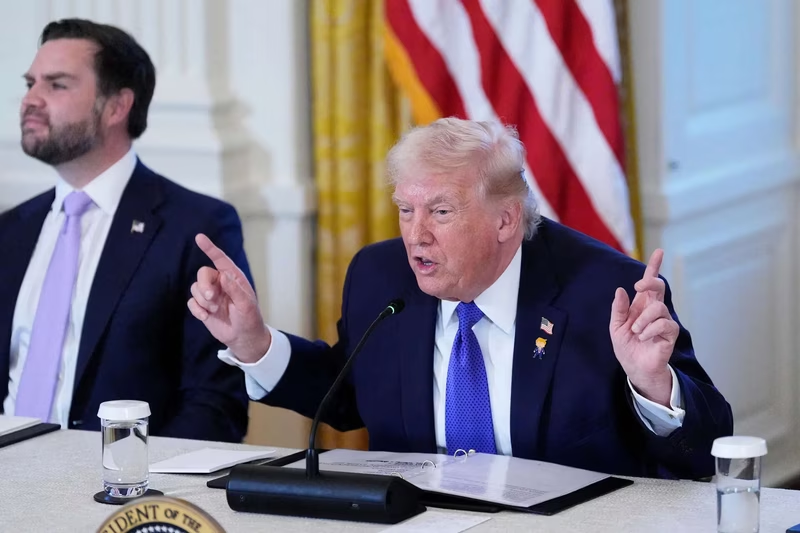
In a move that’s reigniting the national debate over consumer finance, former President Donald Trump has announced a sweeping proposal to cap credit card interest rates at just 10%. Calling current rates—often soaring between 20% and 30%—a “rip-off” of hardworking Americans, Trump vowed to protect consumers from what he described as predatory banking practices enabled by the “Sleepy Joe” administration .
This isn’t just campaign rhetoric; it’s a direct challenge to decades of deregulated lending norms and could reshape how millions of Americans manage debt. But is a federal interest rate cap legally feasible? And what would it mean for your wallet, your credit score, and the broader economy?
Table of Contents
- What Trump Is Proposing
- Why Credit Card Rates Are So High Today
- Can a President Really Cap Interest Rates?
- Historical Precedents and Global Comparisons
- Potential Impacts on Consumers and Banks
- Political Fallout and 2026 Ramifications
- Conclusion: What to Watch Next
- Sources
What Trump Is Proposing
Speaking at a recent rally, Trump declared: “We won’t let the American public be ripped off anymore!” He specifically targeted major credit card issuers like Chase, Bank of America, and Capital One, accusing them of exploiting everyday citizens with exorbitant interest charges . His solution? A hard federal ceiling of 10% on all credit card interest rates, regardless of creditworthiness or market conditions.
This proposal directly ties into his broader 2026 campaign narrative of economic populism. By framing high interest rates as a symptom of Biden-era mismanagement, Trump aims to position himself as the defender of the middle class—a stark contrast to his previous pro-business deregulatory stance during his first term.
Why Credit Card Rates Are So High Today
To understand the magnitude of Trump’s proposal, it’s crucial to grasp why U.S. credit card rates have climbed so high:
- Federal Reserve Policy: The Fed’s benchmark interest rate has risen sharply since 2022 to combat inflation. Since most credit cards have variable rates tied to the prime rate, consumer APRs have followed suit.
- Risk-Based Pricing: Lenders charge higher rates to borrowers with lower credit scores to offset potential defaults. The average credit card APR in late 2025 hovers around 24.7%, with some subprime cards exceeding 30% .
- Deregulation Legacy: The 1978 Supreme Court case Marquette National Bank v. First of Omaha allowed nationally chartered banks to export their home state’s interest rate laws nationwide—effectively gutting state-level usury caps.
For context, many European countries enforce much lower caps. In Germany, for example, the legal maximum is around 11%, while France caps it at roughly 20%—still far below U.S. averages .
Can a President Really Cap Interest Rates?
Here’s where things get legally thorny. While a sitting president can propose legislation or issue executive orders in limited contexts, a universal Trump credit card interest cap would almost certainly require an act of Congress.
The federal government does regulate certain lending practices through the Truth in Lending Act (TILA) and the Consumer Financial Protection Bureau (CFPB), but it has not imposed a blanket interest rate cap on credit cards since the 1980s. Any such law would face fierce opposition from the banking lobby and likely constitutional challenges based on states’ rights and contract law.
However, presidents can influence policy indirectly. For instance, they appoint CFPB directors who can tighten enforcement on “unfair or deceptive” lending practices. Still, a hard 10% cap? That’s uncharted territory in modern U.S. finance.
Historical Precedents and Global Comparisons
The U.S. hasn’t always tolerated sky-high credit card rates. During World War II, the federal government capped all consumer loan interest at 6%. More recently, the Military Lending Act of 2006 limits APRs for active-duty service members to 36%—a protection widely seen as successful .
Globally, interest rate caps are common:
| Country | Max Legal Credit Card APR |
|---|---|
| United States | No federal cap (avg. ~24.7%) |
| Canada | 60% (criminal rate), but typical cards ~20% |
| United Kingdom | No fixed cap, but FCA enforces affordability rules |
| Germany | Approx. 11% (based on civil code) |
| Australia | No statutory cap, but ASIC monitors excessive pricing |
This shows that while a 10% cap is ambitious, it’s not without international precedent—especially in nations prioritizing consumer protection over lender profits.
Potential Impacts on Consumers and Banks
If enacted, a 10% cap could have wide-ranging consequences:
For Consumers
- Pros: Lower monthly payments, reduced debt traps, and increased disposable income for millions.
- Cons: Tighter credit approval standards, fewer card options for subprime borrowers, and potential elimination of rewards programs funded by high interest margins.
For Banks & Lenders
- Projected revenue losses in the tens of billions annually.
- Possible shift toward higher annual fees or stricter penalties to compensate.
- Increased lobbying against the measure, citing reduced access to credit for vulnerable populations.
As noted by the Federal Reserve, credit card debt in the U.S. surpassed $1.1 trillion in 2025 . Even a modest rate reduction could save households hundreds—or thousands—per year.
Political Fallout and 2026 Ramifications
This proposal is clearly designed to energize Trump’s base ahead of a potential 2026 presidential run. By attacking “big banks” and positioning Biden as complicit in consumer exploitation, Trump is blending populist economics with anti-establishment messaging—a formula that resonated deeply in 2016.
Democrats may counter by highlighting their own consumer protection efforts, such as CFPB actions under Director Rohit Chopra or proposed legislation like the “Credit Card Competition Act.” Yet, few have endorsed a hard interest rate cap, fearing unintended consequences on credit availability.
For more on how financial policy shapes elections, see our deep dive on [INTERNAL_LINK:economic-policy-2026-election].
Conclusion: What to Watch Next
While the feasibility of a federal Trump credit card interest cap remains uncertain, its political potency is undeniable. It forces a long-overdue conversation about fairness in consumer finance and whether the U.S. should follow global peers in reining in predatory lending. Whether this becomes law or remains campaign theater, one thing is clear: Americans burdened by high-interest debt are watching—and hoping—for real change.
Sources
- Times of India. “Won’t let US public be ripped off! Trump puts 10% cap on credit card interest rates.” https://timesofindia.indiatimes.com/…/articleshow/126446174.cms
- Forbes. “Average Credit Card Interest Rate Reaches New High in 2025.” November 2025.
- European Central Bank. “Consumer Credit Regulations in EU Member States.” 2024 Report.
- U.S. Department of Defense. “Military Lending Act Overview.” https://www.dod.mil/mla/
- Board of Governors of the Federal Reserve System. “Consumer Credit – G.19.” December 2025. https://www.federalreserve.gov/releases/g19/