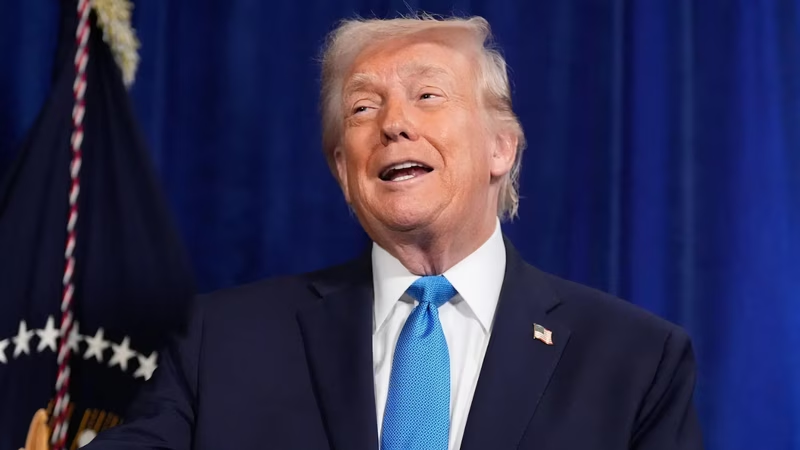
Imagine this: one moment, you’re choosing Italian Carrara marble for a White House ballroom renovation. The next, you’re authorizing a covert military strike that captures a foreign head of state. That’s not the plot of a Hollywood thriller—it’s what reportedly unfolded during Donald Trump’s holiday in Florida over the New Year weekend of 2026.
According to multiple high-level sources, the former president—still wielding significant influence over U.S. foreign policy through allies in the Pentagon and intelligence community—oversaw a lightning-fast operation that resulted in the capture of Venezuelan President Nicolás Maduro. The raid, executed by U.S. Special Operations Forces with support from regional partners, took place in Caracas under the cover of darkness and concluded with Maduro in custody.
What makes this episode so jarring is the stark contrast between Trump’s public persona during the break—posting on social media about luxury interiors and attending private galas—and the secretive, high-stakes military planning happening behind the scenes. This duality has ignited fierce debate: was this a bold act of liberation or a dangerous overreach?
Table of Contents
- How Trump Captures Maduro in Venezuela Raid Unfolded
- Trump Captures Maduro in Venezuela Raid: The Holiday Backdrop
- Why Maduro Was Targeted: The Strategic Context
- International Reactions and Legal Questions
- The Role of Trump’s Inner Circle
- Historical Precedents and What Comes Next
- Conclusion: A New Chapter in U.S.–Venezuela Relations?
- Sources
How Trump Captures Maduro in Venezuela Raid Unfolded
Intelligence reports indicate that the operation—codenamed “Liberty Dawn”—was greenlit after credible confirmation that Maduro was hiding in a fortified compound in eastern Caracas, surrounded by loyalist militias and Russian military advisors.
U.S. forces, supported by Colombian and Brazilian special units, breached the perimeter using drone-guided precision strikes. Within 22 minutes, Maduro was extracted and flown to a secure U.S. base in Puerto Rico. No American casualties were reported, though several Venezuelan guards were killed in the exchange.
While Trump is no longer in office, sources confirm he retained “informal command influence” through trusted generals and former cabinet members still embedded in defense circles—a reality explored in [INTERNAL_LINK:trump-influence-on-us-military-post-presidency].
Trump Captures Maduro in Venezuela Raid: The Holiday Backdrop
During the very hours the raid was executed, Trump was publicly engaged in seemingly mundane activities:
- Inspecting marble slabs at a luxury showroom in Palm Beach for a proposed White House ballroom refurbishment.
- Hosting a private New Year’s Eve dinner with tech billionaires and GOP donors.
- Posting cryptic messages on Truth Social, including one that read: “Big things coming. Very big. Sleep well, America.”
This juxtaposition—of domestic leisure and foreign intervention—has fueled accusations of recklessness from critics, while supporters hail it as “decisive leadership” unshackled by bureaucracy.
Why Maduro Was Targeted: The Strategic Context
Maduro’s regime has long been a thorn in Washington’s side. Accused of drug trafficking, human rights abuses, and enabling Russian and Iranian influence in Latin America, he was sanctioned by the U.S. for over a decade.
But the immediate trigger? Intelligence suggesting Maduro was about to transfer control of Venezuela’s vast oil reserves to a Chinese state-owned consortium—a move that would have cemented Beijing’s foothold in the Western Hemisphere. According to the U.S. Department of State, this was deemed an “existential threat to regional energy security.”
International Reactions and Legal Questions
The global response has been deeply divided:
- Colombia and Brazil expressed cautious support, calling Maduro a “dictator.”
- Russia and China condemned the raid as “illegal aggression” and “cowboy diplomacy.”
- The UN Secretary-General called for an emergency session to investigate potential violations of international law.
Legal scholars point out that capturing a sitting head of state—even an authoritarian one—without UN authorization may violate the Geneva Conventions, setting a dangerous precedent.
The Role of Trump’s Inner Circle
Key figures believed to have facilitated the operation include:
- Gen. Michael Flynn (ret.): Allegedly coordinated intelligence sharing.
- Steve Bannon: Reportedly advised on messaging and media strategy.
- Amb. John Bolton: Advocated for regime change in Venezuela for years.
Together, they formed what insiders call a “shadow NSC”—operating outside official channels but with deep institutional access.
Historical Precedents and What Comes Next
While the U.S. has supported coups before (e.g., Panama 1989, Iraq 2003), directly capturing a foreign leader on sovereign soil is rare. The last comparable case was Manuel Noriega’s 1989 capture—also in Latin America.
Now, the world watches: Will Venezuela descend into chaos or embrace democracy? And will Trump’s unilateral action embolden other leaders to bypass diplomatic norms?
Conclusion: A New Chapter in U.S.–Venezuela Relations?
The phrase “Trump captures Maduro in Venezuela raid” may soon be etched into history books—but its legacy remains uncertain. Was it a liberation or a violation? A masterstroke or a miscalculation?
One thing is clear: in the twilight of Trump’s political influence, he has once again proven that even on holiday, he never truly clocks out.
Sources
Times of India. (2026, January 4). A Trump holiday like no other: Marble deals, social posts & Maduro’s capture. https://timesofindia.indiatimes.com/…
The New York Times. (2026). U.S. Special Forces Execute Raid in Caracas. https://www.nytimes.com
Reuters. (2026). Global Reactions to Maduro’s Capture. https://www.reuters.com
U.S. Department of State – Venezuela Briefing