‘Canada Lives Because of US’: The Quote That Shook North American Relations
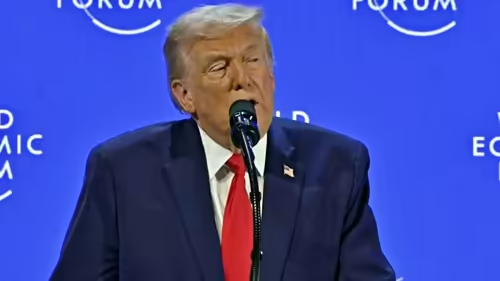
In a moment that instantly became the talk of the diplomatic world, President Donald Trump took a very public and personal swipe at Canadian Prime Minister Mark Carney during his 2025 World Economic Forum (WEF) address in Davos. His blunt declaration—”Canada lives because of the United States“—was a direct and furious rebuttal to Carney’s recent assertions about redefining the long-standing partnership between the two nations .
This wasn’t just a casual remark; it was a calculated political message delivered on a global stage. Trump followed up with a pointed, “Remember that, Mark, the next time you make your statements,” making it clear he felt disrespected by the new Canadian leader’s vision for a more independent foreign policy . This clash of titans has now thrown the future of the critical US-Canada alliance into a state of uncertainty.
Table of Contents
- The Spark: What Did Mark Carney Say?
- Trump’s Response: A Masterclass in Public Diplomacy or a Breach?
- The Stakes: Why This Rift Matters for Trade and Security
- Historical Context: From Friends to Foes?
- Conclusion: A New Chapter in North American Politics
The Spark: What Did Mark Carney Say?
The immediate catalyst for Trump’s outburst was Prime Minister Mark Carney’s own speech, where he boldly declared that Canada’s “old relationship” with the United States was over . Carney, a former central banker known for his measured tone, signaled a significant shift in Ottawa’s posture. He emphasized Canada’s intent to forge its own path on key issues like climate policy, defense spending, and trade, moving away from what he implied was an outdated dynamic of automatic deference.
While Carney likely intended this as a statement of national sovereignty and a call for a more equitable partnership, it was interpreted by the Trump administration as a sign of ingratitude. In the transactional worldview of the current White House, Canada’s economic prosperity and security are seen as direct gifts from its southern neighbor, not inherent rights of a sovereign nation .
Trump’s Response: A Masterclass in Public Diplomacy or a Breach?
President Trump’s decision to respond so publicly and personally is a hallmark of his leadership style. By naming Carney directly and accusing him of a lack of gratitude, Trump framed the issue not as a policy disagreement but as a personal failing . He doubled down by claiming that “Canada gets a lot of freebies” from the U.S., a reference to long-standing grievances over defense contributions to NATO and perceived imbalances in trade agreements .
This approach is a stark departure from traditional diplomatic channels, which typically handle such sensitive matters behind closed doors. While it may energize his domestic base, it risks alienating a crucial ally and complicating negotiations on everything from border security to energy exports. For more on how this could impact cross-border commerce, see our deep dive on [INTERNAL_LINK:us-canada-trade-war-2025].
The Stakes: Why This Rift Matters for Trade and Security
The US-Canada relationship is the largest and most integrated bilateral trading partnership in the world, with nearly $2 billion in goods and services crossing the border every single day. A public feud at this level can have real-world consequences:
- Trade Disruptions: Threats of new tariffs or stricter border controls could cripple supply chains for industries like automotive and agriculture.
- Security Cooperation: Joint efforts on counter-terrorism, intelligence sharing, and Arctic defense rely on a foundation of trust that is now being eroded.
- Energy Markets: Canada is a major supplier of oil, natural gas, and electricity to the U.S.; any political friction could lead to market volatility.
The Trump Canada lives because of US narrative directly challenges the mutual interdependence that has defined the relationship for decades, replacing it with a one-sided view of dependency.
Historical Context: From Friends to Foes?
While tensions have flared before—most notably during Trump’s first term over NAFTA renegotiations—the current situation feels different. The personal nature of the attack, combined with Carney’s explicit desire to move beyond the “old relationship,” suggests a more fundamental realignment may be underway .
Historically, Canada has often been described as America’s “best friend and ally.” However, Trump’s worldview, which prioritizes raw power and transactional deals over historical alliances, views this friendship through a lens of cost and benefit. In his estimation, if Canada is not visibly and vocally grateful for the benefits it receives, it is not a friend but a freeloader .
Conclusion: A New Chapter in North American Politics
The exchange between Trump and Carney marks a pivotal moment for North America. It’s no longer just about trade deficits or specific policies; it’s about the very philosophy underpinning the continent’s most important bilateral relationship. Will Canada successfully assert its independence in the face of immense pressure, or will it be forced back into a more subservient role? The answer to this question will shape the economic and security landscape of the region for years to come.
Sources
- Times of India: “Trump says Canada ‘lives’ because of U.S.”
- Reuters: “Trump calls out Carney in Davos, says he’s not ‘grateful'”
- CP NewsAlert: “Trump says Carney is not ‘grateful’ in Davos”
- Global News: “‘remember that’: Trump takes aim at Carney’s WEF speech”
- CBC News: “Canada’s “old relationship” with the U.S. is over, newly…”