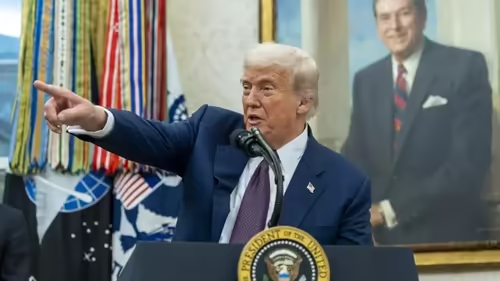
In a move that has sent shockwaves through diplomatic corridors in Ottawa, Washington, and Beijing, former U.S. President Donald Trump has issued a blunt ultimatum to Canada: scrap any potential trade agreement with China—or face “something substantial” from the United States. The warning, delivered during a recent campaign rally, underscores the deepening geopolitical fault lines in North America and reveals Trump’s hardline stance on global alliances in an increasingly multipolar world.
Adding another layer of complexity, Trump simultaneously claimed that the U.S. is engaged in direct negotiations with Iran—a nation currently locked in a tense standoff with Western powers over its nuclear program and regional military activities. With Tehran issuing its own warnings against foreign aggression, the region teeters on the edge of volatility. Let’s unpack what’s really happening behind these high-stakes declarations.
Table of Contents
- Trump’s Warning to Canada: The Full Context
- Why a Canada-China Deal Worries Washington
- Trump Canada China Deal: The Economic and Security Stakes
- The Iran Negotiation Claim: What We Know
- Tehran’s Response and Regional Tensions
- Historical Precedent: Trump’s “America First” Diplomacy
- What This Means for Canada’s Foreign Policy
- Conclusion: A World of Competing Spheres
- Sources
Trump’s Warning to Canada: The Full Context
Speaking to supporters in Michigan, Trump declared: “If Canada makes a deal with China, we will do something very substantial. They’ll be taken over by China—believe me.” He framed the potential pact as a national security threat to the U.S., arguing that closer economic integration between Ottawa and Beijing would compromise North American supply chains and intelligence-sharing under the Five Eyes alliance [[1]].
While Canada has not officially announced a comprehensive free trade agreement with China, discussions around enhanced economic cooperation have been ongoing for years. Prime Minister Justin Trudeau’s government has walked a tightrope—seeking market access for Canadian resources while managing U.S. concerns about Chinese influence [[2]].
Why a Canada-China Deal Worries Washington
The U.S. has long viewed Canada not just as a neighbor but as a strategic extension of its own economic and defense perimeter. Key concerns include:
- Critical Minerals Access: Canada is a top supplier of lithium, cobalt, and rare earths essential for U.S. clean energy and defense tech. A China-dominated trade framework could redirect these resources away from American allies.
- 5G and Infrastructure Security: Past disputes over Huawei’s role in Canadian telecom networks highlight fears of Chinese tech infiltration.
- Intelligence Leaks: Deeper China-Canada ties could complicate sensitive data sharing within NORAD and the Five Eyes intelligence network.
Trump Canada China deal: The Economic and Security Stakes
A formal trade pact between Canada and China would mark a significant realignment in North American geopolitics. For Canada, it promises access to a $18 trillion consumer market and investment in its energy and mining sectors. But the cost could be steep.
Under Trump’s previous administration, the U.S. imposed steel and aluminum tariffs on Canada—ostensibly over national security—demonstrating a willingness to weaponize trade. A repeat, or even harsher measures like exclusion from USMCA benefits or financial sanctions, could devastate the Canadian economy, which sends over 75% of its exports to the U.S. [[3]].
The Iran Negotiation Claim: What We Know
In the same speech, Trump asserted, “We’re talking to Iran right now. They want to make a deal.” This comes amid reports of increased U.S. naval deployments in the Persian Gulf and Iranian missile tests near shipping lanes [[4]].
Officially, the Biden administration denies direct high-level talks, though backchannel communications via Oman and Qatar have been reported. Trump’s claim may be aimed at projecting strength and diplomatic prowess ahead of the 2026 election—but it also risks undermining current U.S. policy, which demands Iran first curb its nuclear enrichment and regional proxy activities.
Tehran’s Response and Regional Tensions
Iran’s Foreign Ministry swiftly responded, stating: “Any military aggression will be met with a crushing response.” The Islamic Revolutionary Guard Corps (IRGC) has also ramped up patrols in the Strait of Hormuz, a vital oil chokepoint [[5]].
With Israel-Iran tensions simmering and Houthi attacks on Red Sea shipping continuing, the region remains a tinderbox. Trump’s public comments—whether factual or aspirational—could either de-escalate or dangerously inflame the situation.
Historical Precedent: Trump’s “America First” Diplomacy
This isn’t the first time Trump has pressured allies over China ties. During his presidency, he:
- Forced renegotiation of NAFTA into USMCA with strict rules of origin to limit Chinese inputs.
- Pressured Australia and the UK to ban Huawei from 5G networks.
- Threatened EU tariffs over digital services taxes perceived as anti-American.
His approach prioritizes bilateral leverage over multilateral consensus—a strategy that often yielded short-term wins but strained long-term alliances.
What This Means for Canada’s Foreign Policy
Ottawa now faces a dilemma. Pursuing deeper ties with China could unlock economic opportunities but risk alienating its most important partner. Conversely, capitulating to U.S. pressure may preserve security ties but limit Canada’s strategic autonomy. Experts at the Centre for International Governance Innovation (CIGI) warn that “Canada cannot afford to be caught in a new Cold War binary” [[6]].
Conclusion: A World of Competing Spheres
Trump’s warning over the Trump Canada China deal is more than political rhetoric—it’s a preview of a potential second-term foreign policy defined by zero-sum competition and coercive diplomacy. Whether Canada bends to U.S. pressure or charts an independent course will test the limits of North American unity. Meanwhile, his claims about Iran negotiations add another unpredictable variable to an already volatile global landscape. One thing is clear: in Trump’s worldview, alliances are conditional, and loyalty is non-negotiable.
Sources
- Times of India. “‘Will do something substantial’: Trump warns Canada against China deal; negotiates with Iran.” https://timesofindia.indiatimes.com/…
- Government of Canada. “Canada-China Relations.” https://www.canada.ca/…
- U.S. Census Bureau. “U.S. Trade in Goods with Canada.” https://www.census.gov/…
- Reuters. “U.S. deploys additional warships to Middle East amid Iran tensions.” https://www.reuters.com/…
- Al Jazeera. “Iran warns against any attack as US-Iran tensions rise.” https://www.aljazeera.com/…
- Centre for International Governance Innovation (CIGI). “Canada’s Strategic Choices in a Decoupling World.” https://www.cigionline.org/…
- [INTERNAL_LINK:usmca-trade-agreement-explained]
- [INTERNAL_LINK:five-eyes-alliance-overview]