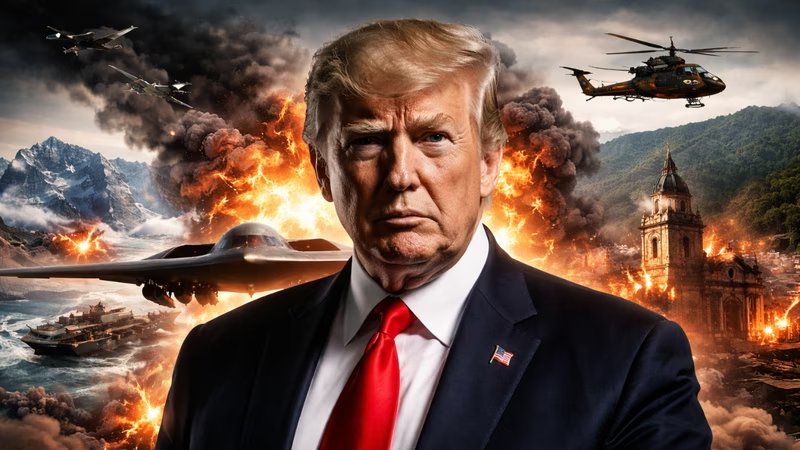
The world is holding its breath. In his second term, President Donald Trump has ushered in a new, assertive era of American foreign policy, often dubbed the ‘Donroe Doctrine’. This doctrine isn’t just about diplomacy; it’s a stark declaration of America’s willingness to use overwhelming military force to achieve its goals. The question on everyone’s lips is no longer if but who’s next on the Trump bombing list?
Recent actions have moved beyond mere rhetoric. The US has already conducted strikes in Venezuela and is openly discussing military operations on Mexican soil . This aggressive posture has left allies and adversaries alike scrambling to understand the new rules of engagement. In this deep dive, we’ll unpack the logic behind the Donroe Doctrine, analyze its confirmed and potential targets, and explore what this means for the fragile state of global peace in 2026.
Table of Contents
- What is the ‘Donroe Doctrine’?
- Confirmed Strikes: Trump’s 2025 Military Campaign
- Who’s Next on the Trump Bombing List?
- The Greenland and Mexico Factor
- Global Repercussions and Allied Unity
- Conclusion: A World on Edge
- Sources
What is the ‘Donroe Doctrine’?
While not an official White House term, the ‘Donroe Doctrine’ has become a shorthand for President Trump’s unique blend of transactional diplomacy and unapologetic military might. It’s a fundamental challenge to the post-WWII international order, prioritizing raw American power over multilateral consensus . At its core, the doctrine is built on the ‘America First’ principle, viewing global politics through a lens of direct national interest and strength .
This approach represents a clear break from his predecessors, reorienting U.S. foreign policy around coercion and the credible threat of force . The goal is simple: to achieve rapid, decisive outcomes that serve immediate American interests, whether that’s countering drug cartels, dismantling hostile regimes, or securing strategic assets.
Confirmed Strikes: Trump’s 2025 Military Campaign
President Trump has wasted no time in his second term, presiding over a significant surge in U.S. military activity abroad . His administration has effectively rewritten the country’s rules of war, putting troops in new and controversial positions . Here are the key flashpoints:
- Venezuela: The most recent and dramatic example. US strikes have directly targeted the Venezuelan government, culminating in the capture of its leader, Nicolas Maduro [[1], [2]]. This unprecedented move has sent shockwaves through Latin America.
- Mexico: In a highly contentious move, Trump has publicly stated the US military will begin hitting land in Mexico to target drug cartels, which he designated as foreign terrorist organizations in early 2025 [[2], [3]]. This stance has been met with fierce condemnation from the Mexican government, which views it as a direct threat to its sovereignty.
Who’s Next on the Trump Bombing List?
Given this track record, speculation is rife about which nation might be in the crosshairs next. While the White House rarely confirms future targets, certain geopolitical tensions make some countries more likely candidates than others.
Iran: The Perennial Adversary
Iran remains a prime candidate. Trump’s disdain for the Iranian regime is well-documented and has only intensified during his second term . Relations have deteriorated rapidly, with the US holding several rounds of tense negotiations over Iran’s nuclear program, each backed by a strict deadline from Trump . Senators have even publicly stated that the US will strike Iran if it attempts to rebuild its nuclear or missile capabilities. The stage appears set for a major confrontation.
Colombia and Beyond
While Colombia is a long-standing US ally in the region, its ongoing struggles with powerful drug cartels and internal instability could make it a potential focus for a more aggressive US counter-narcotics strategy under the Donroe Doctrine, similar to the one being proposed for Mexico. Other nations harboring groups deemed a direct threat to US interests could also find themselves under scrutiny.
The Greenland and Mexico Factor
Beyond direct military strikes, the Donroe Doctrine also manifests in Trump’s ambition to expand American strategic control. His fascination with Greenland is not a new or idle fantasy. The US has a long history of attempting to acquire the island, with serious offers made as far back as 1946 [[15], [20]]. Trump’s renewed and public interest in purchasing Greenland from Denmark is a clear signal of his intent to secure critical Arctic real estate for future geopolitical and resource dominance [[17], [19]].
Meanwhile, the situation in Mexico blurs the line between a bombing campaign and a ground invasion. By framing the drug war as a national security issue requiring direct military action on foreign soil, Trump is testing the limits of international law and neighborly relations in a way that could have profound and lasting consequences for North America.
Global Repercussions and Allied Unity
The Donroe Doctrine’s unilateral approach poses a fundamental challenge to allied unity and the future of collective defense . Traditional allies in Europe and Asia are increasingly wary of a US foreign policy that seems to value loyalty over established treaties and can shift dramatically based on the president’s personal views. This unpredictability forces other nations to hedge their bets, potentially leading to a more fragmented and unstable world order where power, not partnership, dictates the rules.
Conclusion: A World on Edge
The Trump bombing list is more than just a collection of potential targets; it’s a symbol of a new, volatile chapter in international relations. The Donroe Doctrine, with its emphasis on decisive military action and territorial ambition, has created a world on edge. From the streets of Caracas to the corridors of Tehran and the icy shores of Greenland, nations are being forced to adapt to an America that is willing to act alone and act forcefully. As we move deeper into 2026, the question of who’s next is not just a matter of curiosity—it’s a critical concern for global security. For more on how this impacts US domestic policy, see our analysis on [INTERNAL_LINK:national-security-policy].
Sources
- Times of India. “Greenland, Iran, Colombia? Who’s next on Trump’s bombing radar.” https://timesofindia.indiatimes.com/world/us/greenland-iran-colombia-whos-next-on-donald-trumps-bombing-radar/articleshow/126436006.cms
- Various news reports on Trump’s 2025 military actions [[1], [2], [3], [4], [5]].
- Analysis of the ‘Trump Doctrine’ [[7], [8], [9], [10]].
- Reports on US-Iran relations [[11], [12], [13], [14]].
- Historical context on US interest in Greenland [[15], [16], [17], [18], [19], [20], [21]].
- Council on Foreign Relations. “Iran–United States Relations.” https://www.cfr.org/timeline/us-iran-relations